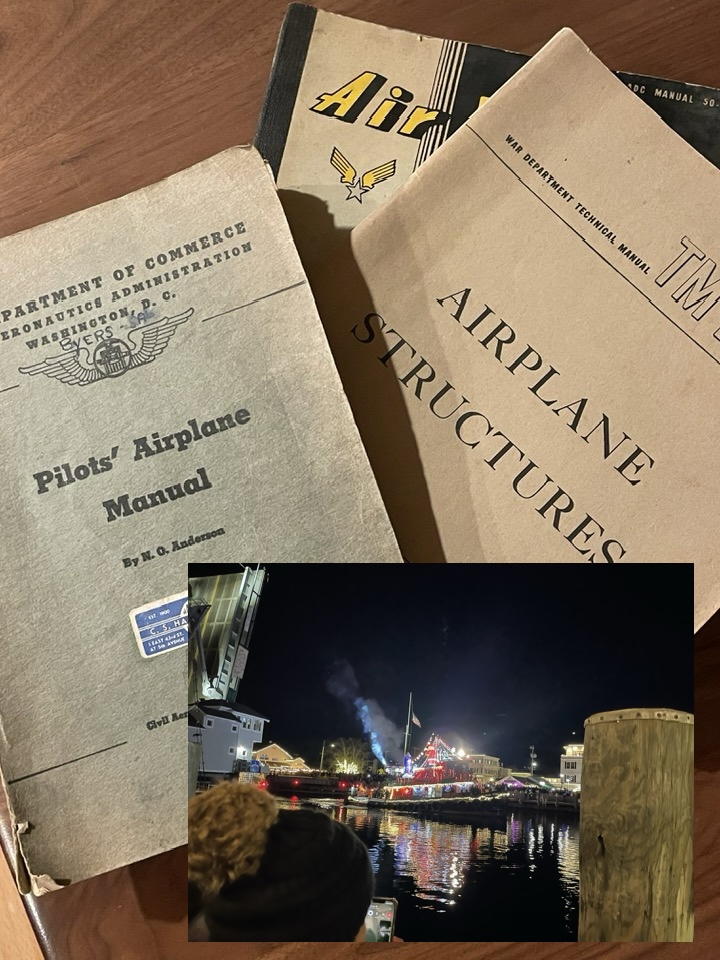
NOVEMBER 29, 2025 – Late this morning all members of our household visited our son and daughter-in-law’s Francophone friends, Flo and Luke, up in West Hartford. In preparation for the trip, Mylène packed a bag of trucks from Diogo’s collection to keep him occupied while the grown-ups visited.
I’m a “truck man” myself, so for me, playing with trucks big and small down on the floor is exactly what I do when no one is watching or . . . when everyone is watching and I’m pretending to play along with Diogo, when in fact, I’m playing trucks on my own account. Maybe someday he’ll appreciate my interest in trucks and ultimately, his great-great-grandfather’s contributions as a veritable captain of the trucking industry. But for now I’m happy watching Diogo drive trucks over the edge of the living room coffee table, ram a dump truck into a wall, and hook the back of one hook-and-ladder to the back of another and see which can win at tug-of-war.
When the playing stops in favor of some other activity, however, I find myself admiring the mechanical engineering that goes into the real trucks after which our grandson’s toys are modeled.
Within minutes of entering Flo and Luke’s house, the engineering theme took off as I couldn’t have imagined. Luke, it turns out, is a PhD mechanical engineer. He’s always harbored as well, an interest in aeronautical engineering. A number of years ago, he’d acquired a hefty collection of flying and aircraft maintenance manuals issued by the War Department during World War II. As I was poring over these, he added a large, dense modern book on the history of engineering behind WW II fighter aircraft produced in the U.K. and U.S. Then for good measure, as I was delving into that fascinating tome, Luke added to the stack of manuals, a copy of the instruction book for construction and maintenance of the Japanese Zero.
As I teased information out of Luke, who was as enthusiastic about the subject as I was, I lost all sense of time and place. The manuals came from an age when all the math behind aircraft design was harnessed by slide rules, not computers—hand-held or otherwise. Luke’s command of language—French and English—is equal to his command of math and mechanics, and I could easily imagine him teaching at some well-regarded university here or in France and being one of those gifted profs whose class fills up within minutes after the sign-up time opens ahead of the semester.
If at the conclusion of our visit I projected the appearance of a kid in a candy shop, that’s because Luke offered to loan me whatever books I wished to borrow. I restrained myself and took only three from the bunch: after all, they weren’t light, and I’d have to stuff them into my luggage. “Plus,” I said to Luke, “if I took everything in this stack, the plane home would have to be rebalanced.”
I left behind the manual for the Zero. After all, the entire book was in Japanese, and besides, who would name anything or anyone . . . a “zero”?
From West Hartford we drove to Mystic to meet our Lyme friends and neighbors, (Captain) Steve and Lin, who’d been on hand for our Thanksgiving Day dinner. The occasion in Mystic was the annual Xmas “Parade of Boats,” featuring a line of fine-looking vessels decked out in seasonal lighting and decorations. We joined a gazillion other spectators who lined the shore on each side of the river south of the open drawbridge in the heart of the tourist center of town. But the best view, I noted to our crew, was from the bright waxing gibbous moon suspended directly above the river.
With a stop at the famous Sift patisserie just down the street from the drawbridge and around the corner, we rewarded ourselves with high-end hot beverages and desserts. Standing in the cold for the preceding 90 minutes had been hard work.
At this writing, all members of the household except me have turned in for the evening. Tomorrow has been declared “lounge day” and the official day for decorating the Xmas tree . . . with the resident two-year-old giving directions—surely to the amusement of his admirers.
Subscribe to this blog and receive notifications of new posts by email.
© 2025 by Eric Nilsson
