NOVEMBER 24, 2025 – Yesterday, while I was taking full advantage of the mild Minnesota weather and stringing Christmas lights around our shrubs out front, our neighbors at the end of the block, Joan and Kent, strolled by with dogs in tow. We exchanged greetings, and the people called a mutual time-out for “catch-up” conversation, leading with, “What are you doing for Thanksgiving?”
When, in the case of Beth and me, I mentioned today’s trip to Connecticut to visit our younger son and his family, Joan said with her usual humorous good cheer, “Oh, so you get to travel with all the millions of other people flying somewhere for Thanksgiving week!”
“Well, Joan,” I said, “not to worry. I mean, they won’t all be riding on our plane.”
In any event, frequent flyers and even most infrequent flyers take air travel for granted—as long as motor vehicle traffic in and out of the airport isn’t jammed up, TSA lines aren’t interminable or staffed by ogres, departures and arrivals are generally on-time, luggage isn’t lost, and of course, the flight itself is safe. What goes on among the ground crew, in the cockpit or between cockpit and ground crew, ATC, and the airline’s weather department are of little concern to the vast majority of passengers. Once we’ve crammed our luggage into the overhead bins and stuffed ourselves into our seats, we lean back (a little), chat, work, read, snooze, snack, or watch a movie. If time travel were somehow available to travelers from all generations preceding the age of commonplace commercial aviation, our ancestors would be permanently gob-smacked by how it all works (especially the time travel part!).
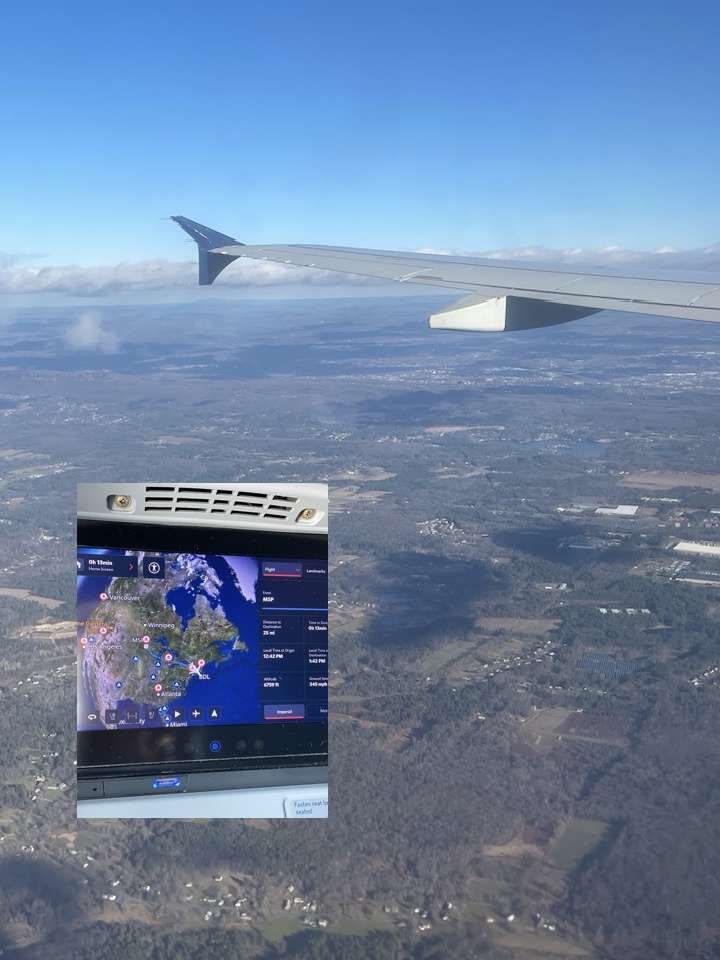
For me, the most important part of air travel is the view of earth from five miles up. A flight’s sub-par if I don’t have a window seat or for most of the ride, there’s a flat, thick cloud deck at 10,000 feet.
In contrast to the rest of humanity’s scorecard, commercial aviation is nothing short of a worldwide wonder, especially when scale and success rate are accounted for by simple statistics: number of flights (>100,000), miles (10s of millions), and passengers per day (10 million to 12 million). Perhaps the best non-empirical but critical evidence of the “wonder” element is that we take such scale and success for granted.
As a beneficiary of another “worldwide wonder”—medical care (at its best, not its worst), I’ve learned not to take anything for granted; especially complex human endeavors about which I know little to nothing of operations behind the scenes. But air travel is in a league of its own (exceeded only by space travel).
I’ve heard it reported that astronauts are never the same once they’ve viewed our precious planet from outer space. The earth itself is perceived as a thing of divine majesty, to be loved and cherished as never before, thanks to appreciation transformed by a rare wide-angle perspective. I’m sure the same would be true of our earth-tethered forebears if they could’ve peered out the window of an Airbus 320 at 35,000 feet.
I can try to imagine the effect that this long-view perspective has on astronauts orbiting earth (let alone those who’ve walked on the surface of the moon)—or would’ve had on yesteryear’s time travelers aboard the Airbus. The impression on the psyche would be indelible. The earth would become sacred; human squabbles would seem inconsequential; perpetual world peace, a possibility. Familiarity, however, divests us of awe. See the world enough times from five miles up and the view loses its allure, its magic and meaning. But somehow, whenever my view is above the clouds, my head is in the clouds. I will always prefer a window seat.
As Newton discovered, however, all that goes up must come down. After a little over two hours in the air, we’re back down to earth, retrieving our luggage and awaiting our ride. Soon we’re inside our hosts’ home, watching with delight as our grandson shows us his latest books, trucks, and puzzles, and demonstrates his coming-together-sentences. I ponder his future, his expanding horizons, his interaction with the world and, I hope, his positive contributions to it. Already a seasoned over-seas traveler with an understanding of two languages, he has yet to grasp the nature of perspective. But if I can have my wish, he will one day develop an astronaut’s—or a time traveler’s—view of life on earth and embrace with love and respect, this precious planet of ours and the good side of humanity that occupies it.
Subscribe to this blog and receive notifications of new posts by email.
© 2025 by Eric Nilsson
