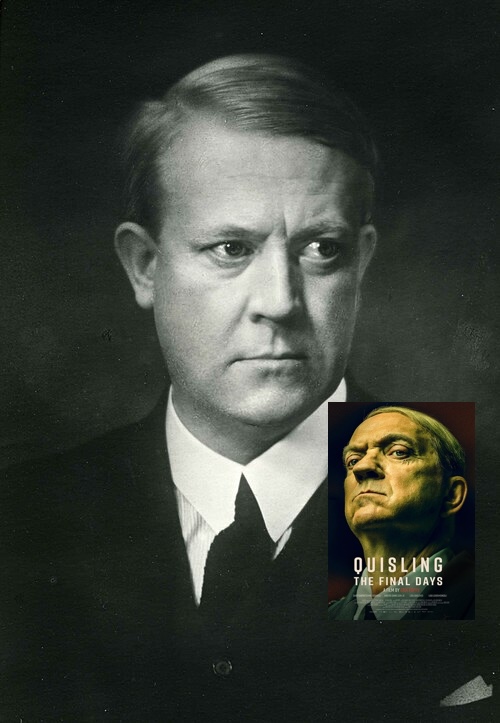
SEPTEMBER 22, 2025 – The film tells us little of Quisling’s ascendancy to power—as it were; he’s not depicted as a megalomaniac or Il Duce character, though as head of the Nordisk folkereisning i Norge, or “Nordic popular rising in Norway,” a political action group established in the early 1930s, Quisling was known as its fører—the Norwegian equivalent of the German “Führer”—but apparently he assigned no special significance to the moniker.
His politics were complicated, from early sympathy for the Bolsheviks (he admired Trotsky, in particular) to later anti-Soviet sentiments after the Kremlin stonewalled his continuing humanitarian efforts on behalf of survivors of the Armenian genocide and victims of the famine in Ukraine in 1928 that proved to be the precursor of the Holodomor. Before he completely soured on the Soviet Union, he served as the legation secretary in the Norwegian embassy in Moscow representing British interests in the absence of formal British diplomatic relations with the USSR.
Over time, Quisling politics shifted to the right and were centered around Norwegian nationalism. His Nasjonal Samling party—an outgrowth of the Nordisk folkereisning i Norge—never gained much popular traction, and both the party and Quisling were largely marginalized by the Nazi in charge, Reichskommissar Josef Terbhoven. Eventually the Germans granted Quisling nominal power—grudgingly—naming him “Minister President.” Thereafter, Quisling expended much of his political capital with the Germans trying to negotiate Norwegian independence after the war.
None of this is covered in the film, which, simply by Quisling’s arrest at the very end of German occupation, leaves the viewer to assume the man committed a raft of dastardly deeds and outright war crimes; that the man was guilty as sin by association with sin itself: the Nazi overlords.
We don’t get to know the man beyond his projected image as an unrepentant and querulous figure who insists (damnit!) that he was innocent of any crimes; that he’d fought long and hard for Norwegian independence, though not in the manner embraced by the Resistance.
But what exactly were the crimes of which he was accused? What stains burden his name in the historical record? He was tried and convicted of murder, embezzlement, and high treason, but the viewer sees nothing of these transgressions. Of murder we hear a young prison guard’s disdain for the man he blames for the death of the young man’s brother in a raid that killed 10 members of the Resistance. We are otherwise merely permitted into the courtroom to hear some of the testimony and arguments. We are passers-by, not jurists presented with the full body of evidence and wearing the mantel of judgment.
We are present, however, for the testimony of one of the 34 Jewish deportees who survived internment in the camps and returned to Norway after the war.[1] Compounding this testimony is Peder’s subsequent “confession” to Quisling:
Peder and Heidi had been hiding the elderly Jewish couple, the Abrahamsens, for quite some time in Olsen’s apartment. But then one day Peder and Heidi’s young daughter discovered the couple. Peder panicked. He was afraid the daughter would talk at school, exposing the whole Olsen family to persecution and imprisonment; possibly worse. To save his own skin and that of his family, he told the Abrahamsens that it was time for them to leave. Deportations had already begun, and everyone feared what might become of deportees. Peder believed they’d survive, however, and return one day. Heidi was far less confident and worried constantly about the fate of the Abrahamsens. One senses that Peder fears her retribution against him as much as he does God’s.
When Peder told the story to Quisling and remarked that it was something he now deeply regretted, Quisling assured Peder that he, Peder, had done what he needed to do, and by implication, bore no guilt. (Peder rejected the “get out of sin jail free” card, however, and acknowledged to out loud—to Quisling, anyway—that Peder bore responsibility for the fate of the Abrahamsens.
But apart from these anecdotes, the viewer is given a relatively narrow basis for excoriating—or more precisely, for sentencing—Quisling. The court, however, is not swayed by the reminder that Quisling saved far more lives during the famine in Ukraine than the number of the deaths in Norway for which he could possibly be held accountable. Moreover, he refuses to follow Peder’s advice to show contrition. Quisling is defiant to the end. He’s to be executed by a firing squad. After losing his appeal to the Supreme Court, Quisling appeals to the King—even to Stalin (!) of all people (though remember, Stalin had been an ally of Britain and the U.S. during the war)—but without success.
Just before he is to be shackled to the execution wall, Quisling hands his fedora to Peder, a gesture of appreciation, if we choose, for the pastor’s efforts. Quisling then asks to have his blindfold removed so that “[he] “can look [his] killers in the eye,” but despised as well as disgraced by his countrymen, Quisling is denied his final request.
The final scene captures Peder’s inner struggle, which now becomes our struggle: sitting down on the ground, he drops Quisling’s hat at arm’s length off to the side, as if to say, “What the hell!”
Ahead of the credits, we learn that Quisling’s would-be confessor later became a recognized authority in psychiatry. Hmmm.[2]
In any event, watch this film. It’s available free on YouTube.
Subscribe to this blog and receive notifications of new posts by email.
© 2025 by Eric Nilsson
[1] At the outbreak of the war the Jewish community in Norway was quite small—under 2,200. Hundreds fled over the border to neutral Sweden. Nearly 800 were deported, mostly to Auschwitz; of these only 34 survived, 25 of whom returned to Norway. By 1946 the Jewish population in Norway was only 559.
[2] Additional research revealed that Quisling’s lawyer (a respected barrister), tried to develop the defense that his client suffered from a brain tumor and thus, should be granted special dispensation by the court. To advance this theory, the lawyer had Quisling subjected to multiple rounds of terribly painful and upsetting tests. No tumor was revealed, and the defense was dropped. Given Peder Olsen’s subsequent study in psychiatry, one wonders if perhaps his experience with Quisling led to an examination of the role of brain chemistry in human behavior.
