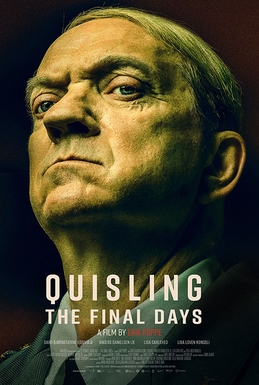
SEPTEMBER 21, 2025 – (Cont.) The best stories are ones that tell us about ourselves, and Quisling: The Final Days, does just that. Not that we’re traitors. Few of us, in fact, would see anything of ourselves in the flawed eponymous character. Enter, however, Peder Olsen, a hospital chaplain assigned by the Right Reverend Eivind Berggrav, Lutheran Bishop of Oslo and Primate of the Church of Norway[1] to to provide spiritual support to Quisling after the latter has been imprisoned on charges of treason and other high crimes following the withdrawal of German occupation forces in May, 1945. The story in this film is told largely from the perspective of Pastor Olsen and relies on his diaries and those of his wife, Heidi. It is their story in which we can see ourselves—irrespective of our own religious beliefs.
The good pastor is earnest to a fault. No supporter or apologist of Quisling, he nevertheless takes his deputization by the Bishop—likewise an opponent of the traitor—seriously. Quisling, despite his Christian faith (his father was a pastor), initially rejects the mild-mannered cleric, but ever the believer in his spiritual wares, Pastor Olsen returns repeatedly until Quisling finally engages.
By order of the Bishop, however, Olsen’s mission is to be kept strictly confidential. Not even his wife is to be told. She learns about it when cleaning out his pockets and finding a slip of paper with the Oslo phone number and address of Quisling’s Ukraine-born wife, Maria. At Quisling’s request Olsen has been visiting Maria, serving as their principal liaison.
This Ukraine connection, it turns out, dated back to the Russian Civil War following the Bolshevik Revolution. Fritjof Nansen, the famous Norwegian arctic explorer, leveraged his celebrity for humanitarian causes, and when disorder in Russia and Ukraine led to famine, Nansen became involved in the League of Nations relief efforts. He called upon Quisling, by then known for his Russian expertise, to manage administration of aid programs.[2]
Heidi confronts her husband. How could he possibly be administering to the country’s most despised citizen—and on top of that, not disclose it to her? It is in this context that we learn of the psychological toll that the occupation took on Norwegians generally and on the Olsens specifically. What spills out is the guilt Heidi, especially, feels over the fate of the Jewish couple that the Olsens had befriended but who were forced to leave Norway. With his faith-based hope, Peder is confident they survived the war and will return. Heidi isn’t so confident and blames Quisling for their friends’ disappearance.
What draws the viewer into the story—again, irrespective of the viewer’s own religious beliefs—is the juxtaposition of Peder, Heidi and Quisling. Peder is the most earnest, not only by upbringing and vocation, but by personality, though one wonders whether his earnestness flows by nature, from necessity—that is, to counter deep-seated doubt—or by indoctrination. Heidi, on the other hand, presents herself as more realistic—more doubt-filled, given the conflagration that the world has endured over the previous six years. And when it comes to forgiveness and salvation, how can these be reconciled with Quisling’s association with the pure evil of the Nazi regime and on a personal level, the disappearance of the Abrahmsens, the elderly Jewish couple, whose photo Heidi clutches tearfully?
Putting cynicism aside, I imagine many fervent Christian believers wish they too possessed Peder’s unwavering faith, his earnestness, his devotion to the notion that God loves a sinner; make that every sinner. What resonates with the sincere Christian is the idea that the greater the sin, the closer to God the sinner becomes—provided the sin is acknowledged. Frustrated by Quisling’s insistence on his innocence, the believer-viewer admires Peder’s dogged persistence.
The doubting-Thomas and -Thomasina viewers, however, are apt to see themselves in Peder’s own tightly managed doubts, manifested most acutely in his ultimate vocational failure: though on the eve of his execution Quisling joins Peder in the Holy Eucharist (performed inside the condemned man’s cell), Quisling never does repent.
And then there’s Quisling himself. If the viewer can’t identify with him, then given the passage of time and a fuller understanding of the man and his circumstances, one can fairly conclude that the death sentence was overkill, so to speak. Although the film doesn’t force this judgment on the viewer, the story certainly gives much to ponder in this regard. (Cont.)
Subscribe to this blog and receive notifications of new posts by email.
© 2025 by Eric Nilsson
[1] In the movie, Bishop Berggrav plays a brief but pivotal role by his appointment of Pastor Olsen. Berggrav had resisted the Nazis and nearly paid with his life. After his downfall and arrest, Quisling requested that the Bishop himself serve in the capacity of spiritual guide. Having been persecuted by Quisling, Berggrav declined but agreed to appoint another pastor (Peder Olsen) in his stead. During the war, Berggrav had been sent to a concentration camp and was saved from execution, ironically, by two prominent German dissidents. The story of his courageous leadership deserves to be told and heard. What’s admirable about Norwegian Lutheran clergy during the war is that they universally and defiantly opposed the fascist regime, unlike their Lutheran counterparts in Germany, with Dietrich Bonhoffer being a notable exception.
[2] Elsewhere I learned that Quisling was quite the scholar. In 1905, the year Norway gained independence from Sweden, he applied to the Norwegian Military Academy and on the entrance exam achieved the highest score of 250 applicants. The following year he transferred to the Norwegian Military College, where he graduated with the highest academic standing of anyone since the prestigious institution had been established in 1817. Though he majored in math, he excelled in the humanities and history and concentrated on Russian history. He also became fluent in Russian. Based on his academic expertise, seven months before the October Revolution he was sent to Petrograd (St. Petersburg; later Leningrad; now back to St. Petersburg) as an attaché to the Norwegian legation. By the time Nansen called upon him in 1921, Quisling was considered Norway’s leading military expert on Russian affairs. Quisling proved to be tremendously competent in this regard, and Nansen later stated that Quisling’s work was “absolutely indispensable.”
