OCTOBER 15, 2025 – Recently, a friend with years of observing and participating in the world, told me that the two things she worries about most for her children and grandchildren are (a) climate change; and (b) our democracy. I would put those same two concerns at the top of the list. Nearly all other issues—neither of us mentioned the threat of thermonuclear war, whether instigated by a rogue state or dastardly nihilists—pale by contrast, or more precisely, are subsets of climate change or the health of our democracy.
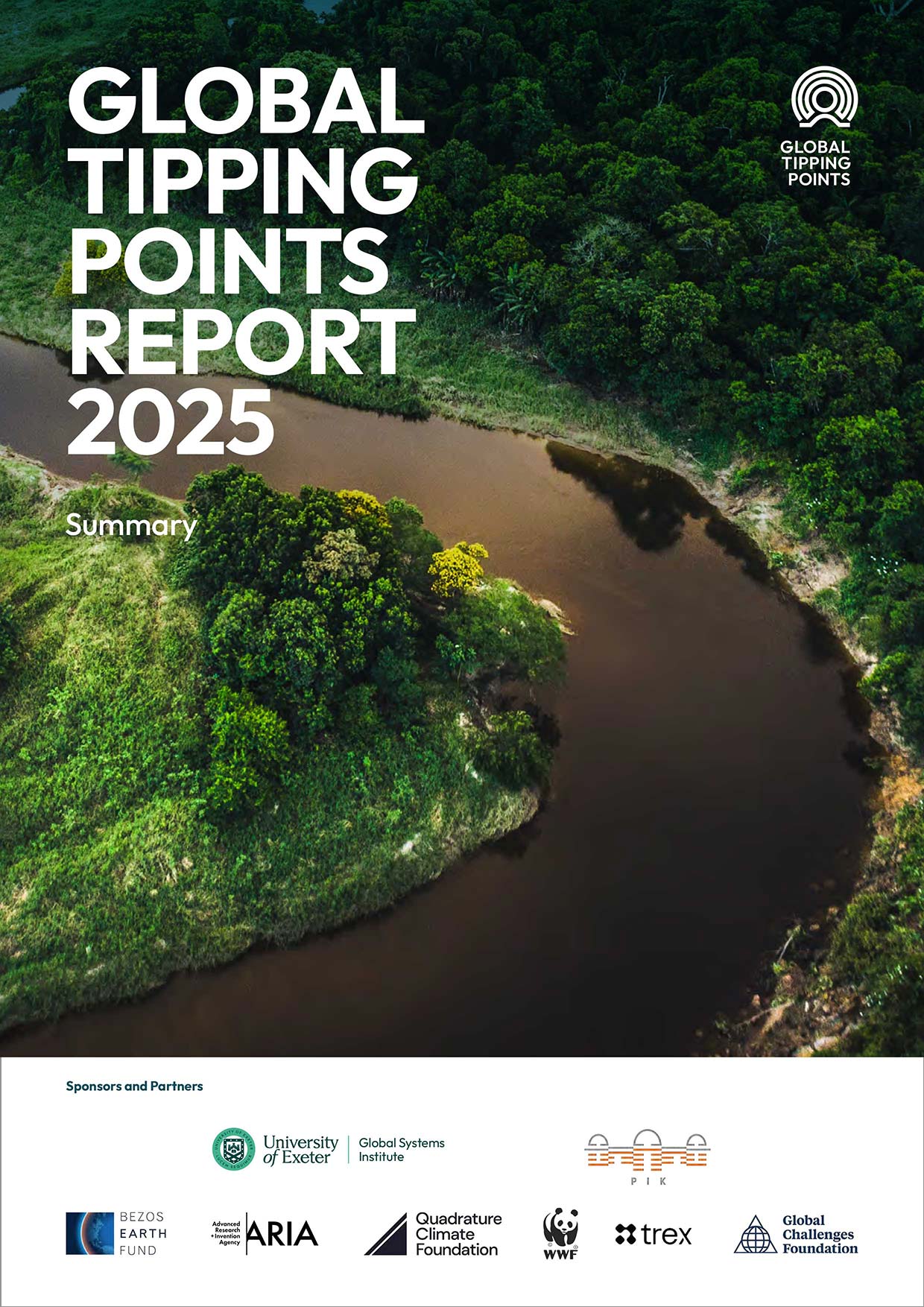
Earlier this week the Global Systems Institute of the University of Exeter issued its Global Tipping Points Report 2025. If before you acquaint yourself with the summary report (https://global-tipping-points.org › download) you’re no more than casually concerned about the future habitability of our unique planet, once you’ve read it (it takes about a half hour to digest), you’ll be sitting-straight-up with urgency. The good news is that if we—as in the “royal we”—take concerted, coordinated action, the same royal we can transform a potentially catastrophic outcome into a positive future. But we need to act now, given that several climate tipping points might have already passed.
For the ostriches and the naysayers, it cannot be denied that eventually, the planet will die in the predictable fashion of astrophysical evolution and devolution: the sun will burn itself out and turn into a giant red star before it goes “poof!” in the cosmic night. The earth, of course, will be put out of existence in the final act—if not sooner by collision with a monster comet roaming into our orbit. But well in advance of the astrophysical scenario of earth’s destruction, our climate will undergo multiple “adjustments” that will result in unrecognizable rearrangements of the biosphere, not to mention extinction of our species. Nevertheless, since the dawn of life on earth, those “adjustments” have occurred either at glacial speed (pun fully intended) or, in the case of cataclysmic changes, with infrequency bordering on infinity when compared to the lifespan of our most enduring civilizations. There’s little we can do about the next natural occurring glacial age 100 to 500 generations from now or the Yellowstone volcano blowing to kingdom come, half of what we call the U.S.—a singular disruption that occurs every 650,000 years, give or take 50,000 (the latest having occurred about 650,000 years ago), but if we fail to act now, people alive today will risk a high probability of environmental disaster.
“Act now,” by the way, means an adrenaline-fueled dash to catch the train that’s already left the station.
What was the other issue that my friend and I worry about most next to anthropogenic climate change? Oh yes—the state of our democracy. Why is that so important? For starters, so we can respond as needed to the imperative imposed by climate change. Given our disproportionate consumption of fossil fuels, we Americans bear a commensurate duty to contribute to solutions. Only if we concurrently remodel and remediate our governance will we discharge that duty as now necessitated by climate change.
Beyond that, for our own security and prosperity—rich or poor, young or old, Democrat or Republican—we Americans need to close the gaping chasm between the richest of the rich and everyone else, especially the bottom 50%, who own and control a mere 6% of the nation’s wealth. Only by courageously pragmatic political action can the wealth and income gap be reduced. Yet that action is possible only if we first reform our system of governance. If we don’t reform that system soon and meaningfully, it will crumble, impoverishing in one significant way or another, everyone except the billionaires—minuscule in number, enormous in power. And American of the Great Potential will become a forgotten relic in the boneyard of history.
We’re on our own with all this. We (the) people. No aliens within striking distance of earth will be able to answer our pleas for help—assuming aliens exist and that they could detect our cries and understand them . . . and want to rush to our aid. We must be the creatures who save us . . . from ourselves.
Subscribe to this blog and receive notifications of new posts by email.
© 2025 by Eric Nilsson
