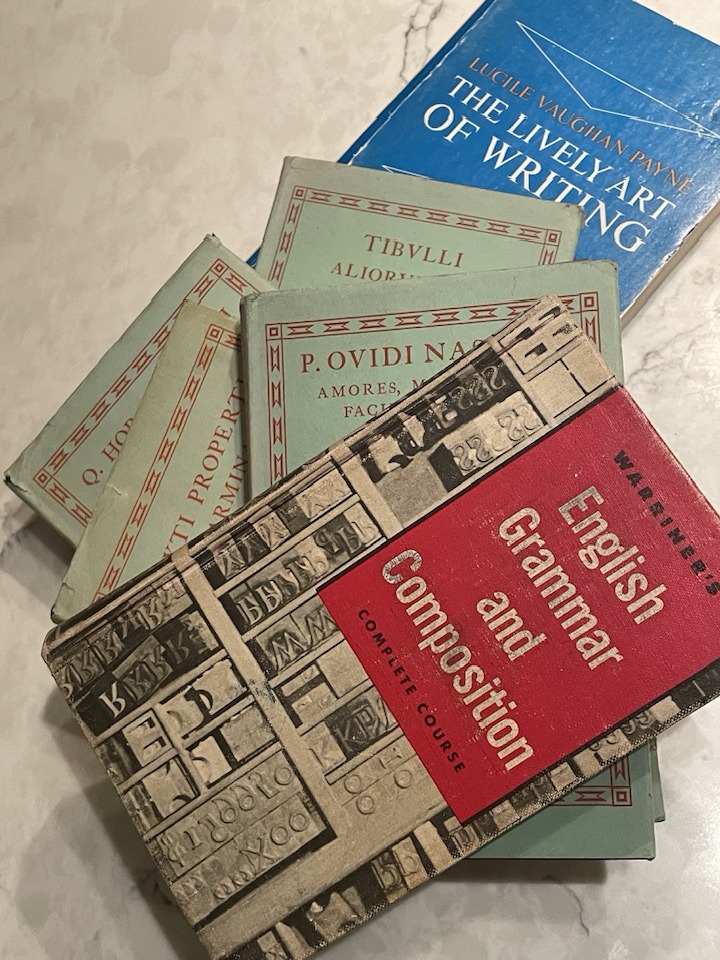
NOVEMBER 23, 2025 – I’m no Latinist, but in college I learned enough to read Virgil’s most famous poem—Aeneid—in the original, albeit with a dictionary close at hand. Sadly, I’ve lost a lot of my Latin, but I haven’t lost my irritation when I encounter speech or writing that fails to distinguish between the singular and plural form of English nouns derived directly from Latin: “alumnus” and “alumni,” for example (not to mention the distinction between masculine and feminine (“alumna”) singular forms); “bacterium” and “bacteria,” for another; and “crematorium” and “crematoria,” for yet another. But the Latin-to-English usage that drives me over the purist’s cliff is the grating disagreement between a singular verb and “data,” instead of datUM (or alternatively put, the deeply offensive abandonment of “datum” altogether).
With a modicum of trepidation I venture into this topic, but I do so assuming you’ll look beyond my pedantry or, in the case of reformed Catholics who were forced to read the mass in Latin, I trust you’ll grant me forgiveness for scratching old scars.
“Data Day” could well serve as an alternative to the popular moniker of our era, the “Information Age.” All the rage right now—AI—is the Great Oz of the future, but behind the curtain lie its three hard-working components: chips, computing power, and . . .DATA. When you enter a search in Google and hit “done,” the AI-generated response draws on a gazillion DATA—plural, thus requiring a verb in plural form . . . or so I thought.
Upon further investigation I learned that English usage, always a thing of fluidity and malleability, has passed me up at the speed of light—or the speed of today’s cutting edge computing power. “Data,” as it turns out, has moved well beyond its ancient origin and now means “information” just as properly as it means “facts.” In other words, given this evolution of language, if you substitute “information” for “data” in its formerly static plural form, a singular verb is perfectly proper—in fact, mandatory: you wouldn’t say, “The information [multiple facts] say that you’re wrong.”
The more practical reality is that 100% of the time, when “data” is (yes, in all contexts singular, since here the four-letter word is the subject, not whatever multiple points are comprised by “data”) is used in speech or writing, the audience or readers, as the case might be, know perfectly well that the user means “information.” “Information,” in turn, can mean a single data point (technically, a “datum” in Latin (and English)) or multiple data.
In any case, I suggest that we mustn’t get any more hung up on “proper usage” than we should snag ourselves on matters of sartorial fashion. Styles and conventions regarding our garb change drastically from season to season, occasion to occasion, and most directly on point, from era to era, even year to year. You might love the look of physical vigor that a fur hat with ear flaps gives you, but as rakish as that might make you appear as you down the sidewalk in the dead of winter, that same choice of headgear would suggest that you’ve lost a few marbles if you wore it outside in July when it’s 100F in the shade. Likewise, you’d be asking for a demotion if you wore a Zoot suit to work on the day when your boss’s boss’s boss is in town for her annual meet-and-greet tour of your branch office. I you have to tailor your attire to the circumstances at hand.
None of this, however, is to suggest that discriminating adherence to old standards isn’t uniformly desirable, even essential in some contexts. Take the case of wearing something besides your underwear when going out in public. The last I checked, this standard is still alive and well, at least in Minnesota. Ditto the use of “thank you” in lieu of “ugh,” or dare I say, writing in which noun-verb agreement is observed. To the hyper-technically argumentative sort, the underwear example might be a bad one. After all, underwear could be hidden by something as nominal as a burlap sack wrap, a pathetically low standard. Granted. More to my point—and in observance of a higher standard—if you’re making a run to your local grocery store, where you’re likely to encounter people from your own tidy neighborhood, you’d be socially inept and unaware if you didn’t wear something more pleasing (and less scratchy) than a burlap sack—just as you wouldn’t allow double-negatives to pepper your small-talk exchange with an acquaintance you encounter in the pasta aisle of the supermarket.
But then there was the case of the “perfect gentleman” who rode my bus to work in the pre-Covid years. He was impeccably dressed—so much so, he was somewhat out of step with modern standards. From head to toe he was a walking fashion statement—from his handsome fedora to his fine Italian shoes, with laces perfectly even, trouser creases sharp enough to slice an apple, suitcoat sleeves tailored in precise proportion to his dress shirt, and a silk tie (with matching pocketchief) sporting colors and pattern better than boring without being too loud. In attire he was the equivalent of an Oxfordian grammarian. For him, it worked just fine, even though by comparison his fellow travelers were seriously style-deprived. (I discovered later that the “perfect gentleman” was a salesman at a high-end men’s clothier in downtown Minneapolis.) For me, such fine threads would’ve been completely out of character—so much so, people would’ve laughed, then said, “Goin’ to a costume party?”
In both English usage and exquisite fashion, there’s a time and a place for every standard. What’s more critical than adhering to the highest standard and eschewing the lowest is knowing what you can get away with—as in knowing when it’s okay to end a sentence with a preposition, or, as I’m doing right here, knowing how to avoid the problem by covering it up . . . with aplomb. “Knowing [with what you can make your escape]” entails accounting for context and the expectations of your audience.
As language—just as clothing style—evolves, so must we adjust, however much we might think it’s “incorrect” (or worse). Adjustments, though, shouldn’t compromise meaning to the point of confusion or obscurity. Not being a fashionista, I won’t opine about what limits should be observed in the clothing department, except that a good rule would be, “keep the underwear—and what’s under the underwear—under wraps.” Nudist colonies, I’d bet, are the exception that underscore the rule . . . so to speak (or write).
Subscribe to this blog and receive notifications of new posts by email.
© 2025 by Eric Nilsson
