DECEMBER 30, 2025 – Throughout my childhood I was dragged to concerts by our parents and grandparents and accompanied by my all-too-willing sisters. Invariably, Dad would grade soloists on their stage presence; that is, whether they engaged in distracting histrionics. When it came to the actual music, no one could rival Dad’s discerning ears, but no matter how superb the musical performance, if it involved lots of dramatics, his spoken review on the way home would deduct major points. In his view, the performer was to be heard, not so much seen—waving this way and that with a screwed-up brow suggesting that somehow the pianist belting out Liszt or the violinist knocking Tchaikovsky out of Northrup Auditorium was channeling the composer in ways no mere mortals in the audience could achieve.
Mother was less vocal about a performer’s stage presence. Perhaps her tolerance for distracting “expressive ecstasy” was related to her nervous tic, which rendered her more accepting of imperfections in others. When she herself dove into one piece or another on the piano, however, the tic seemed to yield to the power of the music. If her head-jerks and jaw snaps didn’t disappear entirely, I noticed, they were largely suppressed—as were any other tendencies toward the sort of dramatics Dad so disapproved.
On the other hand, maybe Mother’s lack of emotional exhibition at the piano was attributable to her mathematical approach to music. When she played Bach, for instance, the gears inside her head were turning to the logic of the master’s modulations and clever use of counterpoint. Such a relationship to the music was more likely to foster Mother’s steady posture and concentration and less likely to stir wild theatrics.
Dad, a man of perfected consistency, played the piano as if he were a mannequin seated at a player piano. His blue eyes fixated on the music in trancelike fashion as his large hands with fine-motor calibration moved effortlessly up and down the keyboard. When it came to “stage presence,” he practiced what he preached. Yet, surprisingly, given his analytical approach to his many other pursuits, Dad’s relationship to music was deeply emotional. Though he was well-schooled in music theory, he never talked about it; never wore “math on his sleeve” the way Mother did at the keyboard.
Dad’s idea of model performers were Jascha Heifetz (violin) and Artur Rubenstein and Vladimir Horowitz (piano). They were old school artists, godlike in their statuesque presence on stage and in album cover photographs.
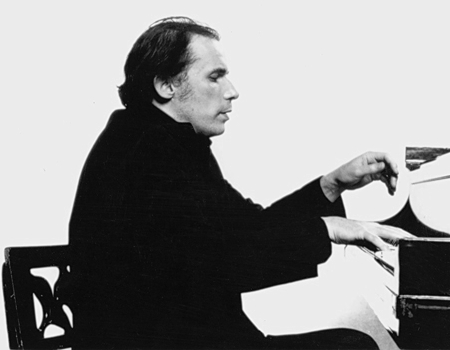
And then there was Glenn Gould, the Canadian savant at the keyboard, especially when it came to the music of J.S. Bach. I don’t know when I first heard Gould’s name, but I’m pretty sure it was Mother who brought his recordings into the house. She was quite enamored of his playing, and though I didn’t know or care one way or another, I thought it was cool that he was from Toronto.
When I learned that he hummed while performing, however, I jumped to two conclusions: A. He was weird, and B. Dad would not approve. I’m not sure who in our household disclosed to me that Gould hummed. It might well have been one of my sisters, who’d noticed from his recordings, but when Mother revealed that she too knew about the humming, she wasn’t perturbed by it. Gould was a quirky genius; nothing wrong with that. Except . . . Mother was quirky, especially the way she applauded over-enthusiastically at concerts, and I found that embarrassing.
A couple of years ago, my sister Elsa told me about a documentary on the life and music of Glenn Gould. She was fascinated by it, though in recommending the film to me, acknowledged that he was, in her words, “one strange duck.” I watched the documentary and was likewise fascinated—at the same time I thought Gould was perhaps the “strangest duck” I’d ever seen at the piano—now that for the first time I was seeing him perform.
On one level the eccentric Canadian was everything that strangers to classical music often perceived (with gross inaccuracy) about a genre to which they had limited exposure—but entirely consistent with their biases and prejudices shaped by popular culture. His stilted speech patterns were off-putting, and his expositions about the intricacies of Bach, Mozart, Beethoven gave new and impenetrable refinement to the term “arcane.”
And then there were the extreme idiosyncrasies: his upper body hunched over his hands; his gangly fingers stretched out over the keys; a bony hand rising now and again above the keyboard, then with a flourish signaling the end of a phrase; and worst of all, the jaw—the spasmodic lower jaw, which was the equivalent of Mother’s tic going full flick, non-stop.
Oh, yes . . . and the chair; the lame, lousy battered wooden chair with the legs cut off a few inches up to give the seat the exact elevation that Gould wanted . . . needed . . . insisted upon . . . and that no manufactured, adjustable piano bench could deliver. The chair went with Gould wherever he played—from his home to the recording studio to Carnegie Hall.
Of all the performers I’ve seen—dead, alive or on YouTube—none can hold a candle to the Canadian when it comes to just plain . . . WEIRD. But no one can match Gould’s rendition of say, Bach’s Goldberg Variations, either. My interaction with his video recordings is dichotomous. When I view them, I’m left to wonder what an alien visitor to our good planet would make of the spasmodic jaw. When I listen, however, I’m reminded that the essence of divinity is to be heard, not always seen.
Subscribe to this blog and receive notifications of new posts by email.
© 2025 by Eric Nilsson
