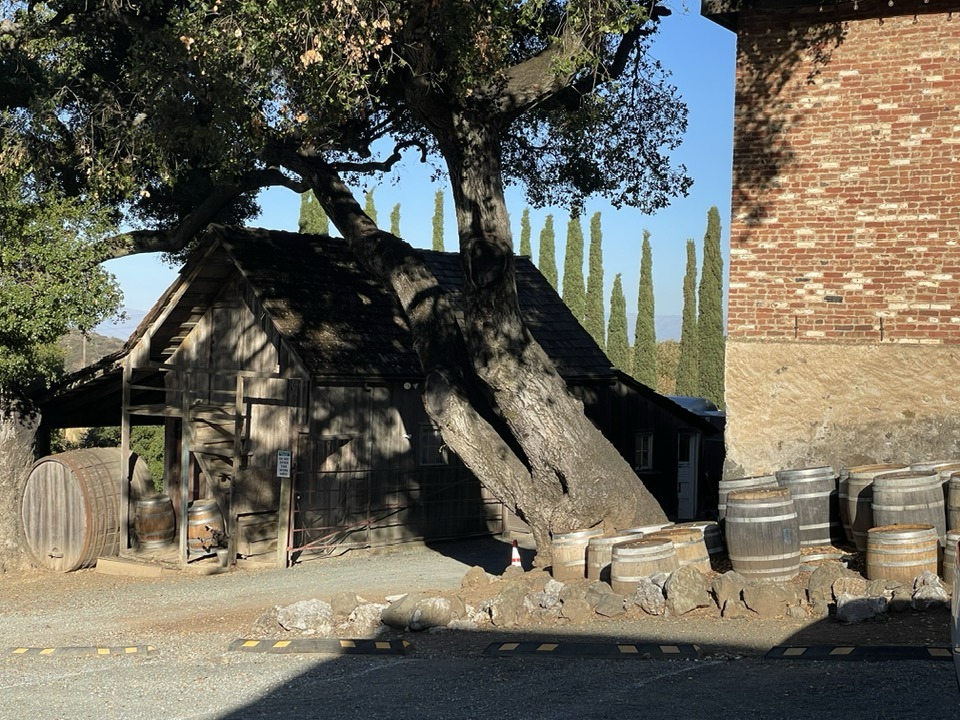
NOVEMBER 4, 2025 – Our day’s end stop Monday was at the Picchetti Winery in the rustic heights above Cupertino. The product of this +140-year-old establishment—now consisting of 9,000 cases of wine a year—is sold only through wine clubs across the country. Our tour guides, Russ and Kerri, have been members for decades and have inside track/first-name-basis status at what seems to be as much a local private refuge as it is a well-modeled business enterprise.
Again, it’s a place that Beth and I had visited before—once upon a time. The original weathered homestead (later converted to house operations), the stack of oaken wine barrels, the sharp slope up to the wine-tasting barn, the vistas through openings in the redwood glades surrounding the main grounds, triggered fond recollections of the place. Out of sight beyond the “Safety First – DO NOT ENTER THIS WORK AREA” sign was the working end of the business, and farther still were the vineyards, though as Russ explained, Picchetti uses as well, grapes from vineyards owned by other growers.
While Beth and Kerri partook in actual wine-tasting as a prelude to buying bottles to supplement existing inventories, I explored some of the history behind the business, which originated with the purchase of the land by the Italian Secundo Picchetti in 1874; Secundo sold half to his brother Vincenzo in 1884.
I’m not much of a wine connoisseur,[1] so rather than embarrass myself at wine-tasting, I investigated a bit of the Picchetti family history. A snippet was encapsulated on a plaque in front of the original homestead, augmented by slightly more information on the internet. The piece that caught my eye, however, and preoccupied my thoughts for the remainder of our time on the premises, was the copy of a newspaper article tucked away in the corner of a modest glass-covered display cabinet in the tasting room. Stuck in time near the yellowed article was a Purple Heart medal in its small presentation case and propped up tentatively inside the open cover of the case was a torn and faded black-and-white photo of a military cemetery.
The article came from a local paper, and its caption read, “San Jose Soldier Overseas 2 Weeks Killed in Action.” The announcement was accompanied by a photo of the soldier in uniform. Its opening sentence read,
Overseas two weeks, Pfc. Virgil Picchetti, 29, son of Mr. and Mrs. A.V. Picchetti of Stevens Creek, was killed in action April 8 while fighting with the Infantry in Germany. [H]is parents were notified yesterday.
By piecing a few data points together, I concluded that the dead soldier was the grandson of Vincenzo Picchetti, one of the brothers who’d started the Picchetti Winery.
At the top of the page on which the article had appeared, someone had written “April 8, 1945.” By that late stage of the war in the European theater, Germany was all but defeated. V-E Day—the day on which Germany surrendered unconditionally—was just one month away.
As I pondered the timing of Virgil Picchetti’s death 80 years ago, a new perspective formed on what I’d read of the family history. When the soldier’s grandfather and great uncle migrated from Italy to California more than three decades before the outbreak of World War I, they could not have possibly anticipated that war or the greater war that would follow; they’d left decades before the rise of Mussolini, before anyone had heard of Hitler, before anyone could have foreseen Italy hitching its fortunes to Germany and both powers becoming hard-core enemies of the Picchetti’s adoptive land.
But then one day would come the shock, the travesty, the tragedy to have one of their own killed in action just two weeks after he’d arrived in Europe and only 30 days before the end of the six-year-long “conflagration to end all conflagrations” (until it didn’t). The familial pain must’ve been unspeakable, and the victory celebrations that followed V-E Day, more bitter than sweet for this family of the grapes, this family from the earth in Italy.
I could relate to that pain by recalling the loss of my own family’s “Virgil”—Robert Holman, the shining light of my mother’s generation of Holmans; the all-star student and captain of the swim team at Dartmouth, swept up by the same war and likewise killed in action. The local newspaper article of Robert Holman’s death was similar to Virgil’s—the headline, the photograph, the “parents informed [just yesterday].” As I thought about “Bob,” whom my mother worshipped—and missed for the rest of her life; whose death his parents surely mourned every day for the rest of their lives—I thought about all the tens of thousands of other sons who’d perished in that war and subsequent wars and whose premature deaths had shattered the lives of loved ones. I dared not take these thoughts any further—to the Holocaust, the sieges, the battles and bombings, the wholesale depravity of man.
Instead, I looked around at the bucolic setting and found peace and promise for our species. I then returned to the wine-tasting barn and listened to the chatter between experts and connoisseurs. Basking vicariously in the vintner’s science and the wonders of wine, I marveled at this universal elixir coaxed from sun and soil—aided by climate, chemistry, and traditions that connect us to ancient times and to one another.
Subscribe to this blog and receive notifications of new posts by email.
© 2025 by Eric Nilsson
[1]A self-characterization that surely humors the two or three readers who know that I’m as far from being a connoisseur of the grape—“much of” or otherwise—as Jimmy Carter is to running again for president.
