SEPTEMBER 1, 2025 – Whether or not we acknowledge our circumstances, we are always and in all places part of nature. That is, we’re captive to the immutable laws of physics, the infinite range of chemical reactions, the irresistible forces of geophysics, and the unending wonders of biological processes. It matters not whether we’re glued to our iPhone screens while seated inside a high-rise apartment surrounded by steel, glass, and concrete or living off the grid in the wilds of Papua New Guinea—we are as much a part of nature as nature is a part of us, starting with gravity and continuing with the oxygen we breathe, the water we drink, and the food we eat.
Up here in the lacustrine Northwoods of recently (in geologic time) glaciated northwest Wisconsin, we’re surrounded by reminders of our integration with nature.
Take for example . . . the acorns that drop raucously from the umbrella limb of an old oak shading our dock from the sun 93 million miles away. The real umbrella designed for sunny days protects us (and our coffee mugs) from the aerial bombardment.
Or . . . consider the eagle that I surprised one fine morning last week, which raptor, in turn, surprised the hell out of me when unwittingly I ambushed it as it dined on a large pike on the shore end of our dock.
Or . . . think about the ehrlichiosis that I contracted up here from a no-seeum, no-feelum black-legged tick earlier this summer.
Or . . . the green mansion of our woods, home to thousands of trees and other flora, not to mention fauna—especially of nocturnal habits.
And . . . from the lake we hear the wild calls and tremolos of the many loons that frequent the lake—nature’s signature sounds in this lakeland neck of the woods.
Then . . . the grandest reminder of all that we “reside in nature”—the nighttime starlit sky. Far from unnatural urban lights (fuelled, of course, by nature one way or another), the celestial wonders shine in numbers that stagger the imagination while at the same time, connecting us to the cosmos.
Call it all “nature in your face.” The central aspect of nature here is the element of surprise. In my many decades here, I’d never come so close to a bald eagle that I could see its individual ankle feathers and the nares of its piratical beak. The encounter lasted for only three or four seconds, but it was so close, sudden and remarkable as to be permanently etched across my retinas.
On Saturday morning, another remarkable phenomenon occurred—another first for me in all the time I’ve spent here “in nature.” I awoke early, peered out the window and saw everything enveloped in a thick fog. “Photo op time” was my immediate reaction.
I jumped into suitable clothes, grabbed my iPhone and slipped out of the cabin. Off the porch steps I entered what appeared as a magical kingdom. The lake in front of our cabin had disappeared, but nothing had taken its place except . . . nothingness. I stepped along the immediate shoreline to photograph what seemed to be the edge of the earth, then proceeded to the path that runs along the shore.
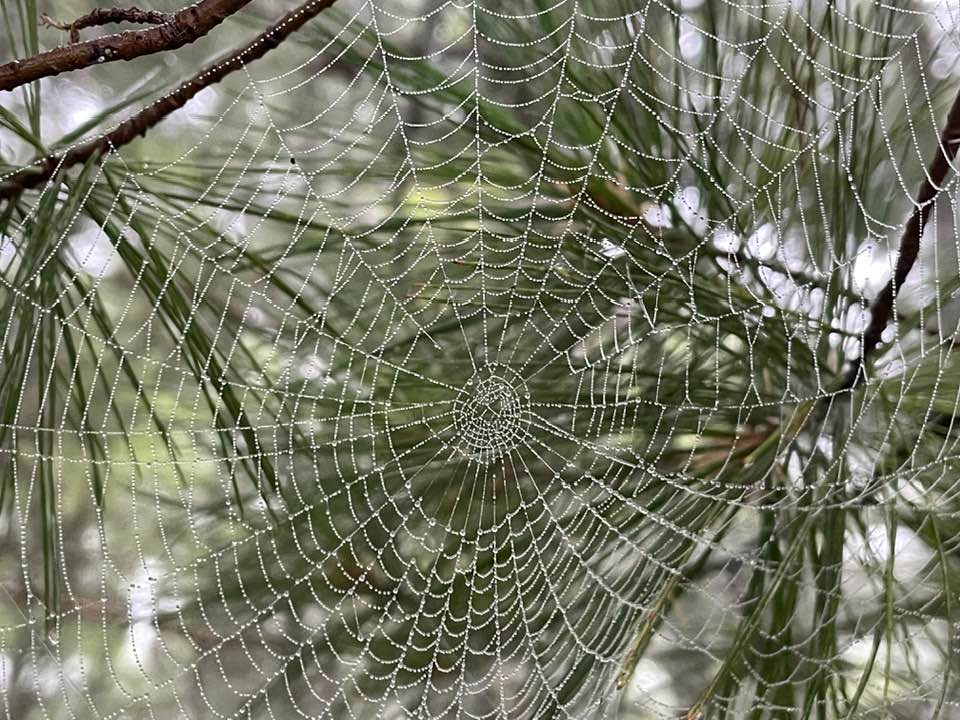
Soon I noticed an uncommon number of spiderwebs on the ground. I looked around and saw more webs—many more—on tree trunks, branches, stumps, over the frame of the cedar swinging bench atop the berm, between the slats of the bench . . . everywhere. There were hundreds, perhaps thousands of cobwebs throughout my surroundings and as far along the path as I could see. Between the steps of the staircase leading down to the pontoon landing was a dense tangle of spiderworks, throughout which were tiny beads of moisture placed by the fog. No photo of mine could capture the full wonder of this cobweb mass.
I’d never seen anything such as what I was then amidst—not in our woods or any other woods or any other place. I was transfixed by the volume and finery of the overnight works of what had to be almost infinite legions of spiders. Of course, I snapped countless photos. Many captured the elegant intricacies of the cobwebs, but I was amused by how many photos revealed absolutely nothing of the intended subject matter. I’d find a particularly unusual cobweb, focus my camera, compose the photo and snap it. Immediately, I’d then review the picture, yet—nothing in the way of a cobweb! It was as though by some inexplicable magic, the camera had made the cobweb disappear. It hadn’t, but an ever so slight shift in angle and lighting had rendered the work of a spider invisible—to me and, I realized, to the spider’s intended prey.
The extraordinary scene was something I wished I could show our soon-to-be-10-year-old-granddaughter, but in the same instant I remembered: she’s scared of spiders. If she were here, I thought, she would be absolutely freaking out and probably determined never to visit the Red Cabin or Björnholm ever again.
I went back to admiring nature’s handiwork, grateful that we just happened to be on hand for what I presumed would be a fleeting display[1]. And sure enough, by the time the fog lifted and bright sunlight was transformed into diamonds across the water, all signs of the astonishing cobweb universe were nowhere to be seen.
Nature is as “fleeting” as it is constant, and since we are “always and in all places” part of nature, we should always have the popcorn ready: “Nature, the Interactive Movie” is full of wonderful surprises.
Subscribe to this blog and receive notifications of new posts by email.
© 2025 by Eric Nilsson
[1] In fact, “cobweb fests” are one part of nature’s infinite cycles. What I witnessed occurs regularly with the change of seasons (usually summer to fall) and is related to spiders’ “group approach” to stocking up on food. The phenomenon is over almost as soon as it appears, which is why a person needs to be lucky to be on hand for it.
