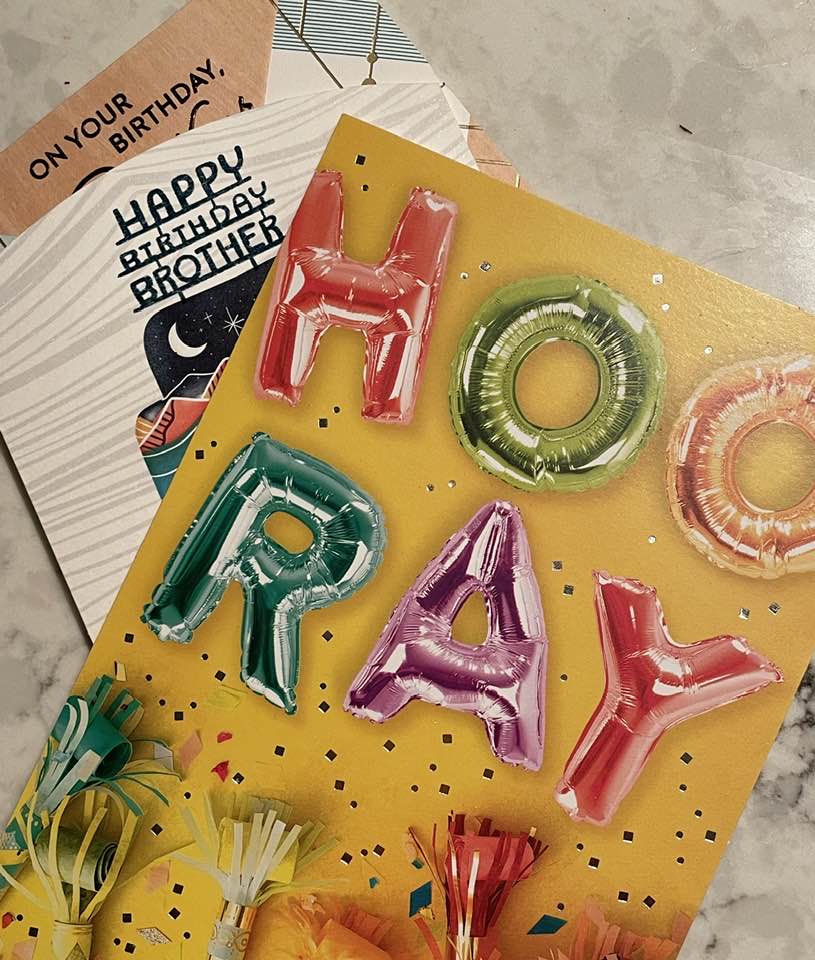
AUGUST 7, 2025 – Today I turned 71, an unremarkable age, perhaps, if you’re, say, 81 or 91. But if you are 70 when you go to bed, and you’re 71 when you get out of bed the next morning, this change in age is a noteworthy event, and so it was for me yesterday/today. Of course, we don’t become a whole year older overnight. It’s a gradual process over 365.25 rotations of our planet in its revolution around the sun. I think of this every night when I crawl into bed: “Hmm,” I say. “Another day down.” Last night I didn’t say, “Hmmm. Another year down.”
But speaking of years, it’s coming up on three of them since my stem cell transplant (on August 23, 2022, to be precise), a miraculously successful treatment of my particular affliction—multiple myeloma. This timeframe puts me inside the three- to five-year longevity range that a drug-only treatment would’ve afforded me. The transplant expands it to a five- to seven-year horizon. “And after that,” the research doc at the University of Minnesota told me, “we have other stuff we can throw at it [including some cutting edge treatments that I hope to heaven won’t be interrupted by the current administration’s bomb-throwing approach to medical-science research]; ah . . . you’ll go on so long you’ll die of something else.” (Whereupon, I threw my cap down on the floor of the exam room and said indignantly, “What?! You mean I’m gonna die? After all that you’ve put me through, I thought I was gonna live forever!”)
All kidding aside, whatever my longevity might be, it’s no longer an objective (though, back to kidding, I permit myself to say my goal now is +80). When I was 50, I wanted to live to be 100, not understanding quite yet, what existing that long might entail in the way of extreme unpleasantries. When I was confronted with the diagnosis of a disease that killed my father[1], I instantly adjusted my sights. Living life to 100 held no currency; meaning in whatever time I had left now meant everything.
“Meaning”? Right. What’s “meaning”? Every single one of us seeks it, consciously or subconsciously, and some of us find it—and know so—while others find it and don’t realize they have, while others still, for one reason or another, within or outside their control, miss out on meaning altogether.
Until my diagnosis, my life seemed to fade in and out of “meaning.” In retrospect, I don’t think I’d assigned sufficient consideration to the definition. Exactly what did “meaning” mean to me? When Dr. Kolla informed me that the sword of Damocles was dangling over my head (that’s not how he described it, but that’s how I imagined it), I felt as if I’d been struck by a bolt of lightning.
The immediate effect was to know exactly the meaning of “meaning.” In that instant I was a changed man. Everything in my life to that point was condensed into a single point of reference giving direction to the rest of my earthly existence, however long that might be. Soon I entered the world of treatment for my disease. Every single aspect of it was new; much of it was terrifying. In time I chilled and developed what felt like a divine connection with people who joined the massive effort to give me . . . time. I soon experienced gratitude on a level I’d never experienced. My attention shifted from humanity’s ubiquitous dysfunctionality to humanity’s highest level of achievement—medical science and above all, genuine care on the part of every single care-provider with whom I interacted.
To this day the experience has rendered me an incurable optimist and believer in the goodness of humanity.
Today I received many kind and generous greetings. Each was a reminder of what goodness resides in people’s hearts and minds. Each message was its own blossom, and together they formed a wondrous bouquet. May I, in turn, be a better blossom in the bouquets of others.
In these reciprocal arrangements—gratitude for care; giving as much as receiving—lies ample meaning with no need for further definition.
Subscribe to this blog and receive notifications of new posts by email.
© 2025 by Eric Nilsson
[1] Albeit at the age of 88 and with no diagnosis until he had less than two months to go and therefore, received nothing but palliative treatment.

2 Comments
Happy birthday, Eric. Always liked the card I saw in Sweden once. A goofy drawing of a man resembling Einstein with the message, “Gattis, Einstein. Nu er du relativt gammal!” (Congratulations, Einstein now you are relatively old!)
Ha! Great card, Erik!