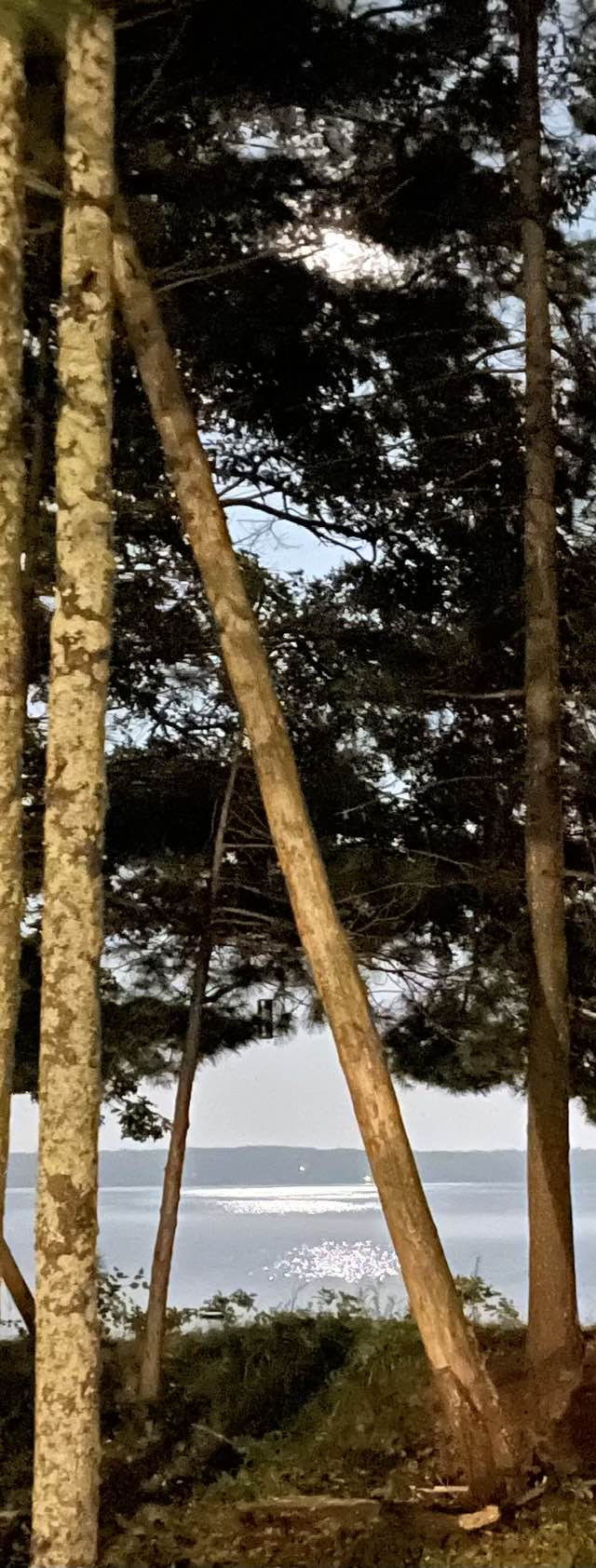
JULY 28, 2025 – Late last summer, a tree along the shoreline in front of the Red Cabin got tired of standing—years after it had died. In fact, it had been dead so long that its identification might be difficult to someone unfamiliar with local arboreal species. It was a white pine. I knew this from the many years of its thriving life. Eventually, however, the tree succumbed to disease, and over time its remains were converted to a giant housing project for all kinds of organisms on which the life of the forest depends. Moreover, this tree—as is the case with most standing dead trees—became a feeding ground for a variety of local birds, and these descendants of the dinosaurs are essential to the good health of nature’s garden.
I am not unaffected, however, by aesthetic considerations: I’d much prefer to look out at a line of live trees than have my view obstructed by dead ones. After the subject tree had been quite dead for quite long, yet when I still had the strength and energy to man-handle a 30-foot tall tree that was a foot in diameter at its base, I had considered felling the tree—or rather, what was left of it—a standing trunk showing a fairly advance state of decay and numerous spiky dead branches from about the halfway mark of the trunk all the way to the top.
The proper way to attack the project would have been to haul out the pole saw and trim as many of the lower branches as the telescoping saw would allow; more than a half-hour task, including the clean-up. But then another principle of arboreal art and science had entered my thoughts—a principle I try to apply when considering any cabin project—a variation of the Hippocratic Oath: Whatever the hell it is you think you’re going to “fix” or “improve,”. . . DO NOT MAKE IT WORSE.
Because of the density of tall trees in the immediate vicinity of the dead pine, I could readily see that it would get hung up on the branches of its neighbors. I knew the method for addressing such a situation—I had observed my dad apply it—but it is not without risks, and to mitigate those risks (with ropes, undercutting, steel-toed boots, gloves, and helmet) involves a fair amount of monkey business. I decided (rationalized?) that by the simple passage of time, the tree would become increasingly lighter as decay took its inexorable course. Either the tree would fall on its own accord but would be easier to deal with because of its lesser weight or, over the longer haul, birds and bugs would deconstruct the standing trunk, branches and all.
Then came the day last summer when the tree fell—well, kinda, sorta—and as I’d predicted, became hung up on the dead branch of an equally tall Norway pine. As a preliminary test of matters, I wrapped my hands around the underside of the now slanted base of the tree to see if I could lift—or lever—it. In two words: nothin’ doin’. The tree was still too heavy to maneuver, even in its compromised state. The trunk about six feet down from the top was snugly positioned against the Norway trunk, and supporting the fallen veteran was the base of a three-inch branch of the Norway. Though the branch was dead, and though dead Norway branches eventually fall on their own (unlike most dead branches on white pine), the trunk ends of the branches can hold on for decades. Using binoculars to examine the intersection of the Norway trunk and the white pine branch, I noticed two things: 1. If “a guy could” (as my dad always put it when thinking out loud about a cabin project challenge) get a long nylon rope around the top end of the white pine and pull hard enough to slide it out along the dead Norway branch, the branch would probably snap and release the white pine to the ground, and 2. Assuming satisfactory execution of #1—a tall order, so to speak—depending on just where the dead Norway branch broke, the dead white pine could seriously lacerate the whole side of the (beautiful) Norway. Again, I thought about the Hippocratic Oath.
From a purely aesthetic standpoint, though, what stood in my way was not only the imperative, “do not make it worse,” but a bothersome, if slightly amusing, anomaly inconsistent with visual expectations. From nearly every vantage point—yard, porch, and windows of the Red Cabin—facing the shoreline, one’s view is interrupted by the white pine leaning 30-degrees from upright. Again, from every angle, because of the size and placement of two other (upright) trees in close proximity to the white pine, they in combination with the incline of the dead white pine form a perfect capital ‘N.’ From my wife’s perspective, there’s nothing amusing about this. That’s because her last name starts with a ‘B.’
I adapted. There’s nothing special about “Nilsson,” I told myself. Back in Sweden it’s the seventh most common surname, because several generations ago, when every male’s patronym was his father’s given name plus “son.” (The possessive in Swedish is connoted without an apostrophe, thus, you get, “Andersson,” “Bengtsson,” “Carlsson,” and so on—all the way to Nils and his son—back in the day, “Nils” being just as popular as “Anders,” “Bengt,” and “Carl.”[1]) If my last name were something royal, such as Romanov or Czartoryski or de Bourbon[2], maybe my amusement would be outweighed by some kind of royal pride, but then again, that would require a radically different set of circumstances in which the fallen tree had consorted with its neighbors to form a capital ‘A,’ ‘B’, or ‘C,’ which, in any event, would be highly unnatural, at least in this part of the world.
So, I thought, maybe the ‘N’ ought to stand for “Natural.”
But then there’s another angle to all of this. Maybe the ‘N’ should stand for “Non-conformity.” The problem with that, however, is that while in many avenues of endeavor I am a non-conformist (despite titanic efforts to conform), my poor spouse is not of such ilk, which is why her design ideas, interior and exterior, prevail, as well they should.
So maybe I need to settle for this: the ‘N’ stands for “Nothin’ doin’,” as I said near the outset. That position could change but only if a tree cutter comes along and for nothing more than a cup of coffee and two oatmeal, chocolate chip cookies offers to take care of the white pine and guarantees no hard damage to the surrounding trees—while I video the operation and post it online, where it will soon go viral, though probably . . . not.
Subscribe to this blog and receive notifications of new posts by email.
© 2025 by Eric Nilsson
[1] The patronyms of baby girls, meanwhile, consisted of the father’s given name plus “dotter”—which, as you guessed, is the Swedish word for “daughter.”
[2] Or “Bernadotte,” if we’re sticking to Swedish royalty, though Bernadotte was of French origin, not Swedish, but was installed on the Swedish throne as part of the treaty structure following the Napoleonic Wars.
