AUGUST 24, 2025 – I was going to write about something else today, except late in the proceedings—at around 6:30 this evening—I experienced a “Voilá!” moment that inspired me to write about something different altogether. Readers all too familiar with my Pergola-on-a-Platform shouldn’t be surprised that the “Voilá!” moment occurred while I was working on that long-term project, though the project per se is the vehicle, not the destination of this post.
During a break earlier in the day, I’d been reading about Sony, the Japanese company that cut its corporate teeth on the reel-to-reel tape recording machine and made its corporate fortune manufacturing, marketing and selling transistor radios. A big part of the Sony story was the counter-culture outlook of its co-founder, Masaru Ibuka, who encouraged his engineers to think outside the confines of convention. This was a radical notion, because a long-standing aspect of Japanese culture was the concept of saving face. And saving face was closely associated with not failing, most especially, not failing in public view. Avoidance of failure discouraged innovation, however, and some historians have ascribed the absence of an “Asian industrial revolution” to this link between inhibited inventiveness and the fear of failure—that is, the need to “save face.”
By contrast, innovation has always thrived in the United States, where people are free to fail, often big time. In fact, the “freedom to fail” is actually codified in the United States Bankruptcy Code. A primary principle supporting American bankruptcy law is the notion that however bad an entrepreneur screws up, s/he is entitled to a “fresh start.” The ability to begin again encourages risk-taking—an essential ingredient for innovation and entrepreneurship.
The history of business and technology development in the U.S. features as many blow-out failures as sky-high successes. The successes, of course, have far outstripped the failures, at least as measured financially, but much of the foundation for all the success is replete with failure, large and small.
One could argue that failure accompanied a majority of people who migrated to this country from Europe in the 19th and early 20th centuries. By and large the masses who washed up on our shores from Europe were failures; losers, at least in the societies from which they came. They left the Old World to seek a “fresh start” in the New. Yet, for many, if not most new arrivals, the “fresh start” was littered with early failure and extreme hardship before successes could be realized and leveraged.
I was ruminating about all this while working on the Pergola-on-a-Platform this afternoon. At many junctures I wondered if perhaps I’d bitten off more than I could chew. I worried about “failure,” though not so much about “face saving,” since the building site is so isolated, the only people likely to lay eyes on it are rare guests who accept my discriminating invitation to embark on an arduous walk to the site. Nevertheless, all along I’ve wondered whether the project will “fly,” or, in the case of my naïve and whimsical attempt to create a quasi-utilitarian “sculpture,” whether it would “stand up.” Or would the project turn out to be a giant flub, or as I expressed in a post a month ago . . . nothing more than a “bonfire opportunity”?
Late this afternoon, I made major progress. Having completed installation of the deck on the platform, for the first time I stood up on it; I stood on the finished platform portion of the “Pergola-on-a-Platform.” It was a moment filled with exhilaration, as I towered—my height plus 40 inches—above the highest point in the tree garden.
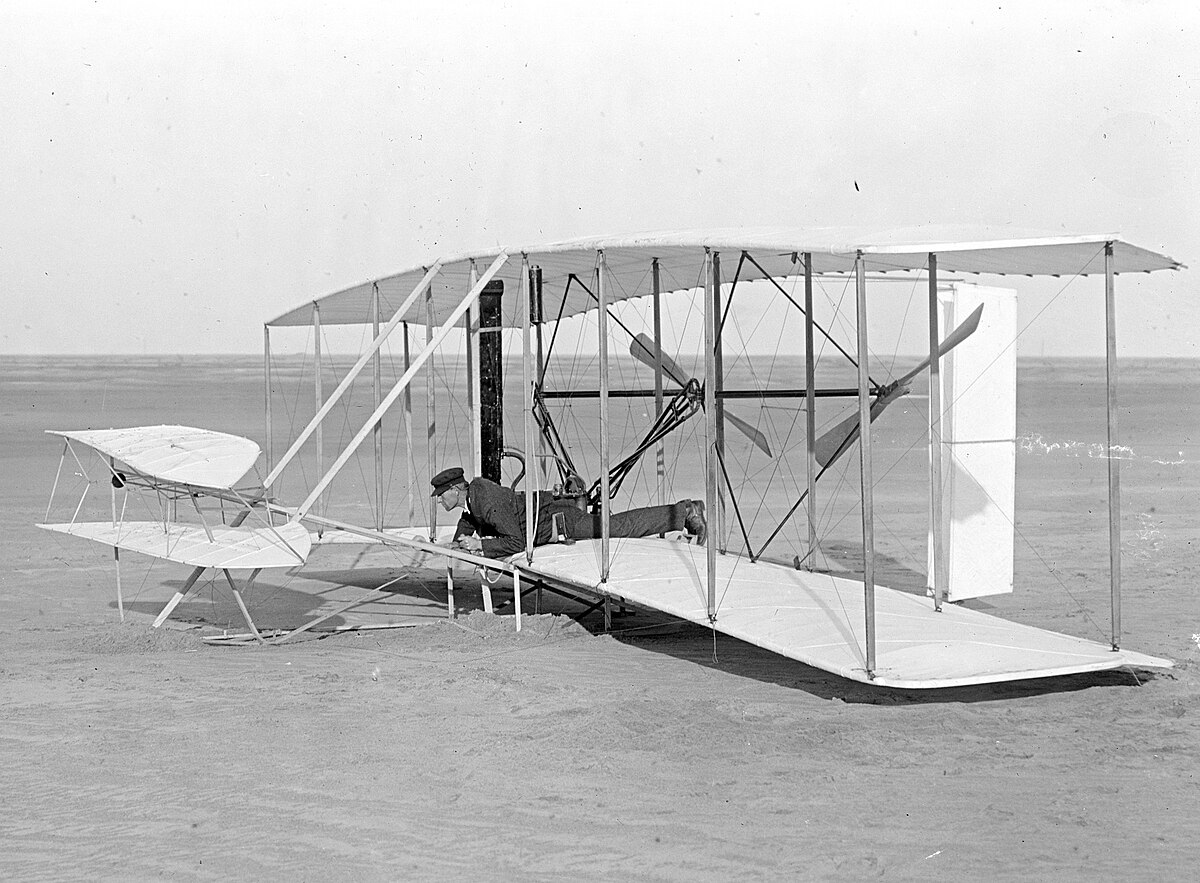
But if the experimental aircraft was now rolling down the sand dune, it had yet to achieve lift. “Lift” in my case, would succeed—or fail—in the very next phase of construction: bolting the pergola posts to the platform posts. Would the half-inch bolt holes I’d pre-drilled line up? Assuming such, would the “spliced” posts be straight? Would they provide level and stable support for the pergola beams I’d designed and cut?
I put my shoulder into the task and worked the wrenches as if I were Orville Wright at the controls on that day—December 17, 1903—at Kitty Hawk. Before I knew it, lift was achieved, and I was soaring over the tree garden. All the questions, worry, mistakes, “do-overs,” and other corrective actions fell away, as my experimental aircraft soared confidently over the woods.
“Voilá!” I cried, knowing in my own small way, the exhilaration that the Wright Brothers and so many other people who’ve tried, failed, tried again, failed again, then finally, finally, succeeded. After landing, I gathered my tools and hauled them down off the ridge and back to the Red Cabin. As I watched the sun slide toward the western shore, I felt grateful for the freedom to fail.
Subscribe to this blog and receive notifications of new posts by email.
© 2025 by Eric Nilsson
