JUNE 25, 2025 – (Cont.) On Sunday morning we cleared out of old Lenox and headed for Stockbridge and the Norman Rockwell Museum. Our progress was deferred, however, by a sign at a junction just below Lenox. It read, “Frelinghuysen Morris House & Studio.”
I must here confess to extreme dereliction; my failure to have reserved time and made proper accommodation to spend half a day at this not-to-be-missed attraction. For the reader who shares my interest in abstract art (along with other genres of visual art), I direct you to the website for a full virtual tour of house and history—and art created and collected by the inimitable art power couple, George Morris and Suzy Frelinghuysen: https://frelinghuysen.org/about.html
I’d heard much about all this from a Bowdoin friend and classmate of mine, Jeffrey McCallum, who lives outside of Philadelphia. Several years ago Jeffrey had informed me that another classmate of ours, Kinney Frelinghuysen, a highly accomplished artist in his own right, is the co-trustee of the foundation established after the death of his aunt Suzy in 1988. Jeffrey had urged me to visit the house and studio and reconnect with Kinney.
I’d explored the website and was determined to visit the physical site on some occasion when my wife and I were in Connecticut, a regular destination of ours, given our family connections to the Nutmeg State. Our planned attendance of Garrison’s show at Tanglewood was the perfect time to schedule a visit the Frelinghuysen – Morris House and Studio.
To my great regret, I didn’t plan and work a full-fledged visit into our schedule.
My wife and our granddaughter acceded to a “stop”—nothing more—before heading to the Norman Rockwell Museum to meet up with my sister and GK. The entrance to the Frelinghuysen/Morris site was marked by a short, wooded drive to a clearing, a small parking lot, and a welcoming gazebo staffed by an excellent emissary of the establishment. We soon realized that a proper tour of the house—not yet visible but accessible at the end of a third-of-a-mile path through an enchanted forest—would entail more than a mere “stop.”
For me that realization unleashed painful regret. In desperation I explained to the emissary that I was a college classmate of Kinney Frelinghuysen and at the very least would like to greet him, however briefly, after 49 years since our graduation. She cheerfully phoned another staff member, who said Kinney had taken a visiting artist from the Met to the train station. I had no idea where the closest Amtrak station might be but knew it would be more than a few minutes. (There would be no other trains from the Berkshires to New York.)
I asked for some paper on which I could write a note and was immediately accommodated. As I scribbled something out (realizing how ridiculous it was to resort to this means in our age of digital communication), the “other staff person” appeared. He was a young, self-assured man who introduced himself as Kinney’s son, Thomas. Smart and amiable, Thomas proved to be another superb emissary of the house and studio. Upon learning of my college connection to his father and my friendship with Jeffrey McCallum, with whom Thomas was well-acquainted, Thomas established an easy rapport with me.
With a schedule to keep (by this time we were running well behind it), I felt the need to set sail again before we’d even docked at the wharf. I thanked Thomas for his kind reception and handed him my hastily written note to his father.
We then continued to the Norman Rockwell Museum just outside Stockbridge, 20 minutes away. We’d stopped there two years ago with our granddaughter in tow as now. She’d thoroughly enjoyed the works of one of America’s best known illustrators. This time around we were awestruck by a special exhibition entitled I Spy! Walter Wick’s Hidden Wonders. Also vying for our attention were All for Laughs: The Artists of the Famous Cartoon Course and Illustrators of Light: Rockwell, Wyeth and Parrish from the Edison Mazda Collection.
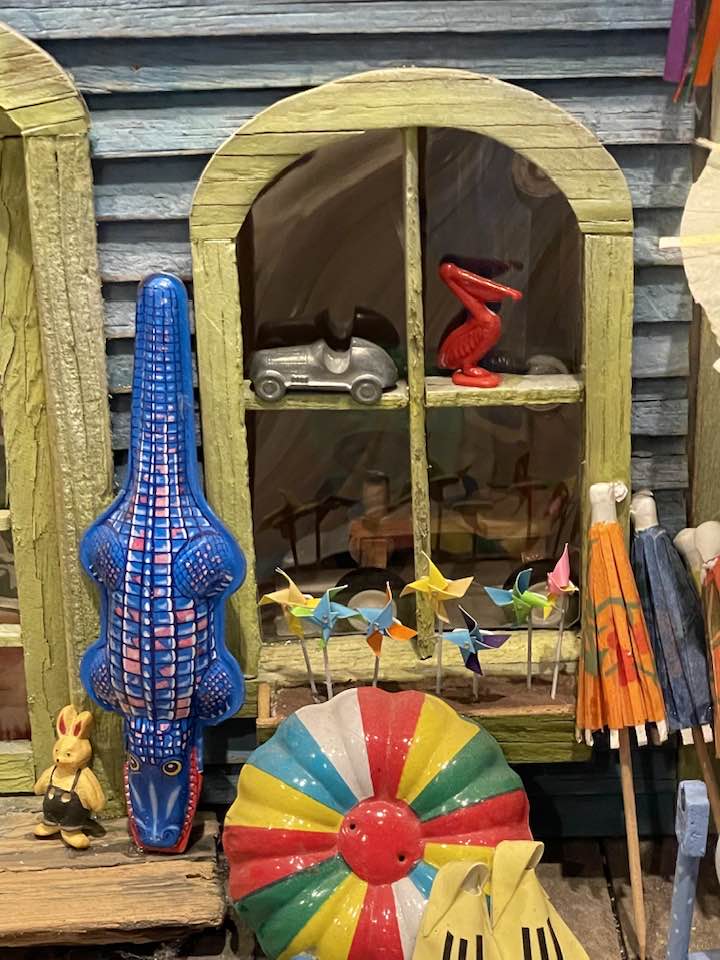
The Wick exhibition was especially fantastic. He painstakingly designed and constructed complex scenes incorporating miniature versions of innumerable objects; a wonderfully cluttered “curiosity shop,” for example, and a strip of tourist shops near the seashore. He then photographed the model scenes from various perspectives, producing jaw-dropping results.
All great art enriches human life, and much great art stretches the imagination and understanding of self and society. Art is as essential to our humanity as nutrition is necessary for life. Though I am neither an artist nor a connoisseur, I appreciate great art immensely and couldn’t live without it. Above all else, this is what I learned from our trip to the Berkshires.
Subscribe to this blog and receive notifications of new posts by email.
© 2025 by Eric Nilsson
