JUNE 24, 2025 – (Cont.) Before Saturday I knew three things about the Shakers: 1. Aaron Copeland had given them tribute in Appalachian Spring, arranged from the ballet music he’d composed for the Martha Graham Dance Company. (One of the signature melodies of the suite is from the Shaker hymn, “Simple Gifts.”); 2. They made simple beautiful furniture; and 3. They were a pacifist sect of Christianity.
On Saturday I learned a few more things: 1. They were a break-away sect from the Quakers and were called “Shaking-Quakers” (later shortened to plain, “Shakers”), because they liked to “shake it all about” during worship services. This predilection for drug-free ecstasy in such circumstances is befuddling given their belief in celibacy (i.e. absolutely no hanky-panky) and leading simple, unadorned lives marked by an unswerving worth ethic. “Shaker” is a lot easier to remember than their original name: United Society of Believers in Christ’s Second Appearing; 2. The break from the “Quake” occurred in 1747. In 1774, “Mother Ann Lee,” the spiritual leader of the group at the time, led a group of eight Shakers to Colonial America and settled in upstate New York. Her then husband was among the eight but later dropped out—of the marriage and the community—and remarried; 3. Shakers were doomsdayers in their religious outlook (“Repent, for the end is near!”) and eminently radical-woke-socialist-whacko-leftwing-communist (by current standards) in their political-economic outlook. They didn’t believe in private property but did believe—long before the rest of the country caught on, often quite grudgingly, in the complete equality of women and all races. Unlike Luddites, the Shakers believed in adapting the latest technologies and encouraged innovation; and 4. After reaching their zenith in the mid-18th century at 5,000 members, the celibacy feature led to the Shakers’ inevitable decline. Several of their 18 communities between Maine and Indiana and south to Kentucky—even Florida—survive as . . . museums.
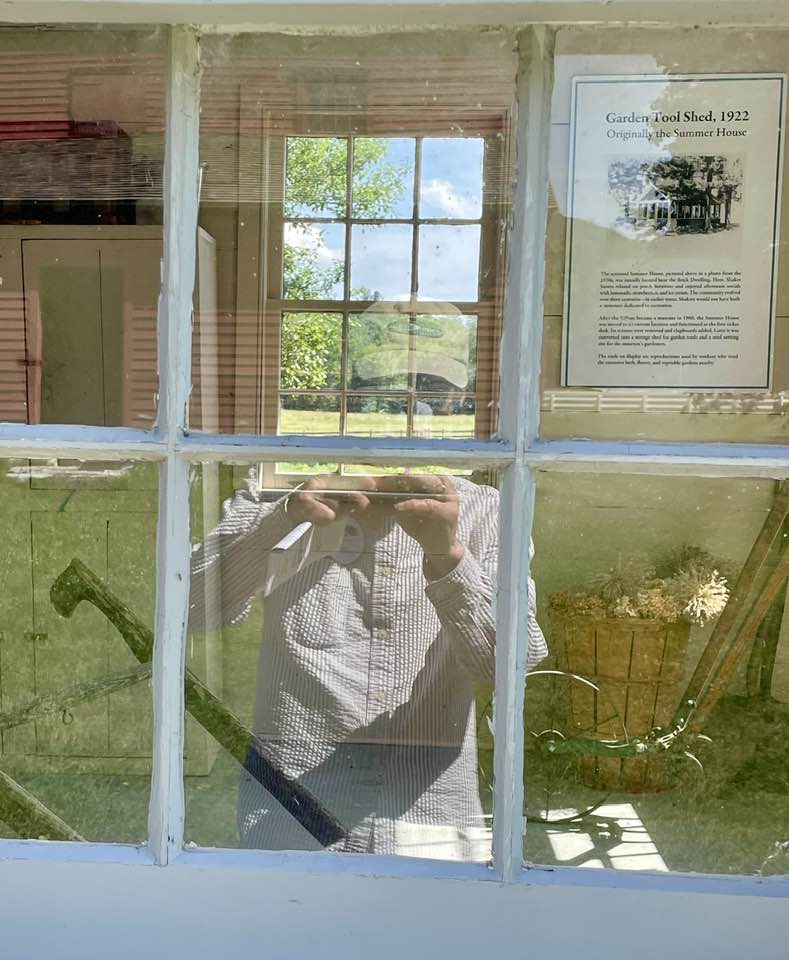
At the Hancock-Stockbridge Shaker Museum in its bucolic surroundings, we saw many artifacts and curiosities of Shaker life—the 1826 innovative, high-efficiency round stone barn for the farm animals that still reside on the premises; the adjacent dairy ell; the blacksmith shop, where several enthusiastic volunteers gave us a lengthy demonstration at the forge and anvil; the brethren’s shop, with a pair of volunteers crafting wooden boxes of classic Shaker design and construction—complementing the art of Shaker furniture, which was widely popular in 19th century America, and continues to attract collectors (and buyers of well-crafted imitations); the “brick dwelling,” where all the sisters and all the brethren, as they were called, ate, slept and attended meetings—a super-sized kind of college dormitory.
We toured no church, for there was none. In keeping with their simple approach to life and religious belief, the Shakers eschewed extravagance, even when used to reflect the divine by imitating the grandeur of creation.
Regrettably, the museum closed before we could visit the school, which the boys attended in winter months and the girls attended during the summer.[1] While our granddaughter and her grandmother were preoccupied with hands-on learning in the “Discovery Barn,” however, I was able to quiz a young volunteer who was very well schooled in Shaker learning. He said the teachers were of very high caliber, and the students were especially well-behaved. The curriculum included reading, writing, math, science, geography (U.S. and world), and history (U.S. and world). The education provided by the Shakers enjoyed a high reputation, and many non-Shaker families from surrounding communities sent their kids to the Shaker School. Enough said.
As we drove back to the “outside world,” I reflected on the Shaker way of living—simple, humble, frugal, tolerant, accepting, hard-working, and innovative. Except for the last two traits, the Shakers were the antithesis of the frenetic dash-n-cash culture that developed around them. Today they are for all practical purposes “extinct without a future.” Yet, their influence endures across our cultural landscape. Besides their many other positive influences, Shakers were the original conscientious objectors, and their pacifism is compelling against the images of war.
If they made a success of communal living and collective effort, their religious beliefs were no stranger than those of any other Christian sect. They pursued a monastic existence in an otherwise tumultuous and hard-driving country—proof that contrary to the opinion of some Americans, this country’s strength is in diversity, not monoculturalism. (Cont.)
Subscribe to this blog and receive notifications of new posts by email.
© 2025 by Eric Nilsson
[1] Given the role of celibacy among Shakers, the presence of children was ostensibly anomalous. They came from families that formed before becoming members (and in effect, disbanding as a family), or in some cases orphans taken in by a Shaker community. Relatively few children, however, stayed with the community after reaching the age of 21. The whole Shaker phenomenon had many attributes of a classic cult—as a condition of membership, you had to empty your pockets and assign all your property over to the collective—yet, at the same time it operated along eminently non-coercive lines. Members who didn’t wish to live up to the Shaker life and code of conduct were allowed to leave and on good terms. No one thought less of the departees for their lack of wish or will to carry on as Shakers.
