JUNE 30, 2025 – (Cont.) The weather Thursday marked a radical departure from the wilting conditions that prevailed since our arrival Tuesday. All in our party agreed that predicted high of 75F and overcast skies would be perfect for walking the town.
Jenny, our guide and consummate New Yorker, has many favorite places in the City, but two of her top three are both called, “the Met.” The third is Central Park, the grand paradise in the heart of Manhattan, bounded by 59th Street on the south, 110th Street on the north, Fifth Avenue on the east and Central Park West on the west. Designed by famous landscape architects, Frederick Law Olmsted and Calvert Vaux, Central Park attracts over 42 million visitors each year, which makes the park the most popular tourist attractions not only in New York City and not only in the United States as a whole, but in the entire world.
With its multitudinous special features, Central Park contains something in abundance for everyone. In my case, there are the 18,000 trees, dozens of which I have photographed over the years on account of their uniqueness, majesty, interesting particularities, and resilience. Also, I’ve always been drawn to the geologic formations; the Manhattan bedrock is everywhere exposed, revealing the forces that have worked over the crust of our planet—tectonic plates, continental drift, ocean waters, rain waters, glaciers, and just plain old time—4.5 billion years’ worth.
One of my favorite activities inside the park is to scramble up and over the many outcroppings and mini-summits that occupy much of the Rambles but frequently appear elsewhere in the park, as well. Illiana was drawn to these as well, and we seemed to take turns diverting from our group’s chosen path and scrambling off to the top of some big rock formation[1]. Why did a nine-year-old girl and her almost 71-year-old grandfather do this? “Because it’s there” . . . which is what George Mallory, the famous British alpinist, told a reporter when asked why he planned to climb Mt. Everest.
But I’m getting ahead of myself. When Jenny suggested a walk in the park, Illiana expressed a keen interest in revisiting the “Alice in Wonderland.”[2] This remarkable large bronze sculpture stands in a terrace just north of the Conservatory Water on the east side of the park around 74th Street. Two years ago on our walk both to the Met and back, Illiana had joined a legion of other young kids climbing all over Alice and her kitten, Dinah, the Mad Hatter, the Dormouse, the White Rabbit, and the Cheshire Cat. Dedicated in 1959, the gift of the publisher/philanthropist George Delacorte and the work of Spanish-American sculptor José de Creeft. So many kids over so many years have given many parts of the bronze a bright polish.
For over a half hour, we grown-up wanna-be-kids watched the real kids scramble onto, around on, off and back onto the sculpture. I think it was a toss-up as to whether the who was having more fun—the real kids or the wanna-bes.
Though we never made it to the art-Met on Thursday’s walk in the park, Alice in Wonderland was a satisfactory substitute.
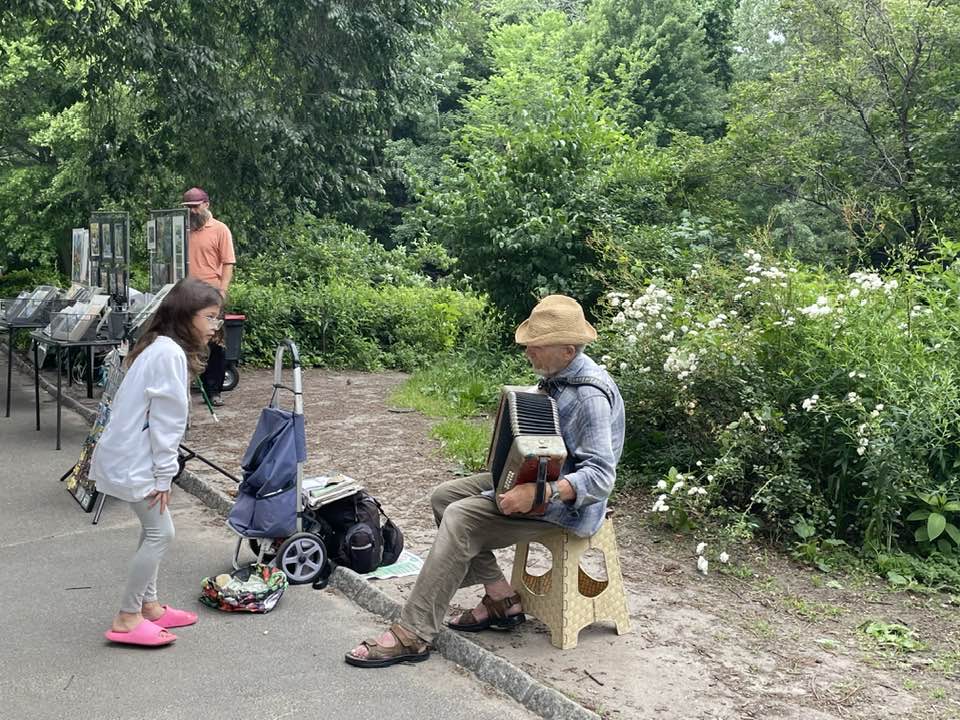
So was the people-watching. In the first place, apart from dog-walkers, nannies with their young charges, occasional self-taught street musicians, and old New Yorkers seeking refuge from the loneliness of their nearby apartments, and the intense bikers and runners among whom I once counted myself—in my imagination more than reality, as it turned out—most of the visitors one encounters in the southern third of Central Park are tourists, and most of them, in turn, judging by their shoe styles and language are from abroad.
As I lagged behind our group (to take a few photos) after a delectable lunch at Le Pain de Quotidien near the Conservatory Water I met one such couple. I was about to pass them as they stood next to several rented radio-operated model sailboats huddled and becalmed on the mid-east shore of the large pond. The couple had just asked a young Asian woman in bleached-white hair (or was it a wig?) for directions, but the latter gave a shrug of the shoulders to express her unfamiliarity with either English or the park or both. Observing this, I tapped the gentleman on the shoulder as he and his wife, I presumed, gave their fold-out map a puzzled look.
“Trying to find your way?” I asked in English, stepping away an appropriate distance.
With smiles the couple signaled their need and relief. They wanted to walk to the Ramble, farther wet, so I reached for their map, rotated it, and pointed to where we were on the map. “We’re standing here,” I said, “and over there is the statue of Hans Christian Andersen.”[3] I directed their view to the prominent bronze sculpture of the Danish story writer that our group had lingered by on our way to lunch. “The way to the Ramble is where those people over there are headed.” I pointed to the broad winding walkway leading in that direction.
The couple thanked me warmly, and being in no hurry, they graciously satisfied my curiosity about the location of their home—Vancouver, they said, adding that originally, they’d hailed from Sri Lanka.
“Canadians!” I said. “Beautiful people from an especially beautiful part of a beautiful country. And today’s cooler weather must remind you of home . . . though yesterday’s sweltering heat must’ve been reminiscent of what Sri Lanka has to offer.”
They laughed, and being in no hurry, the Sri-Lankan-Canadians seemed to invite more conversation, but just then my phone rang. I was being summoned by my group, so I bade my new acquaintances farewell.
What a place, New York, I thought, where nearly everyone is from somewhere other than the City. As I drew closer to Beth, Jenny and Illiana, I thought of The Island at the Center of the World, the intriguing book by Russ Shorto who advanced the thesis that it was the Dutch, not the English, who injected New Amsterdam—New York—with a spirit of liberalism, entrepreneurship and inclusion of all-comers, no matter of what race, creed or national origin.
A place of reliable mirth in Central Park is The Lake, where rowboats can be rented at the Boathouse. Every time we saunter by this place, we find amusement in watching all the rowers who, by their awkward struggles remind us that we’re not in Minnesota, Land of 10,000 Lakes. A notably small percentage of people on The Lake seem to know how to row a boat[4] (just as in winter a small minority of skaters at Rockefeller Center seem to have had much time on ice skates). Invariably, they face the bow and try to propel the boat by pushing, rather than pulling on the oar handles—though at least most people know that the blades need to be in the water. For us “lake people,” accustomed to rowing a boat at some point of childhood, we don’t think twice about facing the stern and pulling on the oars and reversing direction quickly by pushing on one and pulling on the other—while both blades are in the water. This time as we observed the rowers, I suggested that to a novice from arid, inland Spain or . . . that often foreign place called New Jersey . . . facing the opposite direction from the way the boat is propelled probably seems counter-intuitive. But trust me, if you want to row a boat efficiently, it doesn’t work to face the way you’re going.
In one of the open areas toward the southwest end of the park, we experienced a random encounter with a couple’s dog—part Corgi, part something else—and in the same vicinity, a family with two young daughters, one of whom, it turned out, was just turning 10, four months ahead of Illiana. The dog wanted to be friends with all three girls, and soon the four friends were playing a rigorous game of fetch, while the grownups visited for a rewarding time. Again, as we parted ways, I thought, what a place, this park, this city, this country, this world.
We closed out our walk in the park by showing Illiana Strawberry Field. We kept on walking to Citarella’s on Broadway at 75th Street, to buy fresh fish for dinner, then five blocks up on Broadway to Zabar’s, which Jenny wanted Illiana to see. From there we hiked another five blocks north before hanging right on 90th for the home stretch back to the apartment.
Our five-hour outing covered miles of New York City real estate, but our nine-year-old hiker never slowed, never complained, and always showed ample spontaneity.
Back at the apartment we drew the writer from seclusion and over dinner regaled him–and ourselves—with a cheerful recounting of our day in the park.
Subscribe to this blog and receive notifications of new posts by email.
© 2025 by Eric Nilsson


