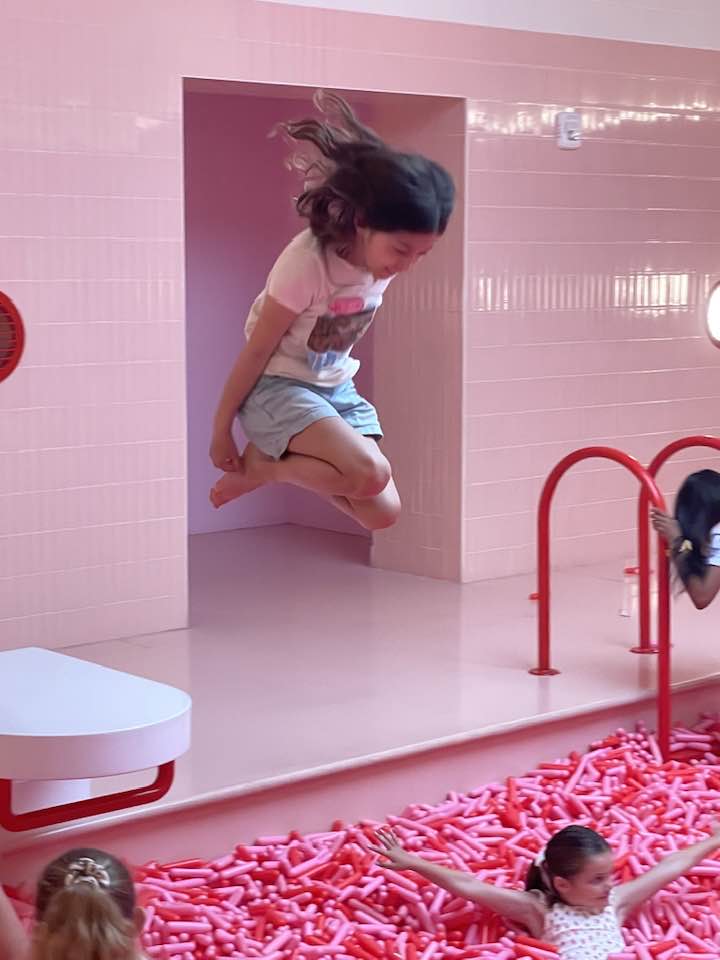
JUNE 27, 2025 – (Cont.) Our visit to the City revolved around the whims of our granddaughter, whose delightful imagination is always engaged. One of the great delights of our lives is having this unusual young person on hand. Any grandparent can readily appreciate this. When our big-hearted, ever-smiling, vivacious grandson was born—pretty much with all those traits in full force, it seemed—I was hugely relieved: I could still say to our granddaughter, “You’re my favorite granddaughter.”
To this point in our vacation we’d spent nearly all our time in “the country” of Connecticut, Cape Cod and the Berkshires. Now it was time to experience the city—as manifest in the City—and Illiana had anticipated it with great eagerness, particularly in the company of her great aunt Jenny, who is a citizen, great champion and aficionado of Gotham. Being the baby among the elders of the family, Jenny is best disposed to seeing life at kid level. This should be no surprise to anyone who knows my youngest sister. When she herself was a kid, she danced to her own music, traveled according to her own itinerary, and delighted in her own perceptions of people, the world and its infinite possibilities. We weren’t the least bit surprised when she put the Ice Cream Museum at the top of her list of suggestions.
On Wednesday morning we braved the extreme heat, already recycling off the pavement, to the subway stop two blocks down from our hosts’ apartment. At 86th Street W we ducked down underground and caught the train south to the Broadway-Lafayette stop. There we emerged and followed our guide to “the museum.”
“Founded” in 2016, the Ice Cream Museum is essentially a movie set for a what could well be a companion film to Willie Wonka’s Chocolate Factory. The ubiquitous staff of “twenty-something” people greeted us with unusual enthusiasm for a day beset by a nearly nationwide heat advisory. After encountering the 10th happy employee in our first five minutes inside the establishment, I concluded that a prerequisite for working there was at least four years of prior children’s summer camp experience. If a visitor were the least bit hot, sweaty and grumpy upon arrival at the site, they would be cured by the first sampling of ice cream.
The flavor theme of the Museum, depending on one’s perception of pink, was either strawberry or raspberry. After clearing the waiver process at the entrance, we were guided to a room in which we were each to assume a stage name of his or choice and write it out on a name tag to wear throughout the visit. Illiana was “Mochi”; Grandma became “Chocolate Sprinkle”; and Jenny called herself “Pistachio.” To throw ICE completely off my trail, I wore a forged name tag bearing the name, “Mango Mike.”
Once we were properly re-I.D.ed, we followed the modest crowd into one room after another on the two levels of the Museum. Each space was filled with lavishly conceived and amusingly constructed fantasies featuring the over-arching theme of ice cream. In every other room we were served yet another dish or cone. My personal favorite was the (pink) bagel sandwich filled with savory “everything” ice cream, which tasted like super-soft cream cheese. By my fourth ice cream cone, it occurred to me that the lengthy fine-print waiver that I’d blindly signed probably included a comprehensive clause covering hyperglycemia, the onset of diabetes, and all conditions relating to the consumption of unadulterated fat. And, I supposed, given the advent of MAHA—the downside of food coloring . . . in food.
On the other hand, when we entered the “swimming pool” room, the waiver tort liability was especially evident. This large space was designed to mimic a rec center indoor swimming facility, with (pink) tile walls and deck, hard benches for parent-observers around one corner of the large pool, which, in turn, sported two diving boards, a water slide, and several side ladders. A smaller “hot tub” under a large suspended sign, “ADULTS ONLY” was just beyond the “deep end” of the pool. Absent was the odor of chlorine: instead of water, the pool and hot tub contained a gazillion strawberry (or raspberry?) and vanilla “sprinkles” in the form of large inflated plastic capsules. Sprinkles, as we all knew, are Illiana’s favorite add-on to ice cream.
A sign on the wall announced the rules, which included removal of socks and shoes and cell phones. In anticipatory breach of the rules, they included the directive, “Turn the volume of your cell phone to LOUD.” If a cell-phone owner violated the primary rule and their phone were lost in the sea of sprinkles, the device would never be seen again if its volume weren’t turned all the way up for the inevitable “try calling it” call.
In the nick of time, Grandma yelled, “Your glasses, Illi! Give Grandma your glasses!” Time to supplement the swimming pool rules, I thought. Once the eyeglasses were safely in Grandma’s grasp, Illiana immediately took to the sprinkles—as had the rest of the kids on hand. For the next 20 minutes, we grownups were amused by the happy faces and yelling and screaming that filled the space. As is the case throughout this part of the world, the pool was a veritable United Nations; a kind of coming together place that reflects what makes America great. As I watched Illiana meet and chat with an Asian-Indian girl about the same age, I was given a measure of hope for the future. This hope was extended when a young Black kid, dressed in a red basketball uniform, stepped up to me and without a hint of reticence asked, “Are you having a fun time?”
I smiled and answered, “I sure am. Are you?” He said he was.
At one stage of our “museum tour” we wound up in a room with a timeline of the history of ice cream illustrated across one long wall. Apparently, the Chinese invented ice cream in 200 B.C.E. when they packed buffalo milk, rice, and spices into the snow to freeze. This room was also set up with small tables and chairs for games of Jenga with ice cream topics written on the wooden pieces. Because of the dimensions of the space and complete absence of sound-absorbing fabric on walls, floor or ceiling, the room amplified by a factor of 10, the shouting and screaming of two particularly large and loud families. After 30 seconds of exposure, I thought I might go temporarily insane. In desperation I snapped photos of the timeline for later reference and proceeded in haste to the next venue—a slide that whisked “young people of all ages” (to borrow a line from Mark Twain) to the last station for another round of free ice cream. I chickened out and took the elevator but rationalized that I needed to get to the outlet of the slide ahead of the queue so I could photograph Illiana as she emerged from the silver slide tube.
Left to my own devices, perhaps I would’ve chosen a true museum over the ice cream version, but in the company of a nine-year-old who loves ice cream and knows how to have fun, I had no regrets about how we’d spent the morning in the Big City.
Again, following Illiana’s wishes, we advanced to K-Town for lunch to celebrate her Korean side. The summary of our experience can be best described this way: We over-ate really well.
From Korea Town, we walked straight west on 32nd Street to Hudson Yards on the west side of Midtown. Jenny had urged us to experience “The Edge,” which is accessible from the retail floors of the complex. “The Edge” is the observation deck on the 100th floor of 30 Hudson Yards. It affords a magnificent 360-degree view of the New York metropolis, and its spaciousness renders it far superior to the outdated viewing platform atop the 102-story Empire State Building. Plus, from the east side of The Edge, the visitor obtains a wonderful view of the older signature skyscraper.
One large section of the observation deck is outside. For the not-so-faint of heart, a floor window allows a view looking straight down 1,100 feet. If Illiana was brave enough to lie down on the glass, she wasn’t gazing downward but lying on her back, looking straight up at the clouds drifting past overhead. After snapping a few pictures of this dichotomy, I ventured to the edge of The Edge to touch the two-inch (or so) glass panels that lean out from . . . the edge . . . at a nine-degree angle.
As I did so, I simulated a horrific thought and imagined sensation. What if there had been a flaw in the design, engineering, manufacturing or installation of the glass panels or their metal fittings? What if by pressing my hand against a panel it should break off, and I should fall outward from the deck, then down 1,100 feet? I imagined my thoughts in the first couple of seconds of the terrible mishap: why in the world had I seen fit to press my luck by pressing my hand against the glass?! And now, what a stupid way to go!
With that irrational thought, I nonetheless stepped back . . . just in case. I later inquired online a bit about The Edge and soon found myself deep in the weeds of a technical paper about the specifications for the glass. In an instant I formed an appreciation for the work of people who devote their professional lives to such things. And building regulations and construction inspections to keep us all safe.
At a safe distance from the edge of The Edge, I took a few photos of the panoramic views of the City and neighboring New Jersey. I couldn’t help but imagine Henry Hudson when on September 2, 1609 he first sailed up the river that would later be named after him. I wondered how the indigenous people of that time would react if they could see their island today, jammed as it is with buildings and people and filled to the brim with over four centuries of history.
Eventually we tore ourselves away from the magnificent views and took the high-speed elevator back down to earth. Once there we proceeded up to 88th street and a two-block walk to Jenny and GK’s apartment, where we “sheltered in place” from the extreme heat. Over dinner we plotted our course of action for the morrow—in one of the world’s greatest cities. (Cont.)
Subscribe to this blog and receive notifications of new posts by email.
© 2025 by Eric Nilsson
