OCTOBER 29, 2025 – Yesterday we flew to San Francisco to visit our inimitable California cousins, led by über-hosts Russ and Kerri. Three’s the charm: over the past year this is our third attempt to make the trip. The highlights of this journey will be the people—plenty of laughter; scintillating, full-spectrum conversations; delectable culinary experiences; and specially-tailored private tours of local points of interest.
Before I convey details of the highlights, however, I must remark about the flight here, since, “half the fun of destination travel is getting there.” I used to be a full subscriber to that adage—back when I was more adaptable, more flexible, less rut-bound, less ossified. It’s been too many years to count since Beth and I last traveled to San Francisco, and it’s been 30 years since I had regular work trips to L.A., which, as any traveler knows, is a completely different world from S.F[1].
To our delight, the aircraft—a brand new Boeing 737-900 series—was only half booked. For me, this was the first flight since a trip in 1981 from Cairo to Athens aboard an Olympic Air 767, on which half the seats were malfunctioning—stuck in a forward-folded position—that wasn’t fully booked. In a corresponding “first” on yesterday’s flight, our seat reservations were changed from over-the-wing to the back third of the aircraft to “balance it out.”
We took full advantage of the extra space by gloating over the fact that we luxuriated in extra space while the first class passengers appeared to be packed into their seats like oversized sardines in an economy can. We in steerage had whole rows to ourselves. Moreover, double snack and beverage handouts were made in record time.
Le piece resistance du voyage, however, was clear weather from the western fringe of the Twin Cities all the way to SFO International airport. From our cruising altitude of 36,000 feet we were treated to a panoramic view of the western United States in all its Big-Ag and geologic majesty. Several matters occupied my thoughts during the three-hours before we began our descent over the Golden State.
First was how I might react to the scenes below if I were an alien from another corner of the galaxy—or from another galaxy in the Local Cluster (of which the Milky Way is a member) altogether. In my transmissions back to Exoplanet One, I’d report that while the planet below appeared to be inhospitable and uninhabited, there did exist enormous perfectly formed and perfectly flat circles, some overlapping, which seemed to have been deliberately placed on the surface of the planet—quite probably by intelligent beings of a kind. In fact, of course, these were large irrigated croplands that were part of capital intensive agricultural enterprises. The surrounding lands looked arid and barren and reminded me of what I’ve read about depletion of the aquifers of that region of the country. I wondered how much longer these operations could continue before the aquifers run dry.
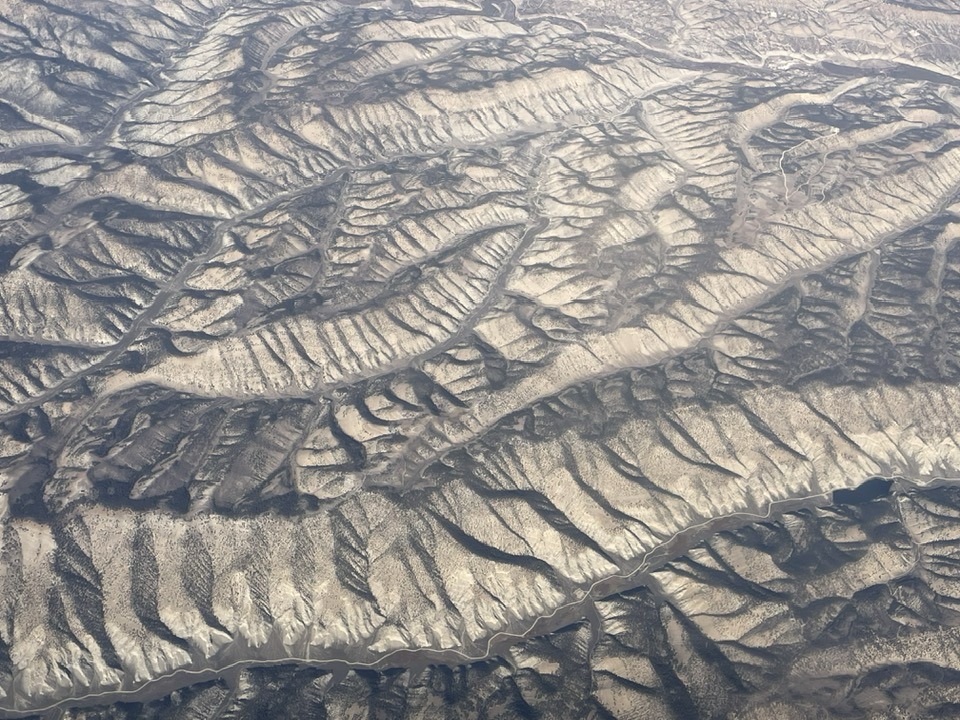
Second, farther west over Colorado, Utah and Nevada, I was mesmerized by the billions of years of exposed geologic formations that seemed to be scale models of themselves. The atmosphere was so clear, I felt as if I could reach down and run my fingers along the deep ruts of erosion that ran indelibly across the rocky surface of this lonely planet. In other places, the combination of erosion and rock strata had worked a repeating geometric motif across highlands above twisting riverbeds. The remarkable design by nature’s hand closely resembled Southwest Native art. I wondered how the Indigenous people gained enough elevation and perspective to see abstract patterns in the rock and soil of what would later fall under the suzerainty of an alien power based all the way back in Washington, D.C.
Third, somewhere in Utah, south of Salt Lake City I saw what must’ve been a data center—an isolated one-level rectangular building of extraordinary dimensions detached from all other signs of civilization except for a narrow road, like an escape route from the facility, and a large-scale solar farm positioned close to the building. How many clicks on my phone and laptop, I wondered, are routed through that place way down there? How many data centers like it exist in the United States? (Answer, I later discovered: between 4,141 and 5,425, depending on how they’re counted, but in any case, more by far than in any other country) What is the pace of their development? (Answer: the number of data centers nearly doubled between 2021 and 2025). How much energy do data centers in the U.S. consume? (Answer: in 2023, 4.4% of all electricity generated in the U.S., with an expected increase to 6.7% to 12% by 2028 (“Go wind power, go solar power!”)
Fourth, the vastly vacant lands below had a place on a map, and the map divided physical territory into arbitrarily declared “states” that had disproportionate representation in the United States Senate, and therefore, disproportionate power over 4,000 presidential appointments, including cabinet members and under-secretaries and federal judges, appellate court justices, and Supreme Court justices—essentially an entire branch of the federal government.
Finally, as we descended over the endless fruit and vegetable farms of California’s Central Valley, I was reminded how interdependent and interconnected we are: if something happens to those farms down there—blight, drought, pestilence, ICE raids—the price of produce for American consumers and maybe even availability will be affected.
As the usual “seatbelts fastened, trays in upright position, electronic devices turned off” announcement was made, I realized that I hadn’t addressed most of the work minutia I’d planned to tackle during the flight. I’d been too preoccupied with the 36,000-foot view. But that’s okay; better to deal with earth-bound matters when you’re down to earth.
Subscribe to this blog and receive notifications of new posts by email.
© 2025 by Eric Nilsson
[1]I remember one biz trip between Minneapolis and L.A. that I completed inside a single day. I caught an early morning flight, which arrived in time for a working lunch, followed by a meeting inside a well-appointed, high-falutin law office inside a high-rise office building in downtown L.A. I arrived back at the airport just in time for 6:00 flight back to the Twin Cities.
A subsequent trip relating to the same business matter involved a court appearance at the same time the jury was deliberating in the OJ Simpson case in another courtroom down the hallway at the L.A. County Courthouse. A regular media extravaganza was in process on the ground floor and outside the courthouse. After the hearing that had brought a bevy of other lawyers and me to town, we crowded into an elevator for the ride back down to the lobby. When the elevator doors opened we were greeted by over-eager reporters elbowing each other for the scoop. “What’s the verdict?” yelled one. “What can you tell us?” shouted another. “Do you have a statement?” blurted another.
I blew a supreme opportunity to make the national, even international news. I burst out laughing, overcome by the chance to pull a major prank on the world. “Ah, yes, in fact, I have lots to say,” I thought of saying. “At this time we’d like to announce that a deal has been struck between the prosecution and the team representing Mr. Simpson. In broad terms, he has agreed to amend his plea to guilty and in lieu of a prison sentence, to commit 600,000 hours of community service as directed from time to time by a commission to be appointed by the governor.”
