JULY 23, 2025 – This morning right up to noon, darkening clouds marched overhead to the command of Notus, Greek god of the south wind. The air was so laden with humidity, a heavy sweat covered the stepping stones along the pathway arching from our porch door around to the lake. Such conditions were the harbinger of stormy weather forecast to arrive by noon, and with an ear to the somber voice of the wind and an eye on the growing chop on the lake, I monitored the storm’s approach.
Before daylight was displaced by night-like conditions, Beth took a walk nearly to Spring Lake and back, because that’s what the stout-hearted do. She gauged correctly: threatening weather allowed her ample latitude for her hike and still accommodated dock time afterward. As eagles cackled in the pine towering over her vantage point, she brought out her new fancy-schmancy camera to take a pic or two, but the birds, with their famous eyes, were wary and uncooperative.
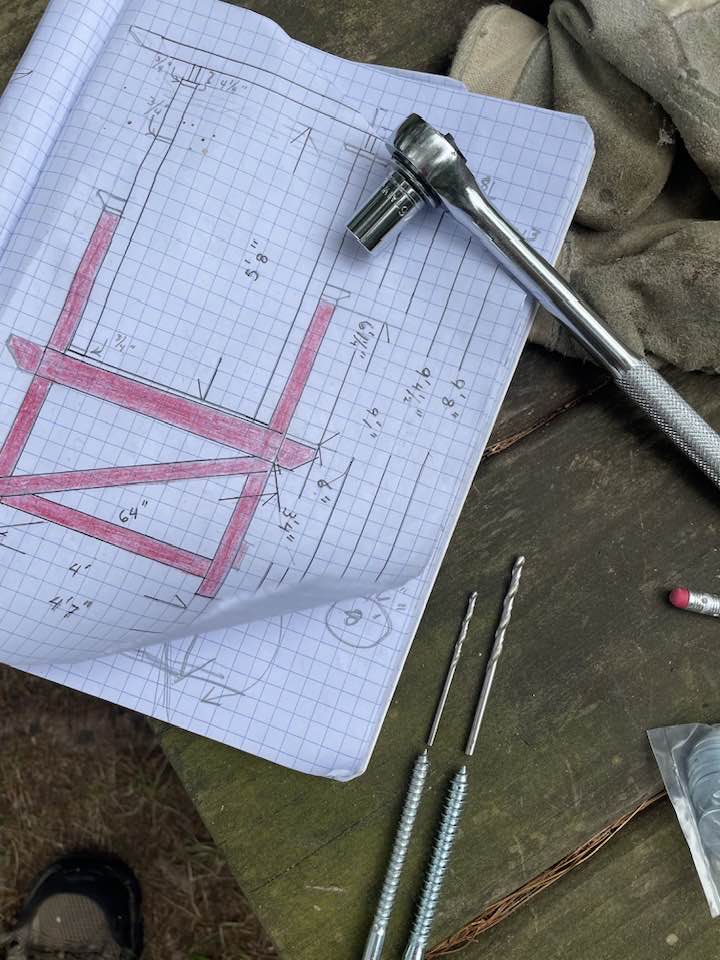
Back on shore a few feet away, I advanced to the next stage of my Pergola-on-a-Platform project—drilling holes for all the fasteners. In the moment I would’ve preferred to sit out on the dock with Beth, as if we were on the bow of a ship as it sliced into the waves and steamed against the wind. But I must adhere to a new accelerated schedule. I put my nose to the grindstone, as it were—our lake being “Grindstone.”
A real engineer would’ve known far before this stage, what size lag screws to use, what their weight-bearing limits are and their tensile strength. She’d also know what size drill bits to use for the pilot holes. I found myself taking a big time-out to catch up on these critical aspects of structure design and assembly.
So much in life comes down to math and within this beautiful discipline, numbers—and lining them up to comply with all sorts of other numbers. In building projects—modifying the staircase down to the dock at the landing, for example; construction of the main gateway into the tree garden and the monument sign (made out of logs) at another entrance; the “Little Red Shed” behind the Red Cabin; bunkbeds for our sons when they were young (from which disassembled furniture I’ve cannibalized the 4 x 4 posts for the Pergola project); and Illiana’s treehouse at the edge of the woods by the Red Cabin—in building each of these, I applied “reasonable guesswork” to fasteners and drill bit sizes. In those efforts I used lag screws almost exclusively and of various diameters and lengths depending on what I thought “looked about right.” Based on what I studied online today, my lag screw choices for all those projects were fine, but my pilot holes were nearly double the size they should’ve been.
As the wind howled through the trees and whipped the lake chop into cresting waves, I attended my self-directed flash online course on “Structural Engineering – Lag Screws 101.” The most salient things I learned were:
- A 1/4 -in. x 3 in. lag screw in softwood can bear about 200 lbs. per inch of thread extending into the wood to which the outer piece is being anchored. This spec depends on the condition of the wood and grain orientation. The proper size pilot hole (for the ¼-inch lag screw) in softwood can be drilled with a 3/32s bit—much smaller than I would’ve guessed. My plans call for 32 of these.
- A 5/16-in. x 3 in. lag screw in softwood can bear between 200 and 272 lb. subject to the same variables as described above. The correct drill bit for the pilot holes is 9/64s in diameter. Plans call for a total of eight of these.
By my rough calculations, the total load bearing capacity of the platform of the Pergola-on-a-Platform exceeds 6,000 lb.—over three tons. The gross weight of the structure itself, all in, including the eight humongous bolts I’ll use to splice the pergola posts to the platform posts, I estimate to be under 300 lb. The dimensions of the platform—4’ x [just short of] 6’ are such that no more than three large adults could fit on it at one time. Even at an average weight of 1,000 per visitor plus the weight of the structure itself, the lag screws and strength of the wood will deliver far more capacity than will ever be reasonably required.
What I find so refreshing about an engineering project is that it turns on measurable and verifiable numbers and their relationships, one to another. I remember what my “brother” Thuan had to say about this 50 years ago. Thuan and his brother Long were Vietnamese refugees that my parents sponsored in 1975[1]. Both became successful engineers. By the time Thuan was immersed in his engineering studies, I had just begun law school. One day I was describing the distinction between statutory law and case law—the latter interpreting the former and thereby creating “new” law to govern the many nuances and ambiguities that reside in our system of property and personal rights. Thuan was perplexed. He couldn’t understand why anyone would want to work in a field that was so full of incalculable variables. He contrasted it to his area of endeavor, which, he emphasized, was ruled by the rules of math.
“Boring,” I thought. But now I have quite a different view of math—and engineering. Far from “boring,” it’s beautiful; doesn’t matter who you are, what language you speak, what beliefs you adhere to . . . math is math. Because it’s universal, it’s predictable. Its proofs are the same no matter where you find yourself. Engineering is simply applied math.
When I saw the curtain of rain begin its long march across the lake, I quickly shifted to close-down mode. First I carried all my tools to safety, Next I carried onto the porch the two large braces that I’d started working on. Then I stacked the rest of the braces on the saw horses out front and covered them securely. The rain curtain swept ashore just as the porch door slapped me in the butt.
I sank into the seat cushion of one of the porch chairs and marveled at the tempest—a bit wild, a bit wooly, but not destructively so. I kicked back and enjoyed the show.
Subscribe to this blog and receive notifications of new posts by email.
© 2025 by Eric Nilsson
[1] Technically, Long was not a refugee. He was a student at Hamline University in St. Paul at the time South Vietnam fell. He’d been relying on a full scholarship funded by his government. Once that entity vanished, Long became a man without a country—and without any means of support. Thuan, a captain in the South Vietnamese Navy, escaped ahead of the North Vietnamese takeover of Saigon, and joined thousands of other Vietnamese refugees who ultimately wound up in America. My parents sponsored him and at the same time, took Long in and helped him navigate through all the red tape necessary to legalize his residency. Both brothers became U.S. Citizens and both became PhD aerospace engineers—by coincidence, following the trail that my other had blazed as an aeronautical engineer during WW II.
