FEBRUARY 6, 2026 – This morning I addressed one of the two certainties in life—the one that starts with “T”. One thing led to another, however, and soon I was off on numerous financial tangents. Two of these required busting through online security barriers. I’ve grown quite accustomed to these, but in the cases at hand, I encountered unanticipated curve balls.
In one instance, account administration had been passed on to a third party provider, with security protocols independent of the principal institution. It worked as if I had approached the teller at a brick-and-mortar bank, only to discover that the person was a mannequin posing as a ventriloquist dummy programmed to say, “If you want the time of day, go to: . . .qwerty.financial.administrative.services/qwertyfindministrativeservi/designed_to_make/you/insane . . . Good-bye!”
The only catch was that since I wasn’t totally on the ball and hammering out the “go to” web address at the speed of light, I was out of luck. Long story shorter, 30 minutes later I found my way to my account.
In another case, I had to punch in multiple phone numbers, select from a slew of menu options, and talk to perfectly cheerful merry-go-round operators who expressed scripted sympathy for my frustrations. By the time my alarm went off alerting me that it was time to drop whatever I was doing so I could go skiing, I had miraculously procured a set of statements that were inexplicably inaccessible online.
I’m still a long way from the goal line, but at least I can report progress to our financial advisor.
During the numerous wait times, I tried to stay productive instead of going insane. What kept me out of the latter lane was the echo of our 10-year-old-going-on-50 granddaughter, whose latest memorable quip before the one I’m about to recount was, “You don’t want to over-do it.” That was in response to my statement that I’d reached a critical threshold of 52 ski days so far this season. Fifty-two is a significant benchmark because it works out to skiing at least once a week over the course of a whole year, with nearly two months of potential ski days to go. But as my frustration level rose during this morning’s endeavors, what echoed in my ears was Illiana’s recent observation, “You’re the most patient person I know.”
When I heard this, I had three simultaneous reactions: 1. She doesn’t know that many people; 2. “You can fool some of the people some of the time . . .”; and 3. Now I’ve got to live up to Illiana’s impression. I take this seriously, because patience is a trait to which each of us should want our children and grandchildren to aspire and the best instruction in this regard is the example we set. In any event, during this morning’s battle with Fort Knox, I was home alone and Illiana was at school. I had a choice: I could go “haywire,” or I could take the opportunity to practice patience.
A modicum of patience is what allowed me to look out the back windows just as a squirrel, well fed by local bird feeders, was scrambling down the trunk of the maple in our backyard. As if it had noticed me watching, the squirrel stopped about six feet above the blanket of snow that still hides the ground. I marveled at the creature and how it survived through such extreme cold as we experienced in January—not to mention how it could race down a tree, thanks to little hooked claws on the back ends of its feet.
As a human of the modern age, I’ve had to adapt to endless requirements that our species has created for its survival—online “accounts” holding bits and bytes that are the equivalent of “money,” a medium of exchange used to procure actual stuff we creatures need to live. If the squirrel only knew what it takes for us to get from one day to the next! I mean, all a squirrel has to do after it’s forgotten where it hid all the acorns the previous fall, is swing its way onto a bird feeder, where a grand feast is to be had.
Recently, on my short daily drives to “Little Switzerland,” I’ve noticed at the intersection of Pascal and Idaho, half a dozen squirrel homes way up in the leafless trees along the boulevard. How those nervous critters manage to construct their arboreal homes is a great mystery. I’ve never witnessed one under construction; they simply “appear.” Today when I saw the squirrel in our backyard, I thought of the local squirrel abodes, which, in turn, reminded me of the Pilgrims and their primitive set-up after landing on the shores of Cape Cod Bay.
Currently I’m reading Mayflower, Nathaniel Philbrick’s superb book about those early American colonists. I read it some 20 years ago, but at a frenetic pace to ensure I’d finish before all the demands and distractions of those days pulled me away from the book for days, weeks, even a month or two. This time around, I’m taking great pains to locate every place name and geographic feature mentioned in the narrative. I pause at the appearance of every new character’s name to let it soak for 5 or 10 seconds in the crowded reservoirs of my memory.
In pondering the riveting account of the Pilgrims and their Native friends and enemies, I find that their struggles resemble more those of the squirrel than of us homo sapiens of today. As I compare the travails and tribulations of people living in New England in the 1620s to the challenges I face, the contrast is laughable. However insane those people might find our way of life today, I would tell them that to think they could survive a two-month voyage in unimaginably bad conditions aboard a crowded vessel across 3,000 of the raging sea, was the very definition of “out of your mind.” If the crossing was bad enough, the venture turned worse with landfall on Cape Cod, rendered desolate and all but uninhabitable, given the absence of food and early onset of one of the harshest winters the region had ever experienced.
If the memory of those early settlers is to be assigned any honor for courage, it must also carry the judgment of “Crazy!” fed as it was by a combination of unpreparedness and religious peculiarities among the “Saints” and a desire among the “Strangers” to improve their prospects in life but with near total ignorance of their new environment.[1]
In any case, I developed additional patience by imagining how the squirrel and the Pilgrims would be equally amused, as well as baffled, by my morning battle with customer portals, user names, passwords, and inaccessible online statements.
At noon I laid the need for patience aside and caught the top-of-the-hour news while suiting up for my ski outing. Displacing ICE-capades as the lead story was the report of Trump’s campaign to sow doubt about the “fairness” of the 2026 mid-terms. As my wife is fond of pointing out, Trump never suggests voter fraud in red states. Election denialism has never been anything but one big hoax. The (latest) news that should give everyone chills is Trump’s statement that he’ll accept the 2026 midterm results “if they’re honest.” This Trumpspeak is tantamount to saying he’ll do absolutely whatever is in his best interest, facts and truth be damned. Already, the November election results have come down to a Trump-style Trump-coin toss: “Heads I win; tails you lose.” This disturbing circumstance made my earlier frustration with online account access—and compensating patience—seem unworthy of mention. I pressed “off” on the remote and headed out the door into the bright sunshine.
The skiing on St. Moritz was about as splendid as it gets. Against a deep blue sky, the bright white and freshly groomed slopes were the most compelling they’d been all season. I skated up and skied down the mountain effortlessly, as if I were on the giant magical masterpiece of an Alpine Kuchenbäcker. I “owned” the place and reveled in my good fortune—like a squirrel in acorns . . . or is it, “in neighborhood bird feeders”? The holes in the hull of our ship of state; the confounding tangle of bits and bytes that govern our financial fates; the struggle not only to survive but to thrive . . . for a robust hour, I set these matters free from care.
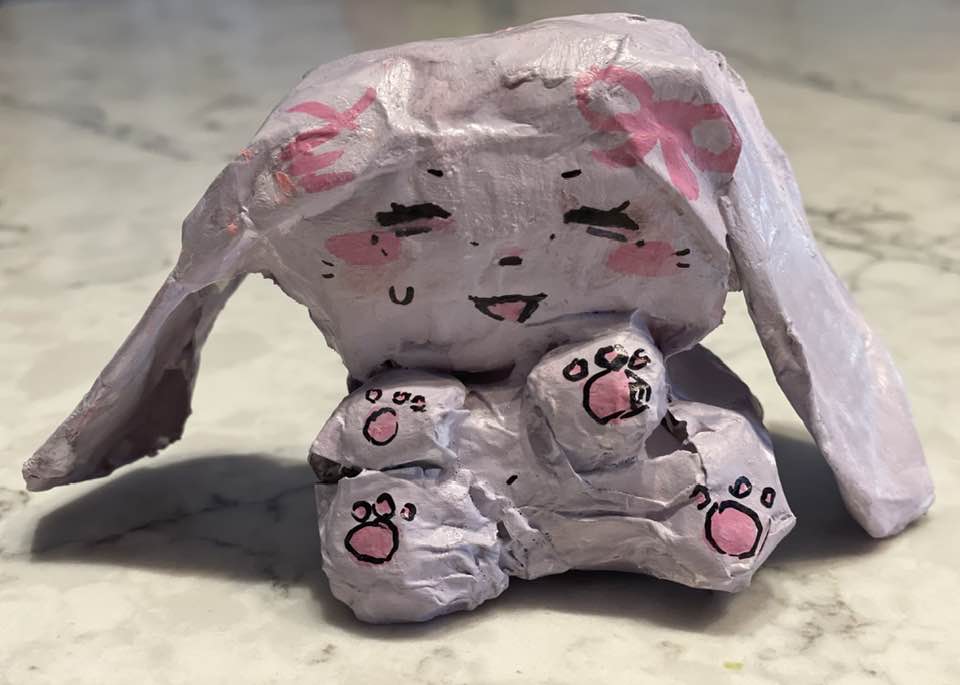
But the highlight of the day came when I picked up Illiana at school. After fastening her seatbelt but before the car queue was waved through, she showed me her creation in art class: a painted papier-mâché version of the Japanese character, “Cinnamoroll.” I was astonished by every aspect of this work and gushed with praise. “Thanks,” said Illiana. Her sweet voice told me that my compliments had meant something.
Subscribe to this blog and receive notifications of new posts by email.
© 2026 by Eric Nilsson
[1] The “Saints” were the religious set, mostly “Leideners” (from Leiden, Holland), where the Separtists (as they were called) settled when ostracized from England. The “Strangers” weren’t members of the religious sect but simply wished to start life afresh on the new continent. The whole enterprise was funded by the “Merchant Adventurers,” a group of investors based in London, hoping to turn a profit on the group’s venture. It turned out to be a financial bust, due in part to the loss of Fortune—the ironically named vessel loaded with valuable furs shipped by Plymouth Colony to the investors. Unfortunately, the ship was seized by the French just days out from its destination.
