NOVEMBER 1, 2025 – Today we awoke to yet another day of perfect weather across one of America’s signature cities. After a high-style breakfast of gourmet (Swedish) pancakes prepared and presented by Kerri, the four of us drove to the short distance to Chinatown.
Our route took us through the Tenderloin District and past a notable number of down-and-out souls in soiled clothes, standing in a food line and walking with bags and blankets—emblems, it seemed, of heavy chains and shackles attached to drugs, mental illness, abuse, misfortunes beyond control, misfortunes within some control but mismanaged, or reasons beyond discernment, if not imagination. Our fleeting view of these people drove home the point that being largely unnoticed, they become in effect non-existent—to us. Given their imponderable burdens, what are we to do and expect?
Without resolution of this question, we proceeded to Chinatown.
From my perspective, our expedition through this famous part of town felt more like a journey aboard a time machine. The faded signs, anachronisms (e.g. printing services; pager numbers listed next to phone numbers on store banners; use of the word “oriental”), dust-covered tchochkies inside shops in dire need of window cleaning, old men playing huqins and working off thick packets of yellowed sheet music, and old women talking to one another over baskets of dried fish and produce—everything and everyone looked worn, frayed, tired and old.
I wondered much about this place. Where were vendors, proprietors, shop clerks under the age of 50? And more to the point, where were signs of a more vibrant future? If under the faded peeling paint one could see 50 years in the past, what could be envisioned for the next 20? Also, in an exception to “old” and “tired,” what quarter of residents had strung up fresh Taiwanese (and American) en masse at the end of one block, and who on the next block had planted two large PRC flags—now faded—on each of the front corners of a three-story building? And who would order, finance, pack into shipping containers, and arrange to be transported, then distribute and sell all those cheap-end trinkets made in China that Chinese tourists might buy and take back to China? Or were the containers, the container ships, and the tourists all of times long past, even though the trinkets still wait to be bought off the shelves? And what’s up with the ubiquitous “family associations” that are housed in basements and second floor accommodations in decrepit buildings?
As a passing casual observer, I had no answers other than uninformed speculations, except . . . I figured it was a safe bet that Chinatown, as opposed to “China” or “the Chinese” would not be the fountain of future international trade, breakthrough technologies, or cultural wonder. Most telling, when it was time for lunch, we didn’t trust our luck in Chinatown without the assurance of any outside recommendations. We wound up descending to the far more vibrant Italian North Beach, where we settled on Tony’s Pizza, a hugely popular place where the sidewalk-side table sloped three degrees in one direction and two in its perpendicular plane—reminiscent of the famous tower, perhaps, or simply a metaphor for the history of what we now call Italy; where the house salad was the size of a mansion and the Little Kahuna pizza was plenty big when served at a slant.
“Slant” is a geometric attribute that defines the visitor’s experience in San Francisco. You can’t travel far without ascending or descending, often at a severe angle, and in neighborhoods where the signs direct you to “Park at 90 degrees,” you learn to see the world with a whole new slant, as if you’ve been transported to another planet featuring a mutation in the laws of physics. Its effect is rather amusing once your eyes—aided by a compensating shift in the fluid inside your inner ear—recalibrate “level.”
Following lunch, our hosts—whose enthusiasm and civic pride has transformed them into honorary emissaries for this fair city—led us to the Tunnel Tops inside the Presidio. There we mingled with the crowd representing the full circle of ages. Contentment with life, at least then and there, was palpable, and directly observable human interaction gave the lie—however fleeting in our ephemeral dimension—to warnings of isolation by digital captivity and the dehumanized dystopian commands of AI, much of which, ironically, has been unleashed from the state of California.
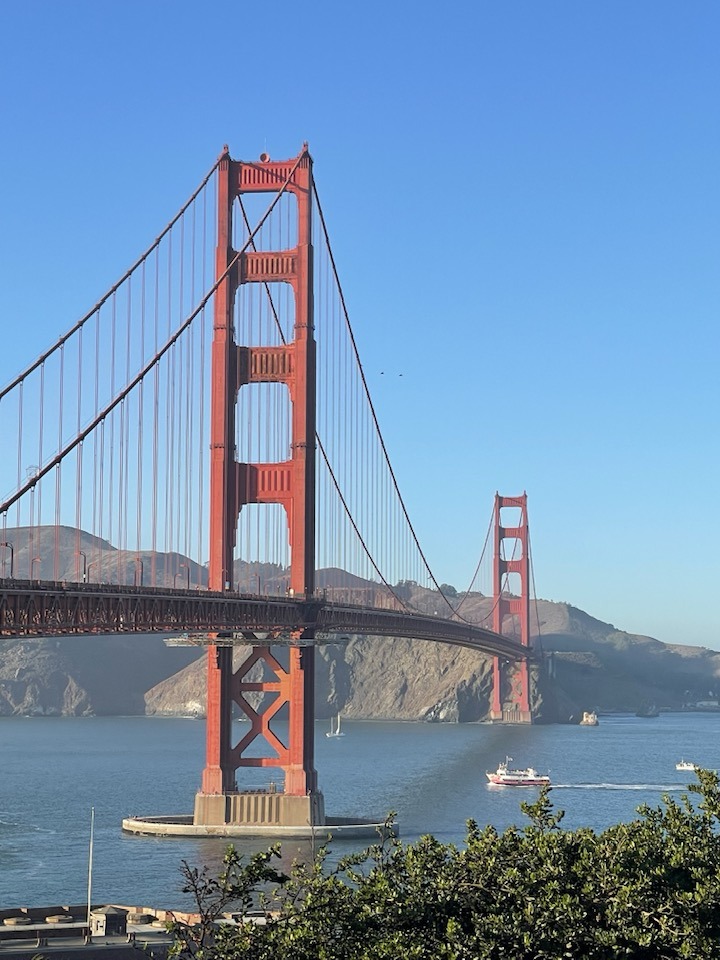
While admiring the signature views of San Francisco Bay, we indulged in generous portions of genuine sorbet and soft-serve ice cream acquired from a genuinely cheerful human being working out of an old but plucky food truck. We then strolled back to the car and proceeded a bit farther to the Golden Gate Bridge Viewing Center.
There we went to school on the history and engineering of one of the world’s most recognizable landmarks, completed in May 1937 after nearly four years in the making. The political, financial, and engineering wonder of the Golden Gate Bridge should again, just as yesterday’s story of the SF cable cars, inspire us all in these times of national self-doubt. If we worry about the bolts, the ropes, the carabiners by which we cling to the untoward slant our country has taken, we should take faith in the imagination, fortitude, and achievements of our forebears. The Bridge is a perfect example of human conquest of gravity, the elements, the unknowns, and what many were convinced was impossible. As flabbergasted as I was by the cable cars, today as I tore myself away from “class” about the Golden Gate Bridge, I said to myself, “Cable cars, schmable schmars, THIS, The Bridge, is a ride to the moon!”
Yet, I thought, how we all take such a thing for granted—the bridge, as well as the ride to the moon—just as we’ve taken our whole country for granted. But the bridge was engineered to “last forever,” provided, it turned out, that it’s properly maintained, year in, year out. Likewise, so does our democracy need to be inspected, maintained, painted, parts replaced, supports buttressed—vigilantly with care for the future.
With that as the highlight of the day’s personalized tour, we descended upon the abode of our host’s older son’s family. The center of attention for us all was the youngest on hand—a bright-eyed infant not quite five months old. In her eyes and cries, her kicks and smiles, were to be found the same hope and inspiration that we saw in the construction of the Golden Gate Bridge: a marvel, a wonder; a convincing affirmation of life on earth, and who knows, what just might be the only life in the whole cosmic shebang.
At least that’s the slant I’ve adopted now that I’ve gotten a feel for Slant Francisco—and renewed my faith in the full potential of our country.
Subscribe to this blog and receive notifications of new posts by email.
© 2025 by Eric Nilsson
