DECEMBER 12, 2025 – Life lately has been a blur of images—as is often the case during a period featured by the absence of “dull moments.” But when you feel the train wheels bouncing off the tracks, you stay with the train. You trust that gravity, die Bahn, der Zug, and a pinch of good fortune will work in concert to cause your carriage to land squarely back down on the shiny ribbons of steel. After this occurs once, twice, four times in quick succession, you develop confidence in a dual possibility: A. You might have boarded the wrong train; but B. You live a charmed life.
The salient lesson to be drawn from the trip, however, is that whatever control you thought you had over your itinerary in life, the reality is that the free-wheeling train dispatcher gets to “throw the switch” at every juncture.
The catch in all this is that you have to . . . roll with it. In a reasonably well-ordered society—at least for those of us growing up within a broad band of felicitous parameters—we’re afforded considerable input in identifying our desired destinations. Moreover, we’re able to procure tickets aboard well-oiled carriages linked to other smooth riding cars pulled by powerful locomotives down well-maintained tracks. But none of the luxuries aboard the train or appealing scenes outside the first class club car windows guarantees that we’ll enjoy the ride or reach our goals.
Yet, at the center of this image, the idea of life as a train trip with unexpected bumps and “thrown switches,” lies the essence of travel: the journey itself, not the destination, whether one of fate or design.
I remember my first trip abroad, in 1979 with my sister Jenny. We had certain destinations in mind—Luxembourg; our ancestral home in Småland, Sweden; Stockholm; Oslo and Bergen, Norway; Salzburg, Austria; Interlaken in the Bernese Oberland of Switzerland. In Sweden our cousins were our guides. For the rest of the trip, we relied on Frommer, Fodor, and a Eurail map. After Switzerland, Jenny flew home, and I pushed on—to Italy, Greece, France, back to Sweden, then Luxembourg, and a stopover in Iceland on the way back to New York.
My photos captured many landmarks, but the highlights of the trip were conversations, encounters, impressions, experiences that transcended the work of a compulsive photographer. The first of these, I remember, was a conversation with a man in his late 60s aboard the train from Koblenz to København (Copenhagen), via a ferry between Puttgarden, BRD (Bundesrepublik Deutschland – West Germany) and Rødby, Denmark. He was Eric Carle, a professional photographer from New York; an amiable, sophisticated, and positively delightful travel companion with whom we established a longtime friendship. Ironically, I don’t remember seeing him take a single photograph. I do remember having lunch with him much later back in New York and exchanging Christmas cards with him and his wife—until he faded into the inescapable folds of time and age. To this day I find myself striving to emulate his infectious good cheer and ready smile.
That trip was filled with many other memorable encounters, each expanding my horizons. The one that endures most vibrantly to this day was with Pavel Šebesta, then a bright gregarious medical student from Praha (Prague), Czechoslovakia, now a family man, heart surgeon, world traveler, philosopher, and artiste-photographer of the highest standard . . . from the Czech Republic.[1]
And yes, I remember the full moon rise over the Jungfrau as Jenny and I ate supper at a sidewalk restaurant in Interlaken near our pensione. We had a view for which Eric Carle would surely have given his fine tweed jacket to have captured. I’d wanted to take a shot of it with my new Canon, but I’d left the camera back at the pensione. I was about to run back for it, when Jenny said, “No. Don’t. The magic of the fleeting scene will be gone by the time you return. You must just soak it up with your memory. Think of it as something special that no one else we know will ever see. Just the two of us here and now.” She was right. If I could draw or paint, I could transfer to paper or canvas what is as vivid in my mind today as it was on that occasion 46 years ago.
So it was and so is life today, filled with landmarks—and benchmarks—to be sure, but more important, marked by a meaningful chain of encounters, not merely a blur of images.
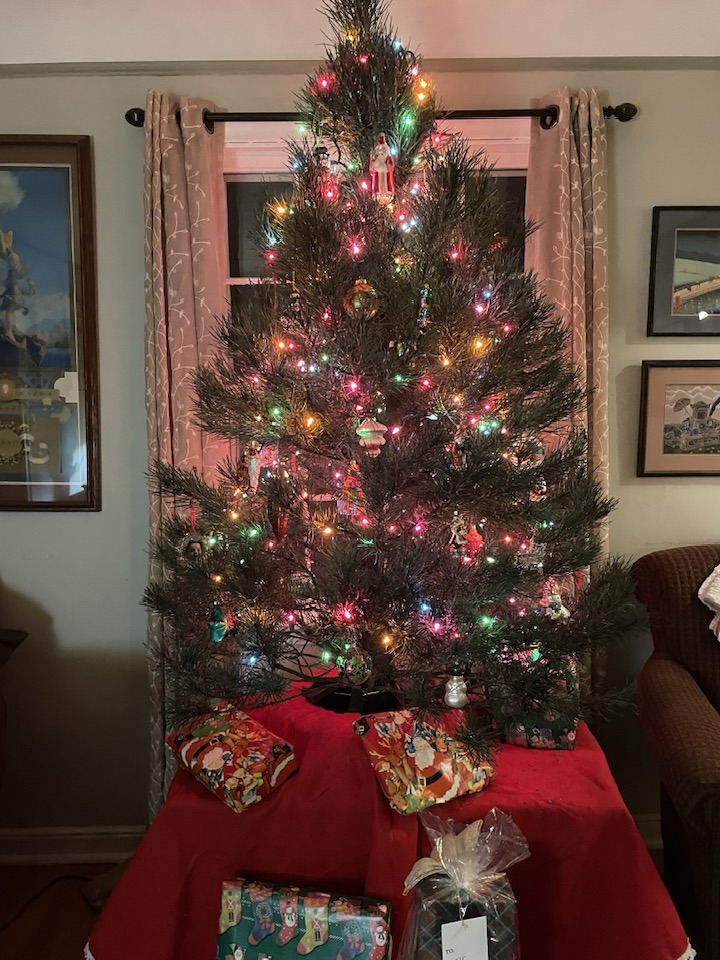
I was reminded of this when this evening the matter of the tree stand arose yet again. Cory had stopped by to pick up Illiana, whom I’d retrieved from school earlier in the afternoon. He mentioned that he wanted to buy a live tree and put it up for Illiana at their house. He was surprised when I informed him of the tree stand shortage—and the potential cost if he were lucky enough to locate a “BMW” or “Mercedes” version.
“But your old tree stand . . .” he said, “. . . the one Mom was trying to get out of the attic when she fell—it’s still up there, right?”
Before I could stop him, he was in the garage, standing on the next-to-the-top step of a step ladder in the garage!
“Get off that!” I shouted. “Now!”
He ignored me. Worse, he put one foot on the top of the ladder as he pushed up on the cover to the opening into the attic. In his favor, he wasn’t using the tall unsteady aluminum ladder that had nearly killed Beth; instead, he’d grabbed a shorter, sturdy, commercial-grade fiberglass step ladder that had been abandoned several years ago (despite our repeated calls) by an electrical contractor. Holding up the attic opening cover with one arm, he used the other to shine his iPhone light into the black space. As if in amusing imitation of the “Star in the East,” the iPhone revealed the presence of the (previously) elusive tree stand—within easy reach for an athlete six-feet tall with long arms.
Seconds later, man and tree stand were safely down.
At critical times in my relative youth, that’s how I lived, how I thought. I shined an eager, confident light into the unknown, determined to find my objective. And just as Cory did now, I usually found it; I found the figurative “tree stand,” the “destination.” But as I watched him fold the ladder and return it to its proper storage place, I reflected on my many journeys—some arduous and circuitous; some littered with detritus across the tracks or over railbeds in need of repair; others slick and straight. As memories merge into a more definitive line, I realized, the point of life is not what the locomotive’s powerful beam illuminates, as the heavy engine thunders into the night. The point of life is what’s aboard the carriages—the people met, the dinners served, the conversations had, the books read, the stories told, the lessons learned, the beauty beheld . . . in aggregate, the grand rewards of the journey.
Let the history books define and describe our destinations. Let us here and now be vested in living as we experience our journeys.
Subscribe to this blog and receive notifications of new posts by email.
© 2025 by Eric Nilsson
[1] We still correspond regularly. Pavel has been featured many posts here over the years; see in particular the early 2022 series, The Grand Odyssey.
