MARCH 1, 2026 – By all appearances, we’re well into the post-democracy phase of American history. On the surface, this can be quite discomforting, especially for us who’ve been convinced that the sky has been falling since January 20 of last year. But from a broader perspective, the current crisis, if you will, is not some kind of anomalous detour from a straight and narrow path of justice, equality, liberty, freedom, the pursuit of happiness, yada-yada-yada. We’ve long lived under an impressive overlay of myths about who were, who we are and to what we could attribute our felicitous (as the case may be) circumstances as Americans.
For the past decade, I’ve been plodding up and down a twisting, turning trail through the dark jungle of history. I began my journey with the goal of learning more about the jungle so that I could better understand its influences on more familiar ground downstream. I wasn’t prepared, however, for the troubling questions my innocent hike would raise. Now deep into that jungle, I am overwhelmed by the truths revealed, leading with the staggering depth of my own ignorance.
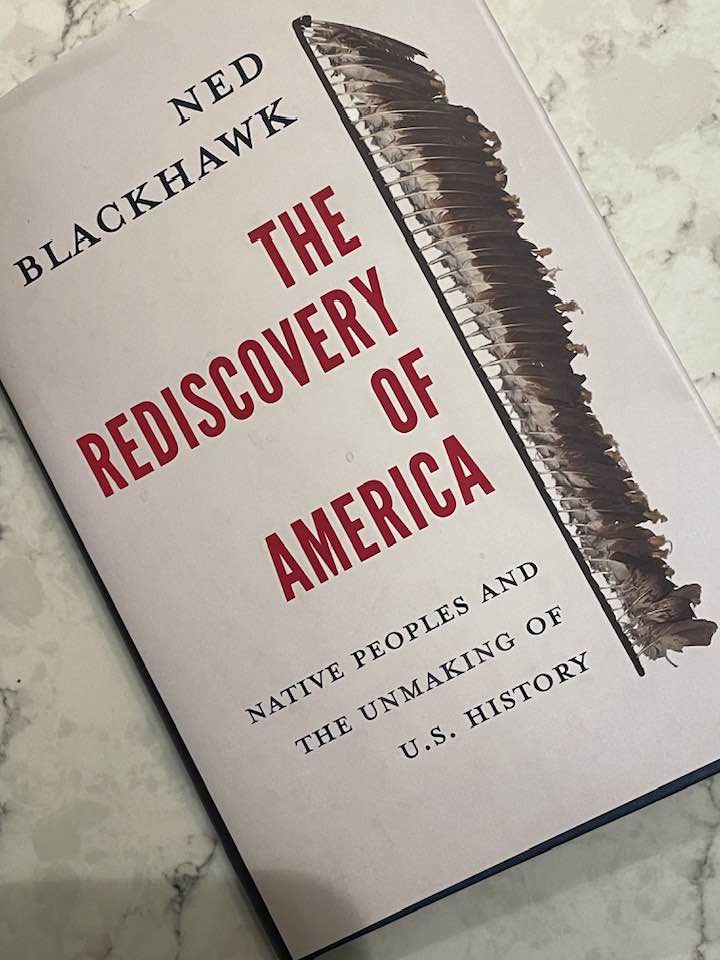
My latest venture is along the trail of The Rediscovery of America – Native Peoples and the Unmaking of U.S. History by Ned Blackhawk (2023 Yale University Press), a recent gift from a close friend with whom I’d worked very closely back in our corporate trust days at Norwest/Wells Fargo. This 450-page (with 100 pages of notes) jungle guide is a remarkable piece of scholarship and synthesis; a work to be read carefully, attentively, thoughtfully, and above all, meaningfully, however long it takes. I’m only 60 pages into it, and already I know I will not be the same person by the time I emerge from the end of this amazing book.
A college friend of mine has been on a similar trek ever since our undergraduate days. He is a real scholar, who has ventured far deeper and higher into the historical jungle and for much longer than I. His reflections gave me little confidence in my own capacity as an “explorer” with what you might call daunted courage.
In a conversation not long ago, we were discussing how much of our respective attempts to fill in the gaps of our formal education “back in the day” have revealed a central truth: If we’re brutally honest, we need to take everything from the “gospel” of our curriculum and culture and turn it on its head. Only then will we perceive things as they should be. A geographer’s equivalent would be to turn all the familiar schoolhouse maps of the world upside down (leaving all the labels and place names “right-side up”).[1]
Where I now find myself is in quite a different frame of mind from where I was before this journey. I question not only the gap between the current state of our country and its ideals, but the ideals themselves, as we’ve so long perceived them. In short, I’ve learned to question the social, economic and political underpinnings of the whole ball of wax we call “our system,” our culture, our country. What I fear is that in truth, all the injustice, inequality, etc. that endure in our country are not mere aberrations to be addressed (or happily dismissed, depending on your political disposition), but the immutable legacy of history’s long reach. That history, of course, is inextricably tied to lucre in a system dependent on exploitation of the many by the few.
The challenge I now face is to temper the disturbing psychological effect that ensues from seeing everything “upside down.” After all, I myself am a product of the system. By luck of the draw, I didn’t have to invite or fight my way in. I’ve prospered under it and my accumulated interests are far too vested in it for me to drop out and join a Buddhist monastery (for example). But I can’t stop there; I can’t stop with the convenient excuse that I’m too old to “do anything about it.” What duty do I have beyond knowing a few central truths about the past? What do I do about them? What can I do about them? These questions will hound me as I continue my wanderings through the jungle.
What I need, I think, is a guide, a mentor, an advisor, a counselor, perhaps most of all, a therapist; someone who’s both inside and outside “the system,” who knows it from all angles, and has explored the jungle of the past extensively; a student of history, to be sure, who can help me in my current struggle to find my way after seeing matters . . . upside down.
Subscribe to this blog and receive notifications of new posts by email.
© 2026 by Eric Nilsson
[1] When I was in Australia, I encountered maps that depicted the world upside down from our northern perspective. The main effect of this orientation was to put Australia “up and over,” as opposed to “down under.” In Europe, I noticed, Europe and Africa occupied the center of Mercator projections vs. off to the right, with the Americas in the center, as is the case on most maps published in the U.S.
