MARCH 15, 2026 – (Cont.) Think and say what you will about Harry S. Truman, but he was a George Washington next to what now passes for a president. Although I have yet to read David McCullough’s definitive biography of Truman, I know enough about our 33rd president to shape a reasonably well-informed opinion of the guy. The docudrama Hiroshima provides an accurate portrait of him and his circumstances, providing sufficient information, I believe, to reflect objectively on his monumental decision to drop not one but two atomic bombs on . . . members of the human race.
I was struck by several aspects of the film, starting with casting[1]. Kenneth Welsh, the prolific Canadian actor who portrayed the president, bears such a likeness to Truman himself, that the viewer is sometimes fooled or confused between Welsh in dramatization sequences and Truman in actual historic film footage. Not only is the physiognomy of the actor almost identical to the historic figure he portrays, but Welsh’s emulative gait, gestures and voice modulations reflect remarkable talent and study. Likewise, Ken Jenkins (Scrubs), as Secretary of State (and former Congressman, Senator (SC) and Supreme Court Justice) James Byrnes; Robert Wesley Addy as Secretary of War Henry Stimson; Jeffrey DeMunn (The Shawshank Redemption) as Dr. J. Robert Oppenheimer; Canadian actor/director Saul Rubinek, as Leo Szilard (Hungarian immigrant to the U.S. and Einstein protégé), draftsman of the “Szilard Petition” opposing use of the bomb; Richard Masur, as Major General Leslie E. Groves (military head of the Manhattan Project); Naohiko Umewaka, as Emperor Hirohito; Tatsuo Matsumura, as Prime Minister Kontarō Suzuki; and Kohji Takashi, as Minister of War Korechika Anami.
I was most impressed by the film’s treatment of Harry himself. Upon learning of FDR’s death, the former haberdasher from Missouri feels the weight of 10 worlds on his shoulders. Marginalized by his larger-than-life predecessor, Truman begins his presidency with very low self-esteem. He has to be corrected when he refers to FDR as “the president.” One person who had complete faith in him, however, was his wife Bessie, who, by the way, was the more cultivated and sophisticated of the couple. This spousal support turns out to be critical in Truman’s remarkably quick adaptation to his new and powerful role.
What’s portrayed especially well—without overemphasis—is Truman’s genuineness, coupled with his directness. He was wholly guileless.
The essence of the other characters—Byrnes, Stimson, Groves, the scientists, especially—and their interactions with the president was also projected superbly. The viewer is made to feel present in the midst of the many debates and discussions among the key players in the drama. Moreover, the American perspective is balanced quite well, I thought, by the portrayal of members of the Japanese government and military establishment.
The film version of “the story” captures what a written account can’t quite equal in the portrayal of emotionally charged debates among the players. In voice, demeanor and substance, the script and delivery were convincing.
The fact that Hiroshima was produced by Canadians and Japanese, not Americans, gives the docudrama an added measure of credibility. It stirs the viewer to engage in further study of the Japanese side of the war, as well as what preceded and what followed the conflict, from Imperial designs hatched after Japan’s stunning victory in the Russo-Japanese War of 1904-05; Japan’s treatment under the Treaty of Versailles in 1919; the country’s rearmament in the 1930s; the perceived divinity of the Emperor—and leverage of the same by the war hawks; the extreme atrocities committed by the Japanese military; the strife within the government after inevitable defeat became apparent (to the realists, anyway); the post-war prosecution of war crimes; MacArthur’s military administration after the war; Japan’s miraculous economic recovery.
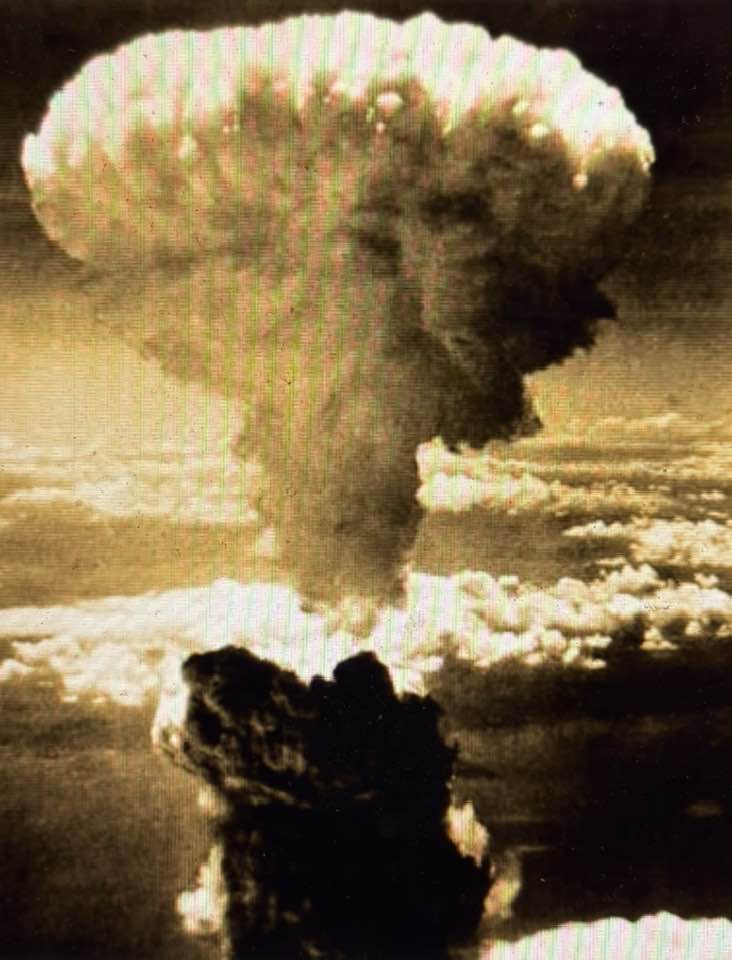
Hiroshima is a perfect springboard for “second guessing” the use of atomic weapons against Japan. Given the proliferation and exponential expansion of nuclear weapons since Hiroshima and Nagasaki, we owe it to the memory of all victims to revisit the decision to drop “Big Boy” and “Little Boy” from the bomb bay. If there’s a moral imperative atop the mushroom clouds, it’s as certain and simple as “Thou shall not kill.” What complicates the imperative, however, is that the war ended with the horrific bombs that produced those clouds; the conflagration didn’t start with them. You could say that the most cataclysmic war in history started way back when a club in the hand of homo sapiens smacked the skull of homo neanderthalensis. We’ve been on a war-mongering tear ever since.
Having read the survivors’ stories in John Hersey’s book, Hiroshima, and being aware of nuclear proliferation since August 1945, I must say that my sympathies lie with the 70 petitioning scientists (led by Szilard) who were so horrified by the Frankenstein they’d created, they wanted to slay the monster before it was too late. But by that time, it was already too late, thanks ironically to the inevitable work and discoveries by an international cadre of physicists. Before the collapse of Nazi Germany four months earlier, German scientists had been hard at work developing an atomic weapon; not long after the end of WW II, Soviets launched their own effort to make an A-bomb. They crossed the threshold in 1949. Today, seven other countries have nuclear arsenals: the UK (1952, France (1960), China (1964), Israel (1967), India (1974), Pakistan (1998), North Korea (2006). In short, if Truman had nixed the outcome of the Manhattan Project (he knew nothing about it until after he was inaugurated following the death of FDR), the atomic cat would’ve soon been let out of the bag anyway.
Nevertheless, the fact that the U.S. wouldn’t retain a monopoly on nuclear weaponry doesn’t absolve the Americans from their use of the bomb, any more than the first school shooter to pull the trigger on an AR-15 is morally off the hook once copycats get their hands on AR-15s for the purpose of terrorizing other schools. The analogy breaks down, of course, over the fact that Japan, the ferocious aggressor and eight-year-long Empire of Atrocities, refused to surrender. It was not irrational for American leaders to assume that absent deployment of the “Gadget,” as the A-bomb was labeled colloquially, they would have to launch an invasion of the home islands at a horrendous cost in American and Japanese lives. If Truman bears ultimate moral responsibility for dropping atomic bombs on Hiroshima and Nagasaki—so far, the only two nuclear weapons unleashed in war—are we to let the Japanese militarists off the hook? It seems that they shared the moral burden at least by half.
Not so fast, some would argue. The 50-50 split of moral responsibility might have worked, but a significant ulterior motive behind the bombs was to send Stalin a message: there’s a limit to your post-war expansionist ideas. That consideration certainly played a role in the decision to bomb Japan, thus complicating the moral analysis.
However we might second guess Truman’s fateful decision in August 1945, revisiting his choices should forever be a worthy case of “moral calisthenics.” Studying Hiroshima—the book and the docudrama—are highly useful guides in optimizing the exercise.
Subscribe to this blog and receive notifications of new posts by email.
© 2026 by Eric Nilsson
[1] The actor portraying General George C. Marshall, the U.S. Army Chief of Staff at the outset of the Truman Administration, didn’t look or sound anything like the highly revered real life character. As it turns out, however, in the docudrama, Marshall plays little more than a cameo appearance.
