SEPTEMBER 26, 2025 – Sorry, Minnesota, Ramsey County and St. Paul: I used to shop at the Midway Menards store near our house. During the week I’d load up on supplies and materials for DYI projects at the Red Cabin and on weekends, ferry them up to the Northwoods. But recently I noticed I’d been paying a combined sales tax of 9.87%.
I have no problem paying taxes. They’re the adhesive that enables society to enjoy common benefits—you know, infrastructure, an educated public, various critical and desirable services that we take for granted, and keeping the marginalized completely out of the gutter so that we don’t pay much higher costs down the road, if, for example, we rely on homeless shelters and hospital emergency rooms to pull people out of the gutter because we didn’t want to pay to keep them out of Rocky Bottom in the first place. Yet despite my altruistic leanings, a sales tax of close to 10% on my project addiction triggered the cash management side of my brain.
I didn’t have to look far for a more favorable alternative: the Menards store in St. Croix Falls, Wisconsin, just off the highway on my route to the Red Cabin. The total sales tax on the exact same supplies and materials available at the Midway Menards is only 5.5% at the St. Croix Falls store. That’s nearly a 45% delta—a four and a half bucks difference on every $100 of expenditure; money I can use to . . . pay for . . . other junk, such as junk food.
In any event, I now patronize the St. Croix Falls store exclusively, and thus, my home state, home county, and hometown (more or less) miss out on . . . $9.87 of revenue for every $100 of paint, lumber and fasteners I buy at Menards. Welcome to the Disunited States of America.
I know we’re talkin’ small change here, though I have noticed that one of my super-rich clients got to be super-rich partly because he habitually rubbed his coinage together—especially when it came to my fees. But that’s another whole story. The most noteworthy aspect of my shopping now at the St. Croix Falls store instead of the Midway St. Paul Menards is the difference in clientele between the two outlets.
The Midway store is surrounded by communities of color, many of them recent immigrants. I’m guessing that they made up close to half the patrons I observed at Midway. They appeared industrious, and I liked watching the energy and purpose with which they searched for construction wares. Occasionally I’d engage them in conversation, and I admired their chutzpah, their work ethic, and their hopes and dreams.
The crowd at St. Croix Falls is quite different. Since I’ve been shopping there regularly, I have yet to see a single person who isn’t white. Also, whereas the parking lot back at the Midway store was crowded with a hodge-podge of vehicles, including many smaller automobiles, tired old panel vans and small trucks in need of TLC, the St. Croix Falls lot looks like ground zero for a late model extended cab pickup rally. Their front ends stand so tall, I’d need a step ladder to check the oil or refill the windshield washer reservoir. And I’d definitely be holding our 10-year-old granddaughter’s hand, which I do anyway any time we walk from our car and across the parking lot at the grocery store.
Moreover, the St. Croix Falls patrons tend to wear their politics on their sleeves—or more precisely, on the fronts and backs of their T-shirts, on their baseball caps and on the back windows of their oversized pickup trucks. “Faith, Family, and Freedom” is a favorite—front and back on T-shirts. I get the faith and family parts, but I’m curious what response I’d receive if I asked a wearer, “So, sir, if I may interrupt your day just for a moment, what exactly does the word ‘freedom’ mean?”
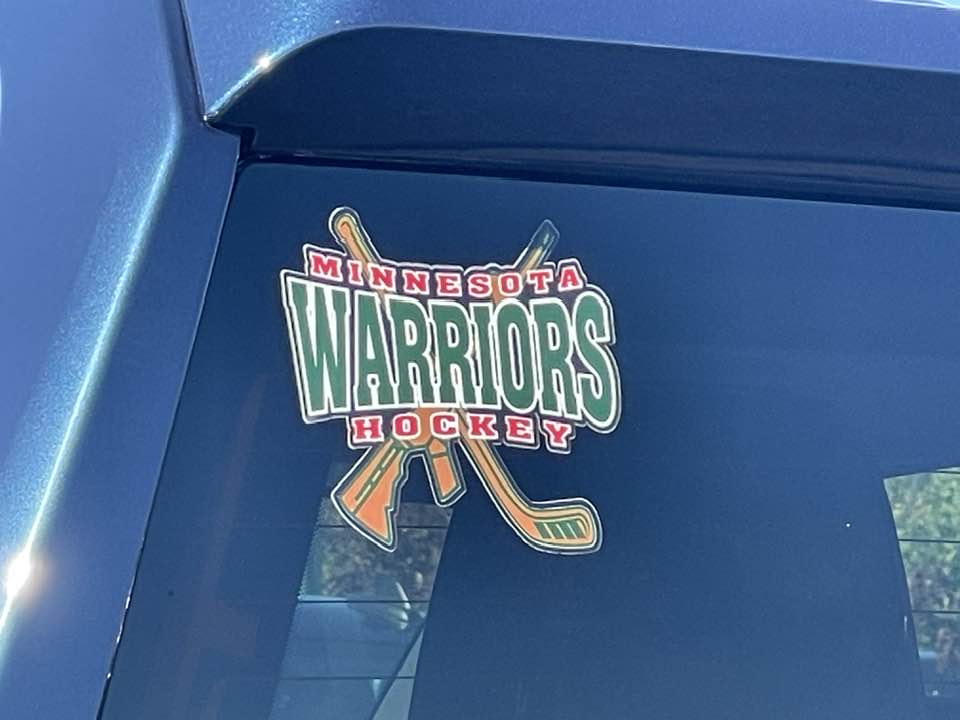
It’s a question worth asking every American. Freedom from what and to do what? We’d be surprised, I think, by the conflicts among our responses. For example, I might say that for my family and me, “‘Freedom’ (would mean) freedom from the fear of living in a country where firearms outnumber the population.” But the next guy—especially the one who climbed down out of the pickup next to me; I’ll explain in a moment—might say, “‘Freedom’ means living in a country with no restrictions on buying and owning an automatic rifle.” I say that guy “might,” but the probability would actually be high: on the back window of his pickup was a sticker for the Minnesota Warriors Hockey. It consisted of those words plastered over the crossed images of an AR-15 and a hockey stick. I wasn’t sure if it was the logo of a militia group’s hockey team or of a hockey team’s militia group. In either case, “Warrior” told me they’re “fighters,” not necessarily “peacemakers.”
Another popular slogan floating around the St. Croix Falls store is, “These Colors Don’t Run.” I’m pretty sure the people with that on their T-shirts—along with the image of the American flag—have some military connection in their family. I’d be curious what their take is on the president’s bone spur deferment, not to mention what their reaction to a bit of ancient history would be: the president’s malignment of the former POW and Republican senator and presidential candidate, John McCain.
The most ubiquitous symbol, however, on clothing, tailgates, back windows, service trucks, and mailboxes up and down the countryside, is Old Glory, big and small, front and back, this way and that, red-white-and-blue as well as black and black with a single blue stripe. I’m not sure of the origins of this flag fetish and what it purports to reflect. “Super Patriotism”? But what, in turn, is that, exactly? “My country right or wrong”? One-party nationalism that brooks no dissent, no criticism (despite the intent of the First Amendment to encourage just that in an effort to foster constructive change), and segues to fascism?
In short, I’m confident in saying that the St. Croix Falls crowd is “very Trumpy.” This is backed up by voting data: in 2024, Trump won 58.8% of the vote against Harris at 39.5%.
As the reader knows, I despise Trump. So how do I feel being in the political minority among those folks at the St. Croix Falls store? Honestly, I’m sure I could find something to talk about with darned near everyone I might encounter there. At a minimum I could talk “projects,” tools, lumber. I’m sure I could learn a lot about construction. Would I become friends with any? Possibly, but I’d likely find more in common with folks in less Trumpy settings.
After loading my car with additional lumber for the Pergola-on-a-Platform project, I thought more about those very-Trumper-like people at Menards—and across the country. If the chaos that their man has wrought since January isn’t enough to turn their minds, then little else can or will. As my sister Jenny said over the phone to me today, “You can’t get people to do what they don’t want to do.” I’d supplement that with, “You can’t get people to believe something different from what they want to believe.”
This evening I listened to a series of clips on FoxNews bashing and belittling Democrats as only the president and his supporters know how to do. I was convinced of nothing that alters my belief that politically, Americans have irreconcilable differences. Where all this will lead, no one knows, but I’m unnerved by what Beth reported from a conversation she had with an elderly couple earlier this week in Ireland. They said they can’t see how America will avoid a civil war, and they’re terribly concerned about it.
“Civil war”? That sounds overly dramatic and extreme, but it gave me pause that an Irish couple who’ve seen much in their long lives would have that view. What I worry about more is that with a few narrow exceptions defined mostly by wealth and power, we are well on our way to becoming a marginalized nation, at least against the measure of our historical record and thus our potential—before January 20.
Personally, and for many of the aging Baby Boomers shuffling across the Menards parking lot today on their way to and from their super-sized pickup trucks, the most immediate manifestations of our national decline will be in health care. In my own medical “expedition” over the past three years, my most critical healthcare providers have been immigrants. Moreover, I’ve been given hope that cutting edge research—in America—could well lead to additional effective treatment, perhaps even a cure, of my disease. But this week I received a publication from the University of Minnesota foundation for cancer research that included an alarm: the drastic cuts in government funding have disrupted critical research. The week before a highly educated client/friend of mine from Pakistan, whose wife—also from Pakistan—is a family physician, mentioned a troubling consequence of the chaos since January 20. He reported that the high-potential scientists and engineers he knows from Pakistan, who were bound for the United States are now looking elsewhere, most particularly, Australia. “They’re afraid to come to the U.S.,” he said. “There’s too much uncertainly, too much chaos.”
We’ll know the ship is in trouble when high-potential scientists and engineers who are already here decide to leave.
Somehow, I don’t think the Trumpers worry about any of this. If they did, they wouldn’t be Trumpers.
Subscribe to this blog and receive notifications of new posts by email.
© 2025 by Eric Nilsson
