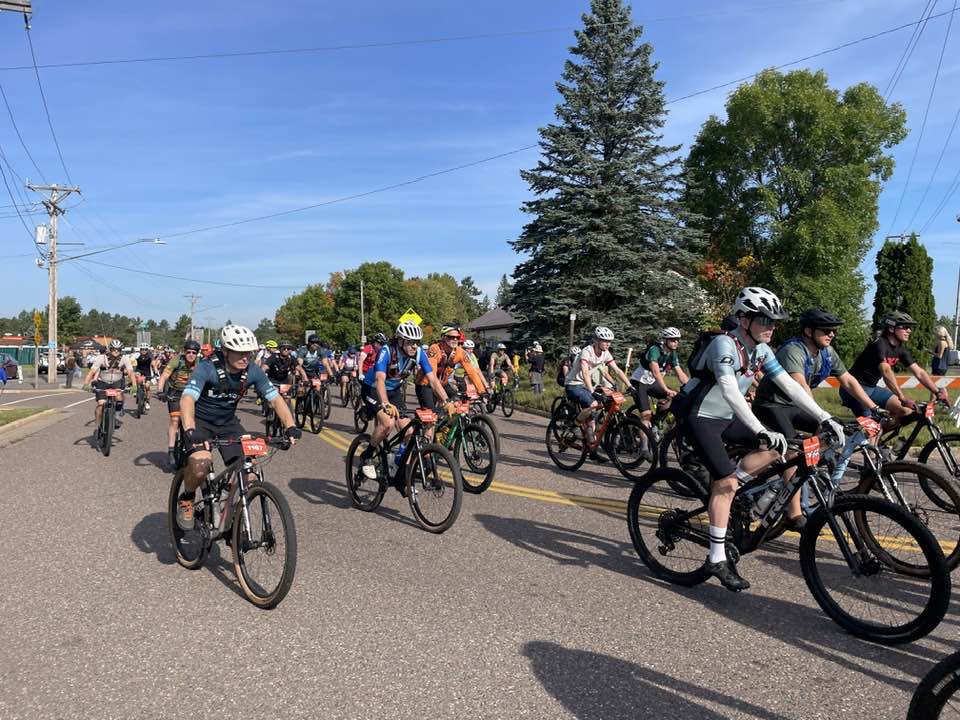
SEPTEMBER 13, 2025 – Today I was an observer at the Chequamegon 40, the mountain trail bike race I mentioned in yesterday’s post. The experience brought back many pleasant memories that kept at bay all current woes of the world.
In the first place, the race reminded me closely of the American Birkebeiner Ski Race, which I’d skied eight times. The “Birkie” and the “Chequamegon” are held largely on the same course, though in opposite directions. Second, the biker crowd overlaps substantially with the skier crowd. Third, everyone involved—racers, spectators (predominantly family and friends of the racers), vendors, and volunteers—is laser-focused on the event, and in aggregate, that focus produces an amazing spectacle, proof that when a few thousand people put their best feet forward, humanity can achieve something worth writing home about.
The start of the race was in Hayward, and where we (my two Red Cabin guests, Paul A. and Paul M.—ski instructors by winter; mountain trail bike racers by the rest of the year—and I) parked in the municipal lot behind the Frandsen Bank on the main drag, I could see diagonally across from the bank, the building that still houses the “Law Offices” where I worked for Tom Duffy during the summer of ’79.
Tom and his wife, Carol, were avid x-c skiers and just getting into marathon running, and it was about that time that Tom joined forces with Tony Wise, founding father of the American Birkebeiner, to establish the “World Loppet,” a series of some 10 international marathon x-c ski races around the world. As I recall, Tom was one of two or three other Haywardians that I’d gotten to know well that summer, who were the first in the world to complete all 10 World Loppet races.
Two blocks from the parking lot are several large-scale murals featuring the portraits of prominent citizens of Hayward since its founding. Among them is Tony Wise, the serial entrepreneur with grand visions and a talent for talking people out of their money but less talent for running enterprises at a profit. Nevertheless, it was his vision that formed the foundation for the Birkebeiner, which, in turn, led to the World Loppet and established the springboard for the Chequamegon 40.
The start of today’s race was in front of the Armory on the north edge of town. I accompanied the two Paul’s to their respective wave sections and waited for the start time of 10:00. After wishing Paul A. well, I walked with Paul M. to his wave. With four minutes left before take-off, Paul M. suggested that I should move quickly down Iowa Ave. (main street) to get a better view of the start. I wished him success, adding, “Remember, the main thing is to have fun out there,” then assumed an uber-brisk pace to find a suitable vantage point to shoot some photos. I still had 100 meters to go when the announcer’s voice boomed over the P.A. system informing us that it was time for the national anthem. Carrying the music through to the crowd remotely were the Hayward High School Band and Choir. When they started up—with surprisingly good intonation, I must add—the crowd went silent, and I accelerated my pace.
I soon realized that I was at complete odds with everyone on hand: they all were facing the flag in front of the Armory, which was behind me, which meant I was walking against everyone: while they were standing still, hands and hats over the heart, I was huffing along as if seriously late for class. This contrarian movement made me uncomfortable, and I soon found myself wrestling against it. I suspected that the crowd was largely MAGA, since Hayward itself is in the heart of MAGA country (among the sons of my old friend and mentor, Tom Duffy, Sr., is Sean Duffy, Secretary of Transportation in the Trump Administration). Many spectators and volunteers were from Hayward, which meant the likelihood was high that most were MAGA. I imagined their disapproval of me in much the same way that devout church congregants would frown on someone taking a phone call during the pastor’s homily. But all the people I saw had a hand or cap on the heart, and I doubted that 100% of the people were MAGA. This latter assumption further aggravated my feeling of disrespect.
After a few more paces, I stopped, turned around to face the flag and covered my heart with my bright blue “Grindstone Lake” visor cap. I’ll be honest—I’ve never liked our national anthem. Its pitch range makes it difficult to sing, and the lyrics glorify bombs and war in the tired old American theme of machoism. But until we come up with something better, the “Star-Spangled Banner” remains our official national anthem, and most people accept it as such. As I waited for the band and choir to deliver the last phrases, I wondered what was coursing through the minds of the people around me: How many Republicans in the crowd were thinking of the “Christian martyrdom” of the guy who was shot in Utah? How many Democrats were pondering the tension between their opposition to political violence and the provocative and immoderate speech of guy murdered in Utah?
But I felt certain of one thing: given how these events roll (so to speak), the people assembled were too focused on the race to exchange ideas or reactions to the most recent instance of gun violence in America.
My position beside the race course no more than 200 feet from the starting line afforded me a chance to see the dramatic start of the competition. I clicked away on my camera, and knowing that Paul M. would be coming down on my side, I kept a close eye out for him. He finally came along, whereupon I called out to him. He answered and flashed a big smile, which I captured on several photos.
Once the entire pack had passed me, I repaired to the parking lot and drove back to the Red Cabin. After 90 minutes of leisurely work on the staircases to the “Pergola-on-a-Platform,” I left the lake again, this time for the finish line at the site of the former Telemark Lodge and ski area—downhill and x-c. In its glory days 40 years ago, the complex drew lots of people, but it faced two major problems that it could never overcome. First, the “Mount” part of “Mt. Telemark” was actually quite puny from the standpoint of downhill skiers. I remember skiing there 10 or 12 times, and lo and behold, it simply never got any higher. Ten turns and a l-o-n-g flat stretch, followed by four more turns and you’d skied the entire vertical height of “the mountain.” Second, as a x-c ski center, Telemark had much more suitable terrain, but the problem was that unlike their downhill counterparts, x-c skiers weren’t big spenders. Nothing that a successive line of owners tried could keep the place afloat.
Then arrived the sad day when insurance premiums and other carrying costs on the main lodge were too high to keep the place standing. It was razed except for the poured concrete stairwells, which are all that remain. They look eerie—a strange monument to the imploded vision of Tony Wise.
After parking among hundreds of vehicles north of the bike race finish area, I walked among the crowd to look for my friends to finish. Paul A. came in at a tad over three and a half hours. I managed to capture his photo just as he crossed under the large finish line banner and time clock. Paul M. followed an hour later.
I’ve not been on a bike in 10 years, and as I accompanied the two Pauls back to the car, I learned that the world of competitive biking is now thousands of miles ahead of where it was when I left off. I couldn’t suppress my total surprise upon learning that gear-shifting on the higher-end bikes, such as Paul A’s, is electronic and can be calibrated down to the tiniest increments. This revelation reminded me of the enormous advances in x-c ski technology from the time I started, 57 years ago—from all-wood skis to complex composites; from bamboo poles (with leather straps) at minimal cost to uber-light, sophisticated fibre poles with grips to render the poles an extension of your arms, at a cost of hundreds of dollars.
As I reflected on the day’s event, I felt as if I were a time traveler from the past, bowled over by the technologies of the future. To recover my bearings, back at the Red Cabin/Björnholm I led my skier/biker friends on a hike through the woods, where photosynthesis occurs the old-fashion way, just as it has for numberless generations.
For me, the race day’s reward was simply watching and remembering, all with the knowledge that because I hadn’t ridden a mountain bike up and down 40 miles of relentless hills, I wouldn’t be at all sore the next day. Yet, through the efforts of my friends and their post-race stories, I was able to enjoy the race vicariously on a gorgeous late-summer day.
Subscribe to this blog and receive notifications of new posts by email.
© 2025 by Eric Nilsson
