OCTOBER 30, 2025 – The first highlight of our trip to San Francisco, of course, was our happy reunion with Russ and Kerri. Our connection ties back to common ancestors of Russ and me: Emma and August Svensson, our great grandparents.
After introducing us to their quarters (between September and November)—and ours for the next week—in the Petrero Hill District of the West Coast’s version of Boston, our hosts introduced us to our second highlight: a trip on Waymo to the Ferry Terminal. For Beth and me, it was our first ride in a driverless car. I gave the experience an enthusiastic “thumbs up.”
Our third highlight was the ferry ride on placid waters across the bay past Alcatraz to Sausalito—for a delectable and leisurely lunch on the water’s edge. A post-meal stroll took us back to the ferry for the return trip to San Francisco. By dinner time we were at the Chase Center for crowd watching ahead of a Warriors game. In the thick of pre-game excitement we treated ourselves to a long conversation over a light meal before returning to our quarters for the night.
Thus concluded our first day in SF.
For our second day, we conducted what for me was a special arboreal pilgrimage to Muir Woods National Monument in Marin County, just 11 miles north of the Golden Gate Bridge. This was our (Beth and I) first visit in 13 years to this enclave of giant redwoods on land donated to the public and declared a national monument by President Theodore Roosevelt in January 1908. The unusual preserve now draws a million visitors a year.
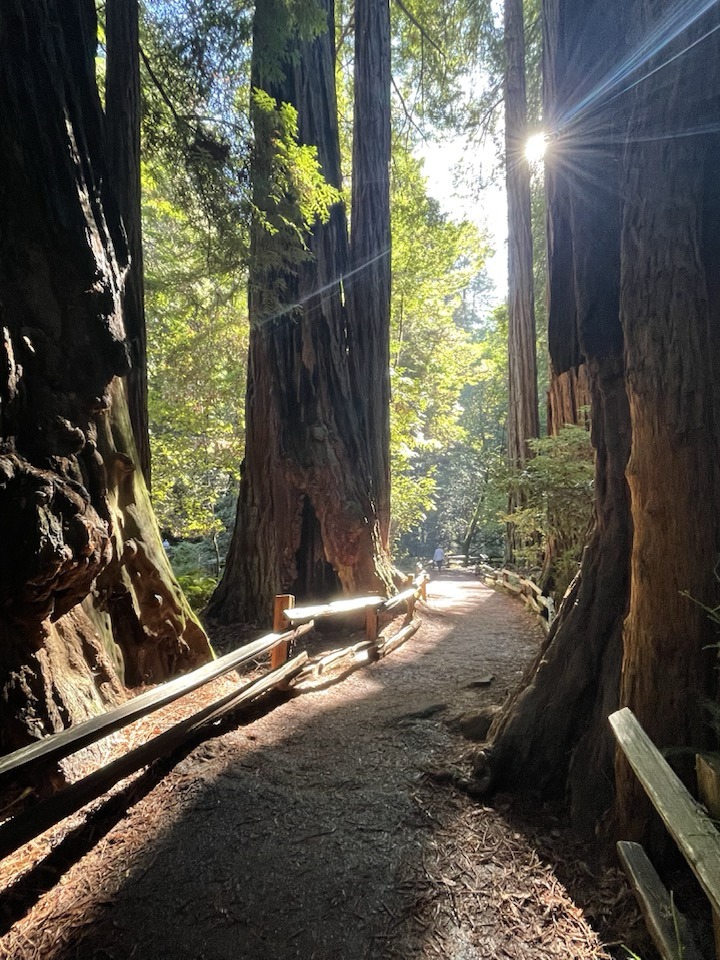
Of all the wonders I’ve seen in the world, none tops the sequoia sempervirens, or “coast redwoods” along the northern coast of California, including those in Muir Woods. Everything about them—their extraordinary height (up to 379 feet) and girth (up to 22 feet at chest height); their longevity (up to 2,000 years); their overwhelming majesty; the intoxicating scent of their bark, needles, and wood; the rugged character of their foot-thick bark; the inner qualities of their heartwood; their personalities, for goodness sake—renders the redwoods spiritually powerful.
As we started along the Redwood Creek Trail, I felt as though we were passing through the narthex of a grand cathedral of world renown. A few steps more and we entered the nave, and there we stopped, awed by the dimensions of the trees and the cavernous space between our awestruck eyes peering upward and the canopy above starting more than 100 feet up the trunks of the first set of redwoods. By the same influence of stained glass and chiseled stone in the cathedral, Creation’s greatest arboreal achievements induced silent reverence in us and the visitors around us.
I’m not a religious person in the respect I don’t follow or subscribe to organized religion; nor am I a “believer,” though for reasons I’ve explained in posts here over the years, I’m no militant atheist. I even find it somewhat ironic, if not downright oxymoronic, to describe myself as a “committed agnostic.” But I have no need for labels, so I won’t waste energy attempting to define them, at least as they might be applied to me.
However . . . what I experienced among those redwoods was nothing short of the same feeling that I imagine highly religious people have when they “speak to God” or “God speaks to them.” I found my pace slowing to that of a pilgrim walking up the center aisle of the great cathedral, my senses overwhelmed by the largest living creatures on the face of the planet.[1] The farther we proceeded up the aisle, the more slowly I walked, passing so closely that I stopped moving my feet altogether and rested my hand on the bark of a redwood—then another and another. Each time I repeated my worshipful gestures: craning my neck to see the canopy above; examining the direction of the bark, which often twisted up the entire trunk of the tree; knocking on it to hear its resonant voice; whispering to the tree my supreme gratitude for its existence, for its age, beauty and wisdom.
I know enough about trees and people to know that no two of either are exactly alike. As I surveyed many of the numberless redwoods in Muir Woods, I saw each had its own characteristics, though redwoods reproduce by sprouts as well as by cone seeds. If two or more redwoods growing side by side might be essentially clones of each other, their outer appearances are distinguishable, just as certain features of my left hand—skin marks, veins visible under the skin, order of fingers—are different from those of my right hand. This observation reminded me of President Reagan’s infamously dismissive remark about redwoods, “If you’ve seen one, you’ve seen ‘em all.” Ironically, that statement was strong evidence that Reagan had probably never seen a single redwood.
Even when observed at a slow, worshipful pace, the natural cathedral of Muir Woods was longer, wider, higher, and more wondrous than any of the many humankind wonders I’ve seen in the world. Moreover, the occasion of our visit coincided with still and sunny weather conditions. I looked straight up as much as I looked at the walls and floor of this remarkable forest. Here and there the sun filtered through the thicket of branches high overhead, but never did I see as much as a twig or needle stir. It was as though the gods of Olympus had stopped not only the air currents over this small corner of the earth but over the entire earth; as if they’d halted the earth’s rotation, even, and the motions of our sister planets, and quite possibly, the inexorable rotation of the entire galaxy. I felt as if by some divine intervention, time and motion had been suspended to optimize our brief time in paradise.
At the end of what for me was a religious experience, I was not the same person that I’d been at the start. I doubt very much that any human who communes with those trees isn’t fundamentally changed by the encounter. Thus was the highlight of Day Two of our San Francisco sojourn.
Subscribe to this blog and receive notifications of new posts by email.
© 2025 by Eric Nilsson
[1] Excluding such phenomena as coral reefs, for example, underground fungal mats, and vast acreage covered by poplar “trees,” all sprouting from the same plant.
