OCTOBER 9, 2025 –
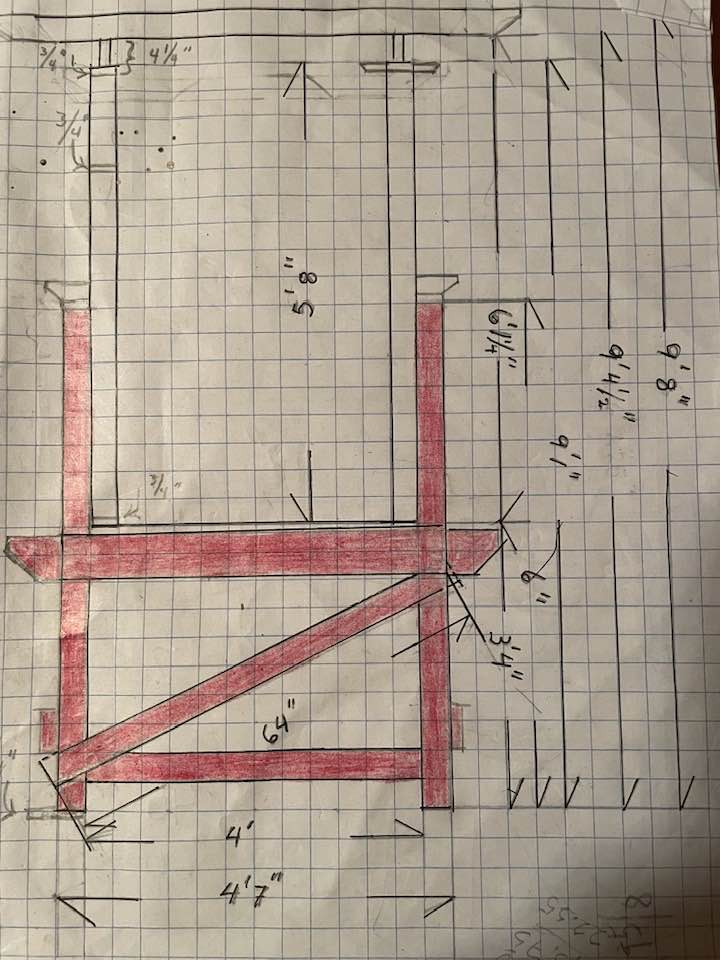
Yesterday and today I continued work on the Pergola-on-a-Platform project and made considerable headway. The second railing on the front of the structure is now mostly in place. I should be able to complete it (the railing, not the structure) before I leave the Northwoods tomorrow for a few days.
The project prompted several conversations about the nature of “perfection”—especially its most salient feature: elusiveness. It all started when my sister Elsa visited the construction site and chatted while I finished the first railing system on the front “Grand Staircase.” She and her husband Chuck have been at Björnholm for the past several days. As we talked about the project, I mentioned the many challenges of identifying, then rectifying—or covering up—mistakes. This naturally reminded us of studying the violin and the ever-present gap between reality and perfection. We concluded that perfection is above all an ideal, a standard, not necessarily a “goal” per se.
Ever since we were kids, I’ve always perceived Elsa as a perfectionist on the violin, but of course, no violinist has ever lived who is an “absolute perfectionist” all the time. In the first place, playing a musical instrument of any kind—in fact, any artistic endeavor—necessarily involves a considerable subjectivity, given the many technical nuances of art and music, not to mention varieties of artistic and musical tastes. At a base level, for example, is the first movement of Chopin’s Concerto No. 1 in E Minor taken at 126 bpm (Chopin’s marking) “more perfect” than a tempo of 116—with lots of rubato throughout the movement? Is Van Gogh’s Starry Night “less perfect” than Rembrandt’s Lucretia? Moreover, a pursuit as complex as classical music contains as many components as there are leaves and needles in the woods. Not every single note—and its connection with the ones on either side of it—can be perfect, any more than every single leaf or needle, can be wholly blemish-free. But as we both recalled Dad saying, “An imperfection here and there might not matter much, but the cumulative effect of multiple imperfections can affect the overall impression that a performance makes.”
We agreed, however, that “perfection” connoting an ideal and a standard is critical to every musician’s striving or for that matter, every person’s efforts in any pursuit or discipline. No matter what a person’s level of proficiency or artistry, the person must have some notion of how “the very best” rendition of a piece sounds. Once that reference point is established, the musician can set goals and mark progress. Without familiarity, at least, with high standards, how can anyone achieve anything worth doing?
Yet, in striving for “perfection,” one risks discouragement and worse—dropping out of contention altogether—if one doesn’t understand the full nature of perfection; that is, fails to grasp that by almost by definition, full perfection in all places and circumstances is unattainable.
Again, our memory of Dad—our model of a “perfectionist”—was invoked. I recalled the time when I was constructing my science fair project in fifth grade. I was cutting out letters for my captions and saw that they weren’t “perfect” despite repetitive efforts. Discouraged, I gave up, retreated to my bedroom and slammed the door. Dad came upstairs to help restore my equilibrium. He told me not to get so hung up on perfection as to give up on myself. He then cited imperfections in his own projects—an acknowledgment that surprised me, since I didn’t think he was capable of doing anything that wasn’t perfect.
“If you don’t believe me,” he said, “go in the girls’[1] room and inspect the bookcase in there. If you look closely, you can see several mistakes I made in building that—and out of fine walnut, too. The joinery on the left side doesn’t line up with the joinery on the right side. At first I was a little upset with myself, but you know, as time went on, I forgot all about those mistakes, and so did everyone else—if they ever even noticed. And the bookcase works just fine; looks just fine.”
Months into my pergola project, I’ve made plenty of mistakes. Some I corrected, some I hid, some I ignored. But in each case I tried to learn and avoid making the same mistakes twice. Nevertheless, I’ve always held in mind a high standard—as depicted in my scale drawings. I know how the ideal would appear; how the perfect Pergola-on-a-Platform would grace the chosen site, and through the tedious process, I always keep that image in mind, even if the reality reflects something short of “perfection.”
Later yesterday I had an hour-long phone conversation with our oldest sister, Kristina. “Perfection” was again a topic of conversation, and she made observations similar to what Elsa had expressed up at the pergola site.
This theme continued this morning in conversation with Elsa and Chuck at Björnholm. I trekked over to say good-bye as they prepared for their return trip to the Twin Cities. We talked about striving for high standards in the music world, and I heard anecdotes from the realm of violin pedagogy—teachers who demanded the equivalent of 20,000 free-throws while blind-folded. Elsa mentioned a well-known taskmaster who would have his students study all 24 Paganini Caprices, which are the triple-black diamond runs of the violin repertoire. “He made his students learn every single one of them and for two reasons: One, to tamp down a big ego, and two, to perfect technique—not at performance tempo, just half speed, but still, you had to learn them.”
“Maybe, I guess, not so that you could play the Paganini Caprices perfectly,” I said, “but so you could master the Bach A Minor.”[2]
By the time I resumed work on the pergola project today, I’d gained new insights into “perfection”—and my relationship with it. My conversations yesterday and today helped frame my perspective and see how to strike a balance between the “ideal” and the limitations of my abilities. As it turns out, my quirky months-long construction project is teaching me all sorts of things about life.
Subscribe to this blog and receive notifications of new posts by email.
© 2025 by Eric Nilsson
[1] Our parents and grandparents referred to my three sisters and me as “the girls and Eric and Jenny.” “The girls” were understood to be the two oldest sisters, Kristina and Elsa.
[2] The implication was that if a person can play all 24 Caprices (however slowly), that person would be able to play the Bach “perfectly.” Technically, the Bach a minor concerto is a “student-level” piece, whereas the Paganini Caprices and his six concerti are “über” expert material. Unless a conservatory student is well on the way to a solo career, even attempting to play Paganini’s works can be as dangerous as riding a motorcycle backwards while standing on one’s head.
