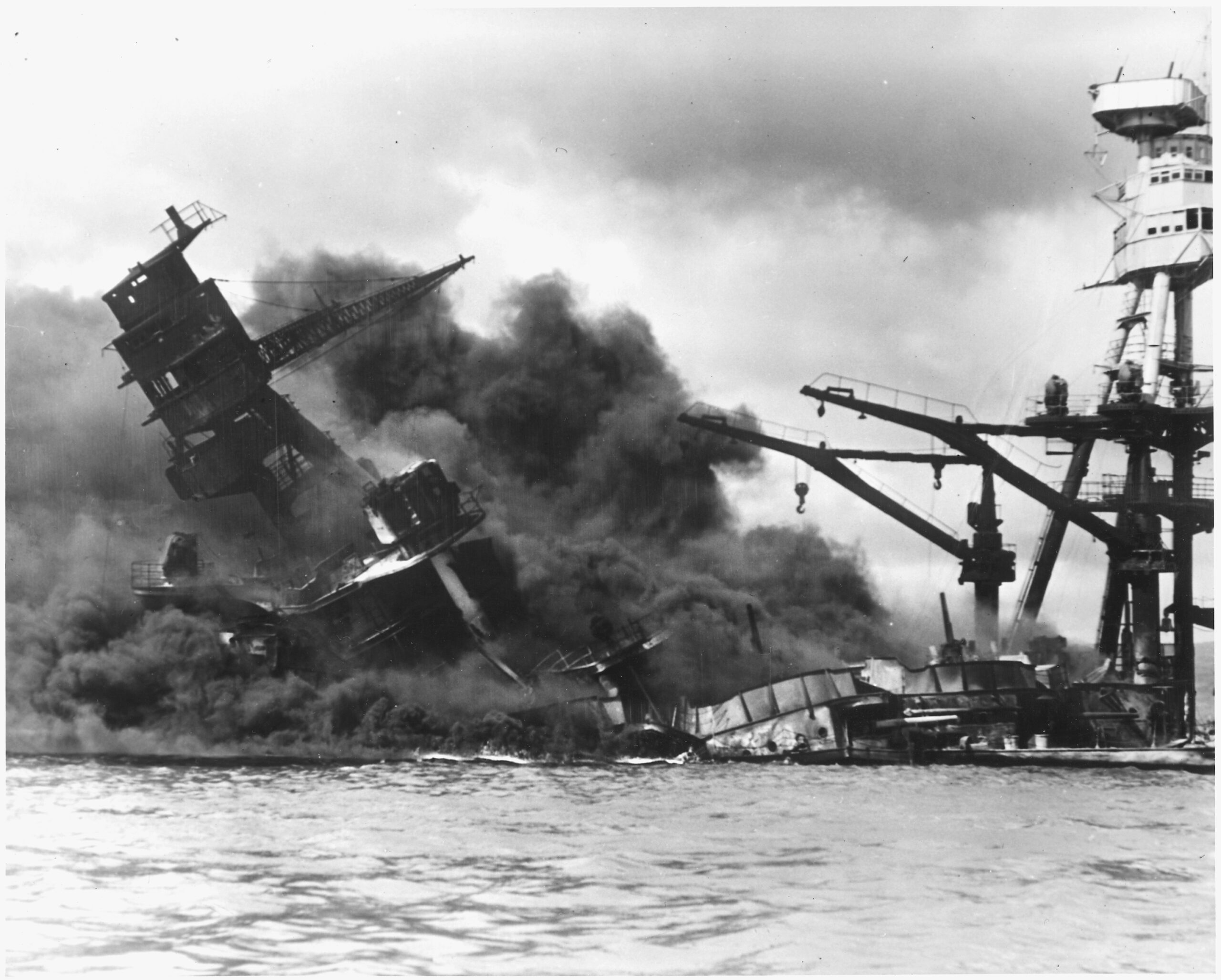
DECEMBER 7, 2025 – For fewer and fewer Americans, this date marks a singular day in our national history. As the irresistible current of time carries us farther downstream from “[the] date which will live in infamy,” as FDR described Imperial Japan’s attack on Pearl Harbor, the people alive then and their personal memories are rapidly disappearing behind the river bend: only 12 servicemen who survived the raid itself are still alive—each now a centenarian. Soon Pearl Harbor Day will go the way of Armistice Day—originally marking the date on which the Great War to End All Wars ceased—the quasi-holiday that morphed into the more generic “Veterans Day” a mere 36 years later (vs. 84 since “a date which will live in infamy”).
Today, of course, Japan is our close ally and among our top six trading partners; a country with whom we share many common values and strategic national interests. This amicable relationship is now 80 years in maturity—long enough to eclipse from our collective memory, the ostensibly irredeemable pathological hatred and violence that darkened the relationship between December 7, 1941 and August 15, 1945[1]. The waning commemoration of the date in infamy will eventually dissolve in the flow of time, much in the way that V-E Day[2] and V-J Day did long ago.
So too will dissipate, the crises and disruptions of our individual lives. This is what I keep reminding myself to “stay in the game,” as it were; akin to donning a helmet, checking my compass, and charting plans of attack and bearing in mind that “This too will pass . . . [or, run . . . its course].”
Just as critical as the field campaign, however, are family and friends as they shout encouragement from behind the lines. Yesterday’s supporters included D, C, M, and J. Today’s included E, J.O., L, and GK. Each message, spoken or written, was turbo-charged in content, comforting in style, and lasting in effect. I tried my best to emulate their examples when I, in turn, extended encouragement to two close family members in their own intractable crisis.
When the Arizona was foundering and tragedy unfolding, our prospects seemed dim. When the next day came, few people could divine what lay beyond the immediate horizon and declaration of war. Diminished by the Depression and retrenched in our isolationism, we were ill-prepared for protracted conflict. It would be a long slog—as we retooled our industrial capacity and regrouped our economy at home and marshalled our military forces abroad. Victory without risk, sacrifice or Herculean effort had no probability. Yet here we are, 84 years later, with the crisis at Pearl Harbor long “resolved.” If there’s one thing “never to forget” about that day and all that ensued from it, it’s not that Japan was our enemy but rather, this: our collective resilience is stronger than the destructive forces that trigger such resilience. Our history abounds with examples. Acknowledging this historical reality sustains me in my personal challenges.
Subscribe to this blog and receive notifications of new posts by email.
© 2025 by Eric Nilsson
[1] The date of Emperor Hirohito’s radio broadcast across Japan announcing surrender. The formal surrender signing ceremony aboard the U.S.S. Missouri in Tokyo Bay occurred on September 2, 1945.
[2]May 8, 1945.

1 Comment
I’m glad you wrote this bc I, too, forgot this date’s significance until you said something. Thank you!