DECEMBER 21, 2025 – I’m no gardener, though I’ve enjoyed modest success in cultivating basil, my favorite herb. I know plenty of gardeners, however, and I enjoy and fully appreciate the colorful (and tasty) results of their efforts, dedication, knowledge, and expertise. Ditto cooking: I’m no chef, though I can boil water without wrecking the pot. I know lots of culinary artists, however, and I enjoy and appreciate the results of their artistry.
My appreciation for gardening and cooking is enhanced by my dual traits of (a) saving stuff; and (b) “rediscovering” it years later. The experience of finding a whole script on dog-eared paper amidst a collection of sheet music stashed away an old cabinet is akin to seeing bright blossoms explode from greens shooting up from a flower bed where seeds and bulbs had been planted weeks before; or savoring a winter stew of chuck roast, potatoes, vegetables and thick sauce that had been mixed into crock pot at two and cooked till six.
By way of further background . . . I’ve been informed by a reliable source that I’m to play my violin at a memorial service during my college class reunion next May. The multi-day occasion of our 50th reunion is likely to attract a high percentage of our tightly knit (back in the day) class of around 350 students. Most of us are “still with the program,” but the operative word, “most,” sadly reveals that some are not. Inevitably in the case of any well-organized 50th class reunion—and for fund-raising purposes, what 50th class rendezvous isn’t well-organized?—a memorial service is a standard feature. And what memorial service is conducted without live music?
But what standing do I have to play at the memorial service in the Romanesque Chapel that has been an architectural landmark of the college since its dedication in 1855 after nine years of construction? And across a broad span of possibilities, what piece should I play?
First, the question of standing . . .
Though for three years of high school I’d attended Interlochen Arts Academy, where music occupied a substantial portion of my waking hours, I didn’t major in music in college. In fact, in my four years as an undergraduate, I didn’t take a single music course and didn’t participate in any formal campus musical performances. This was my loss, since the small but intimate music department had some amazing professors—including the renowned composer, Elliot S. Schwartz.
Nevertheless, during my freshman year, thanks to my oldest sister’s connections at New England Conservatory (“NEC,” where she was studying for her master’s degree), I studied Max Hobart, assistant concertmaster (and stand partner of the famous Joseph Silverstein[1]) of the Boston Symphony. At the crack of dawn every Tuesday, I’d hike down to the Greyhound “depot” (a travel agency storefront in downtown Brunswick) and catch the bus from Bangor for the three-hour ride to Boston. (The ride included a 40-minute layover in Portland, which was only 30 minutes into the trip TO Boston and a frustratingly half-hour before the end of my trip back FROM Boston). After hanging out inside the main building of NEC—attending to college coursework and practicing ahead of my lesson—I’d grab lunch, practice more, then attend my lesson. Max was a great teacher—and exceptional violinist—and under his tutelage, I advanced my repertoire. After my lesson, I’d walk to the bus depot on the edge of Boston’s infamous “Combat Zone” and take the Greyhound back to Brunswick.
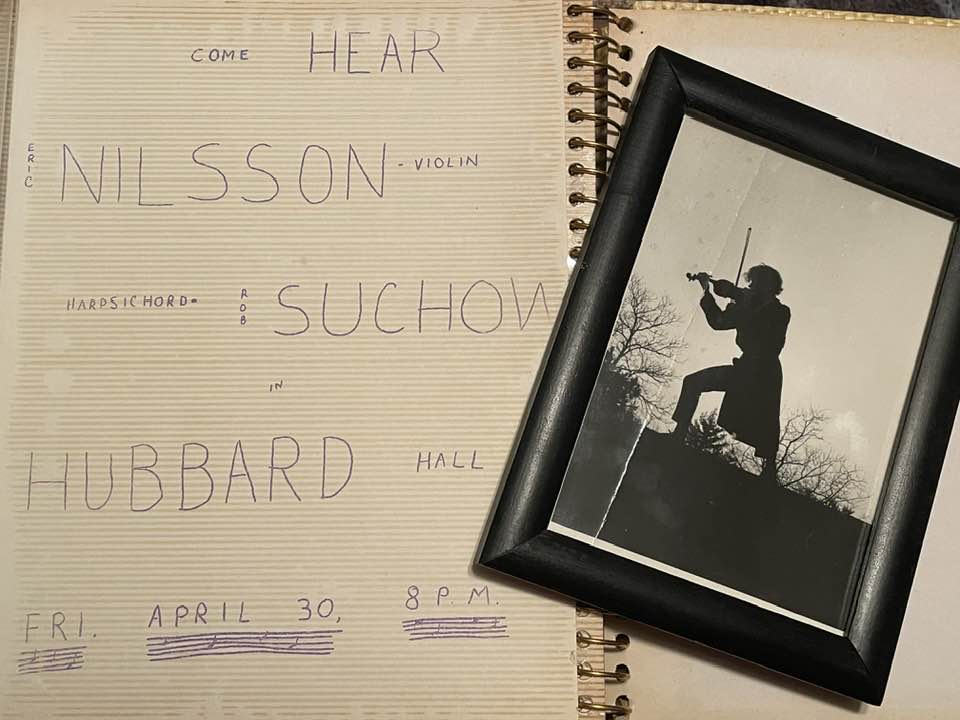
I practiced up a storm that year. In subsequent years, the weekly commute to Boston conflicted too much with my studies and distractions on campus. I still practiced, but not as much. Nevertheless, on occasion, I’d play impromptu “recitals” for small groups of friends and others who might wander by my chosen venues—never formal performance spaces but resonant common areas of venerable Hubbard Hall at the heart of our campus. Often my audiences were appreciative but not necessarily sophisticated.
What I found immensely rewarding was that these “fresh ears” would become quite enamored of a musical genre that had been alien to them before exposure to my renditions of Bach and Beethoven while I was wearing running shoes, jeans, and a “University of Minnesota” T-Shirt. Take for instance, Dave G., who was a year ahead of me. With next to zero exposure to classical music before attending my “concerts,” he became quite fascinated by the violin, and was a loyal attendee. I’ll never forget the time at the start of the next school year when I walked past his dorm.
“Eric!” he shouted down from his second floor window. “Come up here! You’ve got to hear some records I bought!”
Soon I was at Dave’s door. Excitedly, he waved me in and told me to sit down. He pulled out an album, set it down on his high-end turntable and pushed the lever to the stylus arm. As the music started, Dave took a seat in the corner and beamed like a kid showing off a new toy. It was the Brahms Violin Concerto—a central “war horse” of the violin repertoire.
What floored me was not only that over the summer he’d bought a recording of the Brahms, but that he’d purchased no fewer than three recordings, each by a different artist. Dave wanted me to listen to all three and tell him which I liked best. I was non-committal, being far more fascinated by which recording he preferred and why. When he proceeded to tell me, I was astonished by the compressed degree of sophistication he’d acquired entirely on his own. When he disclosed that his appreciation for classical music was all because of my informal “concerts,” he gave me the highest compliment that any performer, from rank amateur (me) to Jascha Heifetz (one of the three artists we listened to and Dave’s favorite), could ever hope to hear.
I tucked that memory away until 34 years later when in partnership with Sally Scoggin, my law school classmate and fellow associate at my first law firm, I started a 10-year series of winter house concerts. I patterned them after those informal presentations back in Hubbard Hall. The thrust was to render accessible and appealing, music that was generally perceived as extremely formal and thus, inaccessible. I wanted to present music in a way that could be enjoyed by people along the entire spectrum of musical sophistication—and lack of it. Our audiences, packed in like sardines, included people who’d never seen or heard a “live” violin before, and also professional musicians but mostly people in between the uninitiated and the highly sophisticated.
Each of the “house concerts,” dubbed, “Fiddler UNDER the Roof,” grew into a major project involving supporting performers and a PowerPoint show of scores of slides filled with images accompanying my running narrative of the featured music and composers. Though Sally and I worked countless hours on the music—taking it as seriously as our training and determination would allow—the presentations themselves were relaxed and filled with (somewhat eccentric) humor. The first set of concerts in 2010 were an experiment; thereafter, a loyal following formed, and we pushed the proverbial envelope to levels that would’ve astounded my original “fans” back in my undergraduate days. (I can’t imagine what Max Hobart (or any of my pedagogues before him) would’ve thought.) Our 10th anniversary concerts—the year before Covid struck—called, “Bach to the Future,” featured works by J.S. Bach and two contemporary pieces that I commissioned—the composers (one from New York, the other from Hawaii), braving the cold to coach us for the week leading up to the concerts, then being on hand for the premiere performances.
All of which is the extended overture to nostalgic moments I experienced late yesterday afternoon as I addressed the question, “What piece shall I play?” (Cont.)
Subscribe to this blog and receive notifications of new posts by email.
© 2025 by Eric Nilsson
[1] In the spring, ahead of a BSO concert, Max had arranged for me to play backstage for Silverstein, a movement of a Bach Partita. It went as well as I could’ve hoped. Ever the gracious maestro, Silverstein listened with courtesy and for his friend’s consumption, complimented me politely.
