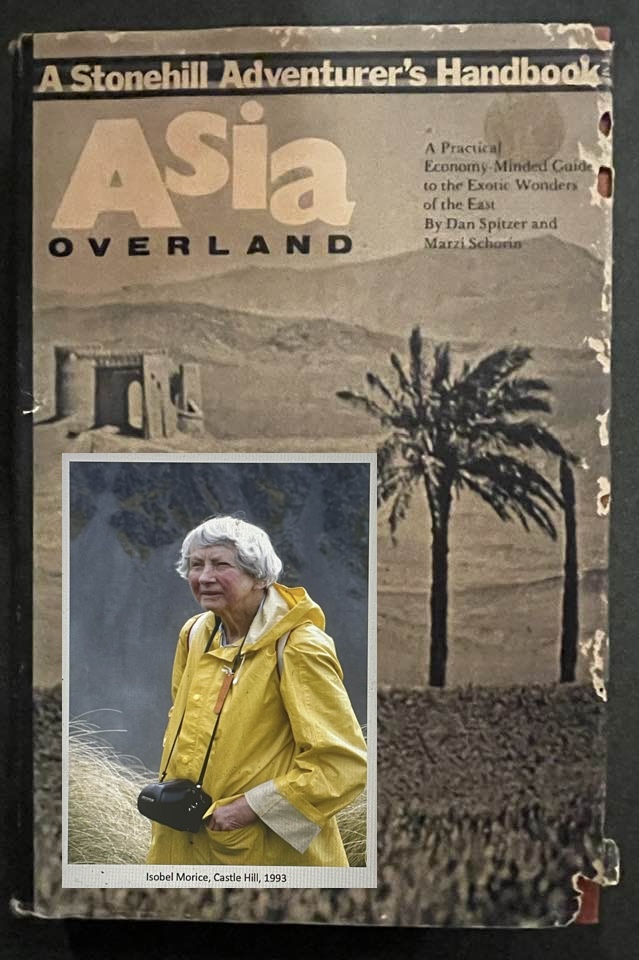
SEPTEMBER 19, 2025 – Among other books I’m currently reading, I’ve been chipping away at a travel guide that my wife had picked up at a thrift shop many years ago and that had somehow resurfaced recently. It’s called, Asia Overland – A Practical Economy – Minded Guide to the Exotic Wonders of the East by Dan Spitzer and Marzi Schorin and was published in 1978, just one year before my first trip abroad and three years before my Grand Odyssey (See my series of posts beginning late January, 2022). Especially against all that had transpired in the world since then, the book is quaintly amusing. Typical is the paragraph on accommodations in Kabul:
Upon arrival in Kabul, you will be thronged with representatives from cheap hotels trying to lure you to their establishments. Ignore them—it is best to pay a few cents more and lodge in clean accommodations like the Cavalier ($2) or Mustafa (about $1.50) for a double). Early risers enjoy the luxury of hot showers at the Mustafa, as firewood is fed into the boiler between 6:00 and 8:00 a.m.
If you are really hard up for cash, there are a number of small hotels in the Shar-i-Nav district that offer lodging at 30 to 50 cents a bed. Avoid the Bost Hotel, which is infested with bedbugs.
The book reminds me of an “overlander” I met in Switzerland in 1979—the redoubtable Isobel Morice. She was then “an elderly woman,” though I’ve since learned that born in 1909, she was a year younger than I am now. Isobel was in the company of her younger second cousin, Helen, and Helen’s husband, Ian. Isobel was from Wellington, New Zealand, and her companions were prosperous sheep farmers or “runholders” in Gisborne on Hawke’s Bay (northeast of Wellington, which lies at the very south end of the North Island). The year before, I was informed, Isobel had travelled overland on her own between India and Europe.
Two years later during the NZ phase of my Grand Odyssey, I was a guest at Isobel’s home in the Kiwi capital. It was spacious and comfortable abode but spartan in furnishings and appointments. She led me on an extensive tour of the 64-acre Wellington Botanic Garden, and it was on this splendid outing that I learned about Isobel’s encyclopedic knowledge of botany.
We exchanged Christmas letters for the next 20 years, but then one year no letter came from New Zealand. I never learned what had become of Isobel, but since she’d seemed “elderly” (though spry) when I’d last seen her in 1981, I assumed that she’d grown that much more elderly and passed away. I’d also lost contact with her cousin Helen.
While musing over the antique book, Asia Overland, I thought of that kind and quiet intrepid soul, Isobel Morice. What had become of her? Thanks to the internet, within a few minutes I found a lengthy account of her life from an unidentified publication via “Amazon Web Services.” Born in Wellington, she was the only child of Scottish immigrants. After obtaining her bachelor of science degree in chemistry, she continued work toward her doctorate at King’s College in London. When the war came to Britain, she transferred to Durham University in Scotland, then found her way back to New Zealand, where she completed her PhD. She never married, and in a sense, never left home: the house where I’d stayed had been her childhood home. She’d spent her entire career working in a government agriculture laboratory, conducting a variety of research.
But her primary interest was botany—and rugged, overland travel. Quiet and unassuming, Isobel—or “Dr. Morice,” as the article referred to her—was the first to recognize a distinct variety of Astelia nivicola, and for that accomplishment, the variety was named after her: astelia nivicola var. moriceae.[1]
Isobel died in 2003, I learned, at the age of 94. For me nearly a quarter century later, her curiosity about the world and her quiet but intrepid spirit are still a living inspiration.
Subscribe to this blog and receive notifications of new posts by email.
© 2025 by Eric Nilsson
[1] According to the article, “Astelia nivicola var. nivicola (‘growing at high altitude’) is widespread in South Island high rainfall areas, in snow tussock herbfield, especially near its upper limit, whereas Astelia nivicola var. moriceae (after Dr I Morice) is found only under beech forest near the treeline on cold facings, in Nelson, Westland and Fiordland. In some areas, Astelia nivicola var. moriceae can be distinguished from the superficially similar and equally abundant Aciphylla nervosa by its rich brown velvety abaxial (underside) hairs.”
