JUNE 19, 2025 – Today our crew—four adults, one kid, one toddler—headed for Connecticut’s best and biggest beach, the main but by no means only attraction at the sprawling Hamomasset State Park halfway between Old Saybrook and New Haven. In tow were four chairs, a beach mat, a beach umbrella (with stand), two hefty coolers filled with food and water bottles, a sack of beach towels, a basket of beach toys, and two bags of sundry clothing and accessories. As we began unloading our gear and supplies, I asked, “Where are the camels?”
No one in our group took me up on the camel joke. Instead, everyone except the toddler readily assumed the role of a sherpa as we schlepped single file into the mist; yet not so much as sherpas as early hominids exploring an unknown world.
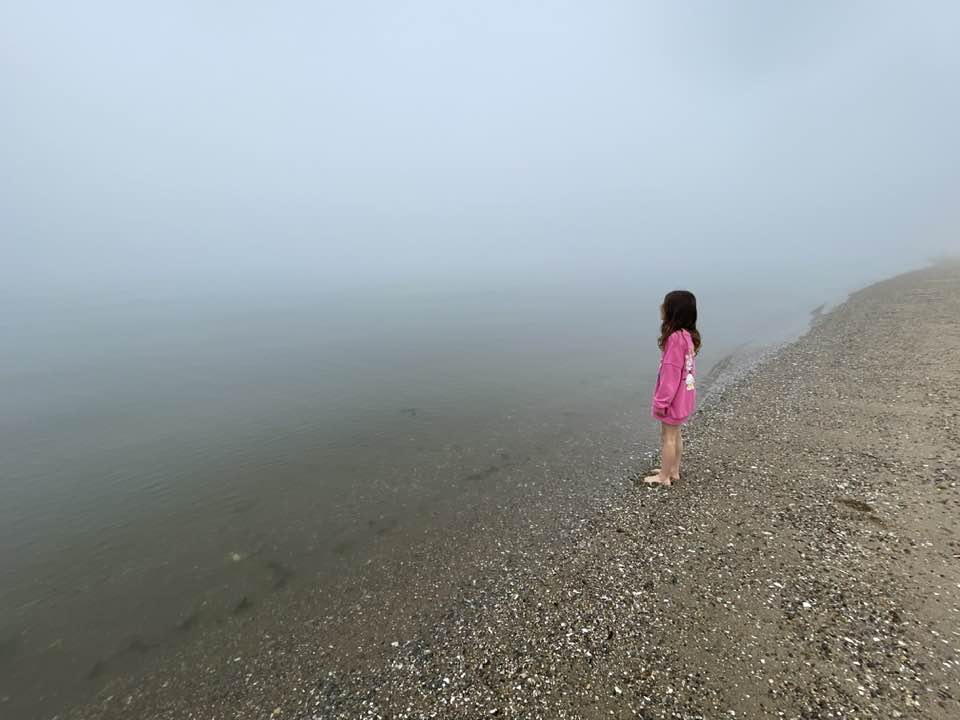
A heavy early morning fog still hid much of the Connecticut coastal region from human view. Upon waking with the dawn we’d been transfixed by the mystical blanket of humid air that shrouded our view of Hamburg Cove, where three of us had spent the night. At Hamonasset the fog transformed the tree-lined marshlands into a primeval world, uninhabited—yet to be touched or viewed, even—by humans.
The dunes, covered with wild rose bushes in bloom, assumed greater definition with our advance. The air was not yet hot or even warm. It was comfortable, still cool and refreshing from overnight hours away from the sun. Upon reaching the crest of the dunes, we caught our first glimpse of . . . nothingness . . . beyond the narrow confines of the beach within our immediate reach. The water of the Sound was calm and clear but so fog-bound that we were deprived of a view extending more than a few meters beyond the ambiguous border between land and water. This arrangement produced the illusion of dichotomy: a world that was at once infinite and finite; a planet with dissipated horizons and unreachable boundaries, yet at the same time, a place with extreme limits, confining us to a zone we could cover with just a few strides.
What we could see of the beach was sparsely occupied. We staked our claim, then set about exploring our immediate surroundings. The space was as much a dream as it was any part of reality—or at least that is what its physical features caused me to think—and its possibilities for a photographer’s lens or a painter’s canvas overwhelmed the imagination.
In time the sun burned through the fog. The temperature rose as steadily as Apollo’s chariot climbed higher, and with the heat the humidity soared. An hour into our presence, the dream yielded to the arrival of more people, first sporadically, then in a flow, and eventually, in a torrent.
Our original unrestricted view of the indefinite line between land and sea was now obstructed by folks setting up their own command post. A waft of cigarette smoke drifted over our encampment, and soft pleasing Latino music began to play. From the shade of our umbrella, I transitioned my sight continually from our grandchildren to the cooler containing water to my writing sketch book to my iPhone taking umpteen thousand photos of our grandchildren (and failing to delete the “non-keepers”) to the crowds beyond us—on land and in the water.
In time I saw the evolution of our time at the beach as metaphor for the evolution of America. We weren’t the first non-native people to inhabit and tame Hamonasset, but we were certainly among the first settlers (today, at least). Just as our nation grew, so did today’s beach crowd, until we were packed across the habitable areas nearly as sardines in a proverbial can. The laughter of children displaced the quietude that had greeted us upon our initial appearance. As our granddaughter discovered other kids in close proximity and with welcoming personalities, she spent less time within speaking distance of us. Our grandson found amusement in watching adults in waist-deep water playing with a beach ball. “Ba!” he shouted in delight, as he pointed. “Ba!”
By the hour of the sun’s zenith, the fog was long gone, and we labored under the increased heat and humidity—if sitting in the shade, drinking water can be considered “work.” I jokingly mentioned to our son how it is that so many people come to the beach hoping for sun—yet bringing with them new and improved umbrellas for blocking out Ol’ Sol. In saying this juxtaposed to the metaphor I’d earlier developed in my mind, I knew exactly what the noonday sun and its consequences stood for: global warming and climate change. How different the beach appeared now from how it was in its cool, fog-bound state at the time of our arrival!
Soon thereafter, I noticed, people began to leave. The earth had become too hot. The beach was no longer pleasant. Our world was no longer habitable by large groups of people. We ourselves packed it up, yet had to cool our vehicles before the air inside was breathable.
Wholly satisfied with our time at the beach, we left it for another magical realm—namely, a family-run ice cream shop in Centerbrook. Our quest was part a continuing mission to sample as many of such establishments as we can during our sojourn in Connecticut. As I consumed my “kiddie cone” of toasted almond ice cream, trying in vain to do so before it melted over my hand, because as any buyer of ice cream cones knows, “kiddie” size means “large,” but what grown-up manly man like me feels manly when placing an order (in a crowded ice cream cone shop) for something “kiddie” size (America’s hallmark far ahead of “freedom” and “liberty” (let alone “due process”), is “MARKETING”) . . . as I started off the longest run-on sentence I’ve crafted yet this year . . . I need to start off afresh with a whole new paragraph . . .
As I consumed my ice cream cone, I wondered what the sequel might be to our species’ “time at the beach” here on this extraordinarily dynamic planet. How will biological, geophysical, and astronomical influences alter our beautiful beach, and how will we adapt? And in the meantime, as more people occupy the beach, how will we interact with one another? In that regard, as I observed the crowd I saw today, I found hope. It was an impressively diverse group of people in physical appearance and (I imagined) socio-economic-ethnic backgrounds, but put legions of people into bathing suits, and they look far more amusing than threatening, with far more in common than not. And most important . . .the hallmark I observed today was civility. Thousands of people along the strand, getting along, enjoying—indeed, celebrating—what we all shared: a desire to be at a beautiful beach along the charming sea on a fine Juneteenth.
It’s still a beautiful country.
Subscribe to this blog and receive notifications of new posts by email.
© 2025 by Eric Nilsson
