OCTOBER 7, 2025 – Over the years I’ve met numerous interesting people who live along my walking route to and from “Little Switzerland.”[1] With some of these folks I’ve enjoyed extensive conversations about a host of subjects.
One standout is a fellow, Phillip, eight years my senior, whose house is on the “Matterhorn” overlooking the second fairway of the golf course. Our paths cross about twice a year, and when they do, we’re good for at least a half-hour conversation. On each occasion I learn something new and interesting about him. We share much in common. He and his wife have two adopted Korean-born adult kids, one of whom is Cory’s age; a carpenter by vocation before he retired, Phillip can “talk shop” with me, though I’m an amateur; he’s a serious photographer—mostly of wildlife—and likes the outdoors; he’s a quite a reader, is a good conversationalist, is quick to laugh—and make his listener laugh; we share a keen interest in politics, share common political sentiments and are incensed by Trump Era Republicans; also we’re both of Swedish ancestry.
Yesterday morning Phillip happened to see me from inside his house as I walked by. He rushed out the front door and called out as I was passing the second of the two large spreading burr oaks in his yard. I was delighted to see him, since many months had passed since we’d last chatted.
“Where are you headed?” he asked.
“I’m out to hike up and down the hills of the golf course. I need to get in shape for my EKG this afternoon.”
Phillip laughed. I was joking about the “get in shape” part but not the EKG itself. At a physical a month ago my doc said I was supposed to have an EKG annually due to a pre-existing condition. He was laid back about it but observed that since I’d skipped the previous three years, I should probably undergo one now.
We then dove straight into politics, commiserating over the state of the Republic and expressing our mutual disbelief that so many Americans could accept so many bulls in the china shop. But we’d also lived through enough and studied history sufficiently to know that we shouldn’t be shocked by what’s going down—or entirely pessimistic about our ability to weather the nonsense.
Against this backdrop I learned about Phillip’s experience in the Navy. Every time we chat, I hear something new and interesting about Phillip, and when he mentioned that he’d been in the Navy, I figured he’d been places I hadn’t—such as Vietnam. I was curious and asked him to tell me this part of his story.
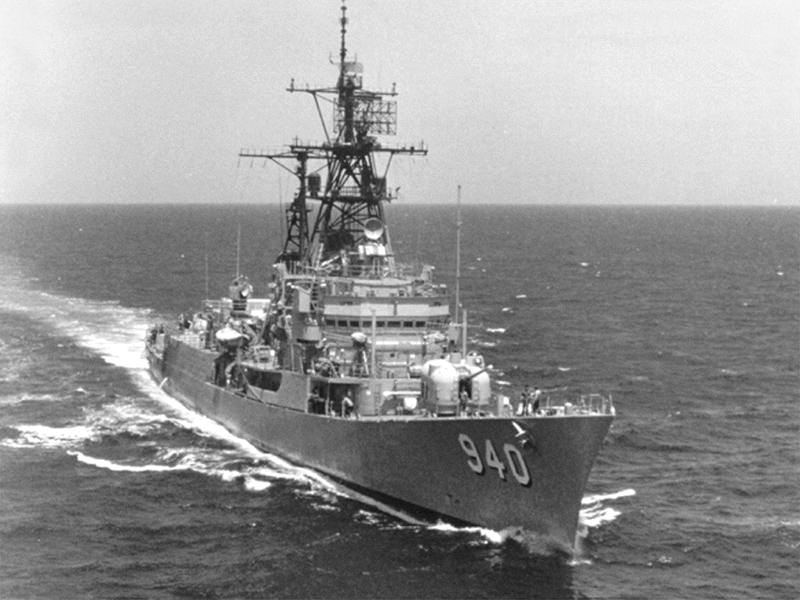
Under the threat of being drafted and sent to fight in Vietnam, Phillip joined the Navy in 1966 and served most of his time aboard a destroyer off the coast of Vietnam. It was an old vessel—one of the last that had been built under a WW II contract. “We had two close calls,” he said. “One in a storm in the Mediterranean and another in the North Atlantic.” In both instances, heavy seas knocked gaping holes in the bottom of the hull, requiring diversion to emergency ports for repairs. Right there, I thought, Phillip experienced excitement at a level I’ve only read about.
He then described operations on board when their ship was called to the “line of fire.” The “line of fire” was the line-up of Navy vessels that fired bombardments at the “enemy.” Phillip was no “warrior” of the sort stereotyped recently by our esteemed Secretary of Defense. “The rule,” he said, “was that we got to leave the line of fire after the earlier of a given time or after we’d shot 320 shells. So guess what we did? Talk about government waste!
“But I tell you, being in the Navy was a real experience,” he said.
“I’ll bet it was—especially during the Vietnam Era.
“It sure was. I got to see just how racist America was. During those storms, the black sailors were in kind of a panic because none of them could swim. Most were from the South, and the reason they couldn’t swim, I found out, was that they hadn’t been allowed to swim in public swimming pools, which meant they could never take lessons, either.”
Phillip continued with another specific anecdote about race in the Navy. “One day a Black guy in our barracks shined up his boots and placed them on someone else’s footlocker. The footlocker belonged to a white guy from the South who hadn’t been present when the Black guy had been shining his boots. When the white guy returned, he saw the boots and asked everyone on hand, ‘Who put their boots on my locker?’ The Black guy stepped forward and said, ‘I did, and I apologize.’ This set off a firestorm on the part of the white guy. He said, ‘You N_ _ _ _ _! No N _ _ _ _ _ gets to put his boots on my locker!’
“The white guy then lunged at the Black guy, but the latter was too fast and decked him, but good.
“Mind you, this was just a couple of years after the Civil Rights Legislation that was passed in 1964 and 65. The South—and most of the men in the Navy at that time were from the South—hadn’t admitted defeat yet in the Civil War. They weren’t yet ready to accept Blacks into the mainstream of American life.”
Phillip was discharged from the Navy on May 4, 1970—the day of the Kent State shootings. What he got out of the Navy besides storms at sea, bombardment of Vietnam, and a close-up view of racism as he’d never confronted it, was a degree from the U of MN under the GI bill, “Plus,” he said with a laugh, “They paid for a fifth year for me to study poetry and history.”
Ha! Socialism, I thought, paid for by the (socialist) United States military!
By this time I realized I needed to get on with my walk so that I could return home in time for my EKG. As I strode from the sidewalk in front of Phillip’s house down the rest of the hill to the entrance to “Little Switzerland,” I pondered all that he’d told me—the Vietnam War, storms at sea, up-close encounters with winners of the Lost Cause, and losers of Reconstruction . . . a century after the Civil War. Ever since our first conversation I’d pegged Phillip as smart, engaged, well-informed, and observant. Now I respect him even more for his direct experience with matters far distant from my own path in life.
Subscribe to this blog and receive notifications of new posts by email.
© 2025 by Eric Nilsson
[1] The golf course at the northwest corner of Como Park, St. Paul’s 378-acre version of Central Park.
