MARCH 2, 2026 – Today I experienced a further lesson in the difficulty of reconciling my circumstances with our country’s ugly past. In this particular instance, I have in mind the treatment of Indigenous populations by the European settlers, colonizers, fortune-seekers, and religious zealots who preceded us, not to mention by us, as well, with our inherited biases and ignorance. I don’t intend to burden myself—or others similarly situated—with guilt for which atonement is impracticable, but today’s effort at conciliation, however lame in concept, proved to be as elusive as atonement.
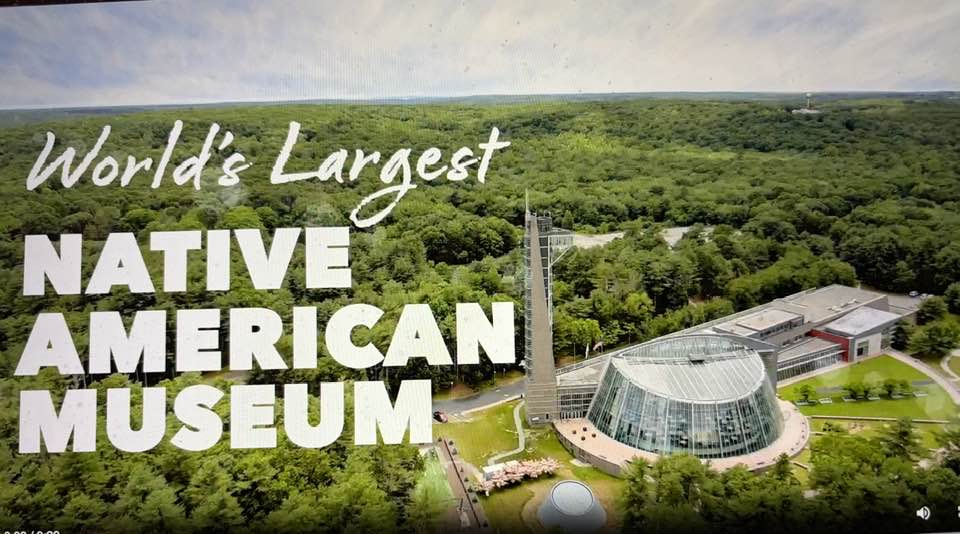
In the introduction to The Rediscovery of America, Professor Blackhawk gives special mention to the Manantucket Pequot Museum and Research Center in Manantucket, Connecticut. Anyone who’s followed this blog for long knows of my familial connections to the Nutmeg State, dating back to the 1630s and the Town of Lyme less than 30 miles from Manantucket. Yet, although the Pequot nation (and surrounding tribes) had occupied this neck of the woods for untold numbers of generations before “my people,” their existence never registered with me. In fact, until very recently, if you’d mentioned the name “Pequot” to me and asked me for context, I would’ve said, “Pequot Lakes, Minnesota,” best known for its city water tower tank in the design of a giant fishing bobber.[1] In typical fashion for me and millions of other non-Indigenous people living in, visiting or passing through Connecticut, I never knew—or gave any thought to—who lived there before the arrival of the Mayflower.
Since I was a schoolboy I’d been aware of European landings and settlements that predated the Pilgrims and Puritans. Jamestown (1607), for example, and the failed settlement of Roanoke a decade earlier. Later, I’d learned about the landing of Bartholomew Gosnold on Cape Cod in 1602. But quite honestly, anything predating 1620—the year of the Pilgrims’ appearance in New England—was essentially pre-history.[2] I never bothered even to wonder much about it. I had no way of knowing it at the time, of course, but my prejudice was created when my first grade class made Thanksgiving turkeys out of construction paper while the teacher told us about the Pilgrims. It’s when I learned the significance assigned to the year “1620.”
In all the times I’ve been to Connecticut, I’ve habitually measured historical dates (usually as they appear as the year of settlement or establishment on official town road signs) to that critical year of the Pilgrims’ landing—the year “history began” in my biased and appallingly ignorant view of things.
Fast forward to the present and my newfound interest in the Indigenous people of Connecticut who preceded “my people” by and for thousands of years. I open the cover of Professor Blackhawk’s book and discover the existence of the Manantucket Pequot Museum. I visit the museum’s website and see that it would be an ideal outing for our June visit to Connecticut with our fourth grader granddaughter, Illiana. I send a text to our son Byron, whose family lives in Chester, just across and upstream a couple of miles from Hamburg Cove. In the text I say,
On our next trip to CT I want to visit the Mashantucket Pequot Museum just north of Mystic. I think Illiana (and your family) would like it too. Check it out.
Byron’s reply:
[The museum] sounds interesting. As much as I try to avoid the casinos there, one does have a gigantic indoor waterpark. So maybe Illiana would be interested in that one day too.
My response to his reply:
Hadn’t considered the “Pinocchioland” features. I can already envision the “material” for a blog post describing cultural genocide segue to a phoenix in the shape of a giant waterslide covered with casino chips.
Later, I investigate the museum a bit further and learn that it is no fledgling non-profit organization dependent on donations from aging white guys like me trying to make amends with his country’s sordid past. It’s a 308,000 square foot complex built at a cost of $193.4 million, “funded largely by casino revenues.”
I recognize that high stakes, high-glitz casinos and gambling are an international phenomenon, but in many respects they are emblematic of much that I dislike about American culture, starting and ending with our preoccupation with MONEY for the sake of MONEY. The ironic parallel to our national history is that the discovery, conquest and exploitation of the New World by Europeans was centered on the same preoccupation with MONEY. The circle of irony closes with the fact that the only way the Mashantucket Pequot Museum could’ve been built—to illuminate the dark regions of our history—was with revenue generated by a quintessentially capitalist creation conceived by the very culture that obliterated the Indigenous people featured by the museum![3]
The challenge of reconciling my privileged circumstances with the injustice wrought by my forebears just grew infinitely more complicated. I feel a need to explore this with Byron, a man of finance, but also with Illiana and eventually, Byron’s kids.
Subscribe to this blog and receive notifications of new posts by email.
© 2026 by Eric Nilsson
[1] According to the official record of Minnesota geographic names, in 1896 the local post office official named the town “Pequot Lakes,” because it was “the first Indian name he could think of.” Apparently, he was a transplant from southern New England.
[2] In reality, of course, this was hardly the case. By 1620 the Indigenous population of New England had already been decimated by disease transmitted by earlier encounters with European “discoverers.” Because European diseases had felled so many Indigenous people, from 1492 to 1776 the population of North America actually declined, despite the influx of European settlers and colonizers.
[3] Further irony is to be found in the development of wampum—woven strands or belts of beads made from quahog and whelk shells from Long Island Sound—which became the currency of choice among Indigenous and English/Dutch traders in the 17the century. Wampum was an Indigenous monopoly, given the skill and labor involved in its production and proved to greatly valued by all parties—the bitcoin of its era.
