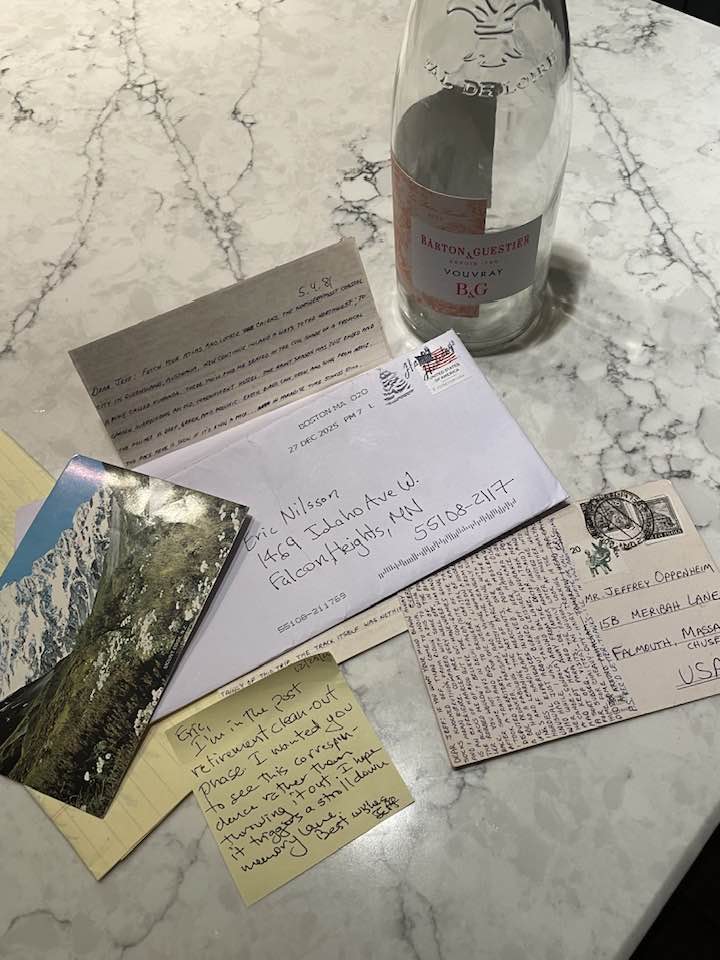
JANUARY 4, 2026 – Yesterday, our old-fashioned mail delivery service dropped into the mail slot of our old-fashioned house, an old-style letter envelope containing two ancient letters and two postcards of the same vintage as the two very old letters. On the face of one of the postcards was a Post-It Note bearing the handwriting of a good long-time friend of mine. It read, “I’m in the post-retirement clean-out phase. I wanted you to see this correspondence rather than throwing it out. I hope it triggers a stroll down memory lane. – Best wishes, Jeff.”
“Jeff” is Jeff Oppenheim, one of my closest college friends. One of the letters was 45 years old. The other correspondence was written 44 years ago. The first missive, dated January 11, 1980, was written on paper from a legal pad of the sort I used at my then job as a law clerk at the old St. Paul firm of Briggs & Morgan. It expressed grave concerns about the future of our country—a year before I’d embark on my extended leave of absence from America. The second letter, on faintly lined 6” x 8” notebook paper, was jammed with my hand-printed words so small I needed to use my cheaters to decipher them. It was dated April 5, 1981 and told of my adventures in Australia in the course of my 10-month “Grand Odyssey” around the world. My postcards, also packed with “cheater-sized font” lettering, featured rugged mountain scenery—one in Mt. Cook National Park on the South Island of New Zealand; the other depicted the Himalayas of Kashmir. The “Kiwi card” was sent in March, 1981; the “Kashmiri card,” in May of that year.
For me, these pieces of my past were like forgotten notes in a bottle scooped from the waters of time.
Apart from triggering recollection of long dormant memories, these writings were a quaint reminder of how life compresses upon itself, much as gravity works on an amorphous cloud of swirling cosmic gas until the cloud becomes a solid, definable celestial object—our own precious Earth, for example. Throughout its life, the planet—the person—contains the same elements it started with but is transformed by a multitude of forces working by fits, starts, chance encounters, evolutionary processes and occasionally, cataclysmic disruptions. The end-product is unrecognizable when compared to its origins.
With age comes a natural change of perspective, from gazing into the future to reflecting on the past. The present also changes—from a launch pad view aimed at the stars to focus on a landing site surrounded by rescue vehicles and responders. Throughout the voyage of life, however, is one constant: the unending search for the elusive Holy Grail; or more precisely, the Great Meaning of Life as each of us perceives it.
The “notes in a bottle” that arrived yesterday from distant times stirred me to resume—for a few moments, at least—that familiar search, which of late, I’d placed in abeyance. I reflected not only on the scenes, people, and observations mentioned in the “notes” but on the compression of memories since—generated by family, friends, work, travel, highlights, low points, victories, defeats—all against the backdrop of a fast-changing world profoundly influencing my life but impervious to any reciprocating influence, however minute and fleeting.
At previous stages in life, I was occasionally seized by the idea of finding—then snatching—the Holy Grail but with little thought as to what to do once it was in my clutches. Put it on display? Fill it with champagne and pass it around a circle of family and friends so each could take a sip and shout, “Eureka!”? Achieve a false sense of immortality by publishing an illustrated account of the search and its outcome so that others might use it as a guide? (Hardly so!) These rhetorical questions never figured in my episodic quest for meaning.
Although the way ahead leads into a fog of speculation, I can see meaning far more clearly. This enhanced vision comes not from foresight but thanks to hindsight down the path I’ve trod so long. “Meaning,” I now understand, is a paradox. It’s as simple a notion as a butterfly landing on my nose; as our 10-year-old granddaughter’s sweet voice saying, “I love you Grandma! I love you Grandpa!” at the end of a visit; as our two-year grandson’s hearty laughter when I make a funny face; as the sympathetic vibrations that I hear and feel when I hit the A in the first octave of an F major scale on my violin, causing the sound waves to “ring” with the open A string—physical proof that with that note in that moment, I’m in tune with the laws of physics by which the Cosmos operates (at least to the extent of our current knowledge). Yet, at the same time I know that this matter of “meaning” is as unknowable as the pure vacuum beyond the edge of space.
And guess what. I’m fine with all that. You could say I’ve become spectacularly “incurious” about the fathomless side of “meaning,” but, paradoxically, being reconciled to such incuriosity might well constitute the essence of meaning.
The “notes in the bottle,” meanwhile, have now been tucked away back inside a different bottle—the thick packet of correspondence behind the back cover of “Vol. II” of my scrapbooks documenting the “Grand Odyssey”; scrapbooks on a closet shelf I pretend is hidden from the inexorable flow of time.
Subscribe to this blog and receive notifications of new posts by email.
© 2026 by Eric Nilsson
