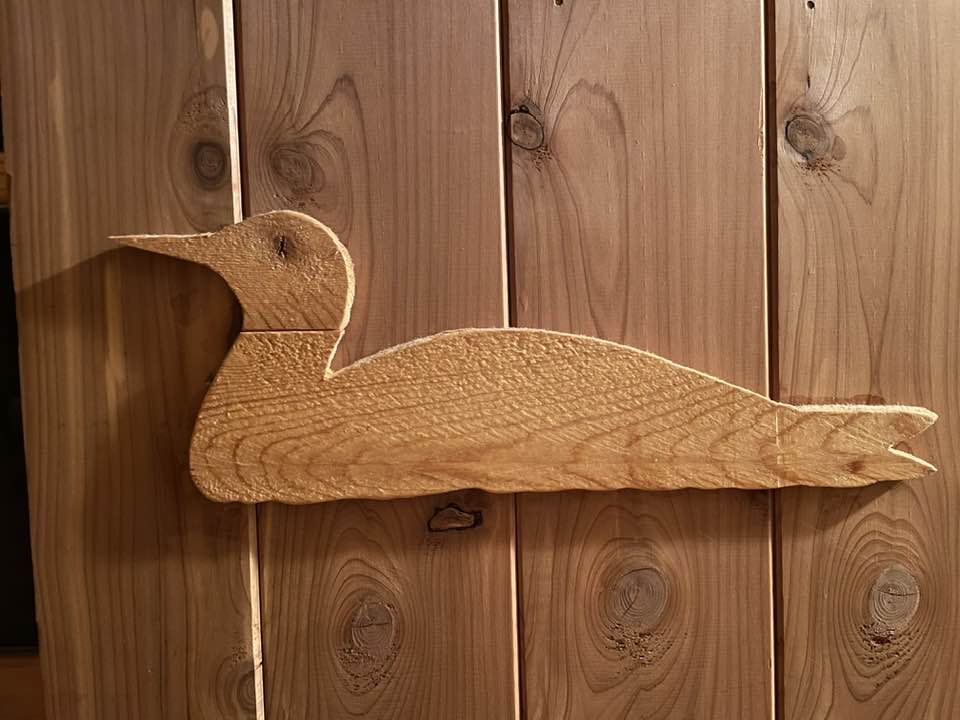
JULY 21, 2025 – Yesterday I watched a pair of loons while they fished in waters just off our shore. I was impressed by their familiar search for nourishment. Showing their distinctive profile, they trolled quietly and with an economy of motion. Occasionally, one or the other would dip its head into the water for a better look. The head would come back up, and a few seconds later the whole loon would disappear below the waterline. A minute later, up popped the loon many yards from its vanishing point. I marveled at this process perfected by a creature that I understand hasn’t evolved much in over a million years.
Today I saw an eagle gliding above the dock, its eyes trained on the same fishery where the loons dined yesterday. I didn’t see the eagle score a hit, but I’ve seen it several times before—the raptor descending on its prey, then, with talons extended, the bird snatches its dinner out of the seafood . . . er . . . lakefood . . . section and carries it off to its private dining quarters.
These nature scenes induce awe in us humans. We want to capture a close-up photograph of the loon with a perch fry in its bill or the eagle with a pike in its talons, but we’d settle for an enlargement of the quick pick of either bird at rest or in flight.
Yet, from a purely practical viewpoint, for all their majesty, the loons and the eagle and all the other creatures in the wild are simply obsessed with their next meal. (Well, okay, squirrels take a longer view, though that’s undercut by the fact that they often can’t remember where they stashed their acorns.) The loons don’t stay submerged for 90 seconds in training for the Loon Olympics, and the eagle doesn’t go after big fish for the sport of it. They’re all about . . . food.
We humans, on the other hand, have evolved way beyond this central motivation in life. Sure, we can’t live without nutritional sustenance, and it’s cliché to speak of gainful employment as the means “for putting food on the table,” but for most people, making money is what pulls and pushes us through each day—money being necessary for a lot more than food.
Money of course, is simply a medium of exchange. We’re interested in making money because it allows us to buy stuff and services we need to survive, given how our economy is ordered. In this regard (and many others), we Americans are different from loons and eagles. Those creatures don’t worry about clothes, housing, transportation costs, medical expenses, and all the rest. Maybe the loons and the eagle could be made to understand the nature of humankind’s “necessities” and take pity on us for how rough we have it—having to worry about so much more than just food. But where the loons and the eagle would be forever “wingin’ it,” would be in trying to grasp the most basic dynamic of a market economy: supply and demand.
In its most fundamental state, supply-and-demand under capitalism works this way: a greater demand for widgets relative to supply will result in an increase in the price of widgets, which, in turn, will motivate widget makers to turn out more widgets, theoretically resulting in a lower price, though probably not as low as before. If the demand for widgets is elastic, all is good for the widget makers, who (putting the illegality of collusion aside) can increase prices without necessarily having to increase supply. This is a sure bet way of making more money. Easy peasy.
But in a consumer society with non-stop ubiquitous marketing, we’ve long been down a path of infinite demand. In many respects, what used to be non-existent before becoming discretionary are now necessities. We’ve worked ourselves into a consumption frenzy. At the base of it is the obsession with making more money. How do you make more money? One of three ways: 1. If demand is elastic, charge more per unit of stuff or service; 2. If current demand is underserved, fill the existing supply gap; or 3. If there’s no or little current demand for the stuff or service you want to sell, you create demand, then provide the supply.
To survive, a market economy must grow continually, year on year, decade after decade. If it stumbles, bad things happen, the over-arching one being recession or, to avoid the “D-word,” a “Great Recession.” This imperative, it seems to me, is what drives us to Krazy Town. It requires a constant ratcheting up of demand; creating a demand where before none existed. As a result, people on the “supply side” work themselves ragged devising, then filling, an artificially created demand. People on the “demand side” likewise work themselves into a frenzy wanting, then needing all the stuff and services being marketed to them. Turn the crank several times, and now the “demand” people are having to amp up their labors inside the gerbil cage to afford all the new stuff and services they once wanted, but now must have. When the wheel in the gerbil cage breaks—job loss, recession, etc.—what seemed like such a perfect economic dynamic (supply-and-demand) becomes disordered, leaving misery in its wake.
Explaining this flaw (just one of many) with our economic order to the loons and eagle would likely fly over their heads. “But don’t worry,” I’d say to each bird. “You’re not alone. Most humans don’t get it either. Yet we keep on going, for the most part accepting the way things are, working the margins but never buckling down to effect fundamental change. Yet, we can kick the can down the road only so far. Eventually, to avoid serious cuts and loss of blood, we need to replace the can with real ideas for structural reform. Neither the DOGE cuts nor the BBB counted as reform. Neither does the campaign slogan, “Throw the bastards out—and by the way, they really are bastards.” We need serious ideas from serious people.
Subscribe to this blog and receive notifications of new posts by email.
© 2025 by Eric Nilsson
