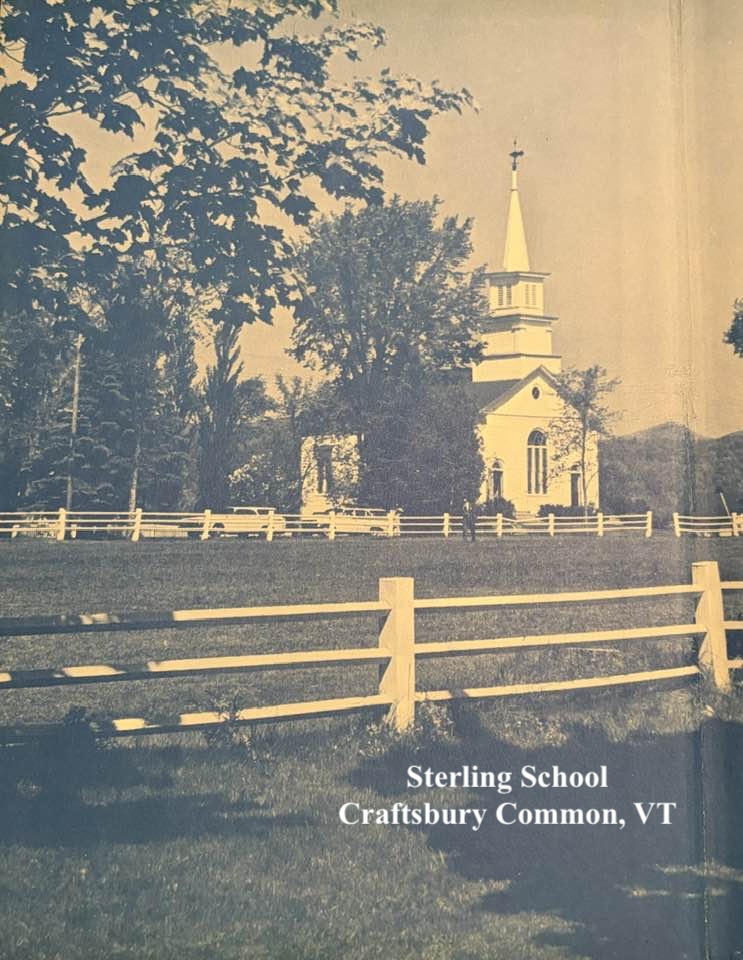
MARCH 12, 2026 – This past Monday’s post was entitled, “Why I Went to College.” Today I learned “Why I went to high school,” or more precisely as regards the latter, “Why I went to a particular high school.”
Long-time subscribers to this blog are familiar with my connection to the Green Mountain State; specifically, to an especially paradisical corner of Vermont, called the “Northeast Kingdom,” located in the extreme northeast alcove of the state. How I landed there was a riot of randomness; an early lesson in how the “dots in life” connect. Upon reasons squirreled away in previous posts, for my freshman year I wound up attending an obscure boarding school—Sterling School—located in the hilltop hamlet of Craftsbury Common.
Founded in 1958, the school was designed to instill in its charges a mix of social decorum, academic discipline and appreciation for the great outdoors, whether on the soccer pitch, the ski slopes of Mt. Mansfield or during the school-wide compulsory winter Outward Bound trip in a part of Vermont so remote I couldn’t relocate it if you gave me a compass, a topo map of the state and a month to search.
What the campus lacked in physical facilities—there was no gymnasium, no formal auditorium—it more than compensated with New England gift-calendar-picture-quality surroundings. Coat and tie were mandatory (except for athletics and Outward Bound training) and we had to stand up in class when a “master” entered the room. Our sit-down dinners were formal affairs, served by student waiters, but our dorm rooms featured unsanded, unvarnished wood and were otherwise bare-bones barracks. If the two-story freshman dorm—Adams Hall—had ever caught fire, the blaze would’ve been short, down to the ground and deadly.
I’ve heard it said that irony is the grist of literature. Well, of course it is, because literature is about life, and life revolves around irony. Sterling’s role in my life was filled with irony.
First off, a contributing factor in my landing at the school was the cumulative effect of a 10-year battle with my parents over the violin: more than anything else, it seemed, they wanted me to practice my violin. Our problem—theirs and mine—was that I wanted nothing to do with the !@#$# violin. Ultimately, I won the war: when I was sent off to the obscure school in a state to which no one in our immediate family had ever ventured[1], I did so without the ball and chain of the violin. I loved the school, and I was well aware of the irony that my attendance there was a result of the violin, which I hated.
About three months into the experience, more irony struck: by way of the radio alarm (the buzzer alarm wasn’t working) on my clock radio, each morning I heard a five-minute dose of classical music broadcast from the CBC across the nearby Canadian border. It was the only signal my radio could pick up. In time I realized I couldn’t live without classical music. Soon thereafter, a friend who was the greatest downhill skier I’ve ever encountered—to this day—and who played guitar in school garage band, learned that I played violin. His surprise turned into a lecture that outdid my parents’ best arguments for “why Eric should practice.” After the next school vacation, I returned with my violin and practiced in earnest.
One thing led to another, and by the next school year, I was a violin major attending Interlochen Arts Academy a gazillion miles from Sterling, geographically and metaphorically. I wouldn’t return to Sterling for 40 years, and in the intervening years, I lost track of everyone I’d ever associated with the place. The school eventually morphed into Sterling College, with a strong environmental theme inherited from Sterling School. In 2005, my wife and I attended an all-school reunion, where I reconnected with a number of people from my era, though none from my class or inner circles of friends. The reunion connections weren’t sufficient to rekindle bygone attachments to the establishment.
Twenty years later, a new subscriber to this blog sent me a note. His name was Erik Hansen, who’d joined the Sterling college faculty decades after my student days. A native Minnesotan, after a storied life away and abroad, Erik had recently returned to his original roots—he being the adaptive sort who had “rooted” himself in many places far and beyond Minnesota and North America. Over a delightful three-hour lunch a year ago, we discovered many shared perspectives.
Today we enjoyed a second three-hour lunch. If our conversation a year ago was enriching, today’s exchange was infused with a greater sense of urgency, fueled in part by the drastic events in the world over the past year (let alone the past 10 days), but also by an added year of perspective at an increasingly vulnerable phase of life.
Erik is many things—a deep thinker, a keen observer, an avid outdoorsman, a learned scholar, an original philosopher, an experienced traveler, a committed teacher and mentor and above all . . . a writer, by aptitude and training, but most critically, by discipline and disposition.
Currently, he’s working on a magnum opus; a novel with roots in Old Norse myth and legend meshed with this grandparents’ immigration to America and interwoven with his own remarkable journey. But the book transcends plots and stories per se and their characters. It addresses the “impermanence of permanence” and filters much other Buddhist wisdom through Erik’s originality and exceptional life experiences examined through a Scandinavian lens.
As I listened to Erik and absorbed all that he had to impart, I felt greatly enriched and therefore, deeply grateful. After bidding each other farewell until the next conversation, which we agreed would be soon again, I realized that his friendship, initiated over half a century after I’d left Sterling School, is a bright light response to . . . “Why I went to high school; specifically, why I went to Sterling School.”
Our lunch conversation today was among life’s treasures that don’t fully surface until we are old enough and lucky enough to see them.
Subscribe to this blog and receive notifications of new posts by email.
© 2026 by Eric Nilsson
[1] Before I arrived on campus with my trunk and duffle bag after a four-hour trip from Logan Airport, neither my parents nor I had ever set foot on Vermont soil. “UB” (see Sunday’s post), on the other hand, had close ties to the state: he’d graduated from UVM and was part owner of a ski area in southern Vermont. For decades he spent pretty much every winter weekend skiing in Vermont. But he’d never done re-con on Sterling. It seemed as though from my parents’ perspective, UB’s affinity for Vermont was sufficient approval of Sterling, however tenuous the connection.
