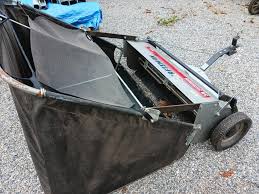
NOVEMBER 12, 2025 – When I was a kid, Dad bought a fancy-shmancy lawn sweeper to replace the rake that he’d used every previous fall. It was from Sears Roebuck, which meant he had to assemble it himself. I remember watching him pull the parts out of a large cardboard carton labeled, “Craftsman” and assemble the apparatus down in his basement workshop, which had a convenient walkout to the backyard.
Under Dad’s expert control, the lawn sweeper worked like an industrial-gauge carpet cleaning machine. I liked the contrast between the solid dark green “carpet” where he’d “swept” and the part of the lawn that was still hidden under a blanket of leaves. Since our lot included a back woods, Dad had plenty of room for dumping the swept-up leaves on-site but out of sight, just as the neighbors across the street pitched their leaves over the steep riverbank along their spacious river lots. Dad had no need and certainly no inclination to emulate our next door neighbor, who raked his leaves into the street and doused them with liberal amounts of gasoline before turning the scene into a pyromaniac’s dream. Even as a young kid, I knew enough to take a few steps back before the match was lit.
As with so many things, Dad set a high standard. Decades later when I had my own leaves on my own yard to manage, my ideal was to remove every single leaf just as Dad always had. Beth and I didn’t have a yard big enough to warrant a lawn sweeper of the International Harvester size that Dad used. Nor was there any extra room in the garage to accommodate such a large piece of equipment that was used so infrequently. Instead, Beth and I used the old-fashioned method: rakes and bags. Each fall we’d rake the leaves into big piles, then stuff a good dozen bags—large plastic ones—and haul them to the local public composting site.
Year after year.
After Beth retired from leaf patrol, I stuck to the rake-and-bag method, even though most of our neighbors had transitioned first to leaf-blowers, then to hiring professional lawn services, all of which used HEAVY DUTY leaf-blowers. I did figure out, however, that if I worked hard at compacting leaves after stuffing them into the bags, I could reduce by more than half, the number of bags I’d have to haul to the compost site.
But this year, I get even smarter: I figured out just how dumb I’d been—or more bluntly, how dumb the whole world has been when it comes to clearing leaves from lawns.
It started with my time in the woods up at the lake. As I dug down into the earth a short way to create a suitable base for each post of my Pergola-on-a-Platform, I found in the detritus of the previous years’ leaves and twigs, a reminder that the woods are a giant never-ending recycling center. Every spring the woods turn green with leaves. Every fall those same leaves turn all sorts of fall colors, then drop to the ground, where in time they recycle into the soil and provide nutrients for the very trees that generated the leaves—and for the progeny of those trees. And so on, year after year.
In short, the trees feed themselves and each other.
But now consider the typical urban yard inhabited by trees. When fall arrives, the trees do what trees do, no matter where they stand: they shed their leaves. And what do we in our unthinking smugness? Of course. We arrange to have the leaves raked, blown, collected, dumped into a large trailer and hauled away unceremoniously . . . out of sight and out of mind.
Over the past week or two as trees in our neighborhood were turning all sorts of beautiful colors, I began to question my long-standing Norman Rockwellian view of fall leaf operations. The trees in our own yard—bright birches and brilliant maples—were in their full fall regalia. Passers-by saw beauty. I did too, but I also saw a million little flags signaling, “We’re about to fall! What are you going to do about clean-up?” I was not looking forward to the task.
Late last week, half the flags were on the ground. By this morning, nearly all the rest were down as well. Beth said, “What are we going to do about the leaves?” meaning . . . (a) was I planning to rake them, bag them, and haul them, or (b) are we hiring out the work? I mumbled a non-committal response.
As I set out on my walk this morning, my ears were assaulted by the high-decibel V-R-A-A-A-A-A-A . . . V-R-A . . . V-R-A-A-A-A-A-A-A-A . . . V-R-A-A-A . . . of a commercial-league leaf-blower deployed mercilessly by a lawn service guy “servicing” a neighbor’s yard two doors down across the street. The output was so great I had to hold my hands over my ears until I was well down the block. I could still hear the blasted machine when I was more than a quarter-of-a-mile away from it! Just think, I mused, what a better world it would be if the noise of a gas-powered leaf blower could be transmogrified into a Bach Toccata.
Upon my return 45 minutes later, the lawn service guy and his confounded leaf-blower, 10-ton pick-up, and double-axel trailer had vanished. The lawn was leafless—a dark green, wall-to-wall carpet just like the one that covered our family’s lawn after Dad’s clean-up job with the lawn sweeper. Our lawn, on the other hand, from back to front and side to side, was completely covered with leaves.
Given the sunny weather and balmy temperature—and that on the work front I’d batted all the “legal balls” out of my court for the time being—I decided it was time to carpe folia.
Enter our neighbor Lynn. I remembered the brief exchange I’d had with her recently over the fence. She’d just pulled the lawnmower out of her family’s garage when I’d returned from a walk and was striding between our houses.
“Lynn,” I called out, “I think that’s the last time you’ll be using that this year.”
“Actually, I’m going to use it to mulch our leaves.”
“Not a bad idea,” I said. Truly not a bad idea at all, I thought. It was all the inspiration I needed.
Today I gassed up our lawnmower and turned it into a mulching machine. The only raking I did was to pull leaves from the corners of our patio out onto the lawn. The whole operation worked beautifully. With far less labor in far less time than would’ve been expended in raking, bagging, and hauling away leaves, I reduced the “million little flags” to millions of confetti particles. By spring, the confetti will become recycled nutrition for its source—our trees!
And in contrast with the dratted V-R-A-A-A-A-A-A . . . V-R-A . . . V-R-A-A-A-A-A-A-A-A . . . V-R-A-A-A of a leaf blower, the lawnmower purred . . . b-r-r-r-r-r-r-r-r-r-r-r.
I dream of the day when our tidy little town will be known as “Mulchville,” where the trees are robust, the autumn lawns are green carpets, leaf-blowers are outlawed, and rake handles are used as fashionable walking sticks by residents out walking their dogs.
Subscribe to this blog and receive notifications of new posts by email.
© 2025 by Eric Nilsson
