JULY 18, 2025 – When it comes to tackling an arduous task, I find that often the best approach is to analogize it to something outrageously dramatic or otherwise ridiculously imaginary.
An example of the former was a scene I adopted to get myself through a particularly grueling American Birkebeiner x-c ski race. I pretended that I was a volunteer in the SACCS [short for, “Scandinavian-American-Canadian Ski Corps], which had been raised and trained in North America, then deployed to the far north reaches of the Scandinavian Peninsula to free Norway, Sweden and Finland from brutal Russian occupation. The only catch was that our commanding officer was a former Russian Olympic Biathlon gold-medalist-turned-defector, who brooked no complaints. To ensure we were effectively motivated, he issued an order that all stragglers among us were to be shot at the slightest sign of . . . straggling. With the thought of these dramatic circumstances looping through my head, I managed to maintain my pace and finish the 52-km race with a halfway respectable time—for me, anyway.
Today I motivated myself with a focus on less dire conditions. The task, which I alluded to yesterday, was to haul rocks uphill. This foundational effort, as it were, was to build adequate bases for each of the four posts that will support my Pergola-on-a-Platform high up in our woods.
You would be wholly aligned with reason to ask, “Why? Why way up in such an inaccessible place, when you could build it much closer to the lake, where you and your guests could see it and appreciate it without so much effort; without having to mimic the legendary labors of Sisyphus?” As I explained previously, I like the idea of creating a rather sizable and totally whimsical structure in an improbable place, causing a stir in the thoughts of the few hiker-visitors who might wander up “Nor-Way Trail in the Björnholm Trädgård. A secondary reason is that I don’t want the tax assessor to jack up the assessed value of the property on account of this added “improvement.” On the other hand, it could be that if the assessor did catch a glimpse of my Pergola-on-a-Platform, he’d reduce the assessment—perhaps materially.
Whatever. I’d committed to the site, and this irrevocable decision would require no fewer than 12 loads of rocks and sand.
Taking a step back for background . . . Recently, I viewed with amazement a friend’s daily posting of photos of his cross-country (as in across the whole country of America) bike trip on the Great American Wheel Route. One of my comments was that to grasp fully geographic distances, a person needs to walk them. At some scale, such as the one my cycling friend is on, biking accomplishes the same thing: an appreciation for how much grass is in Nebraska, for example, and how much corn is in Iowa.
Today, I thought about my walking/biking adage as I lugged all those rocks up the narrow trail. I’d blazed the trail eight years ago and regularly battle the persistent vegetation along its course. In short, I know the trail as well as the back of my ha . . . make that the veins of both my forearms after umpteen blood draws over the past three and a half years. But in the context of hauling rocks today, I modified my axiom: “To come to terms with this trail, a person needs to hike it carrying a heavy load of rocks.”
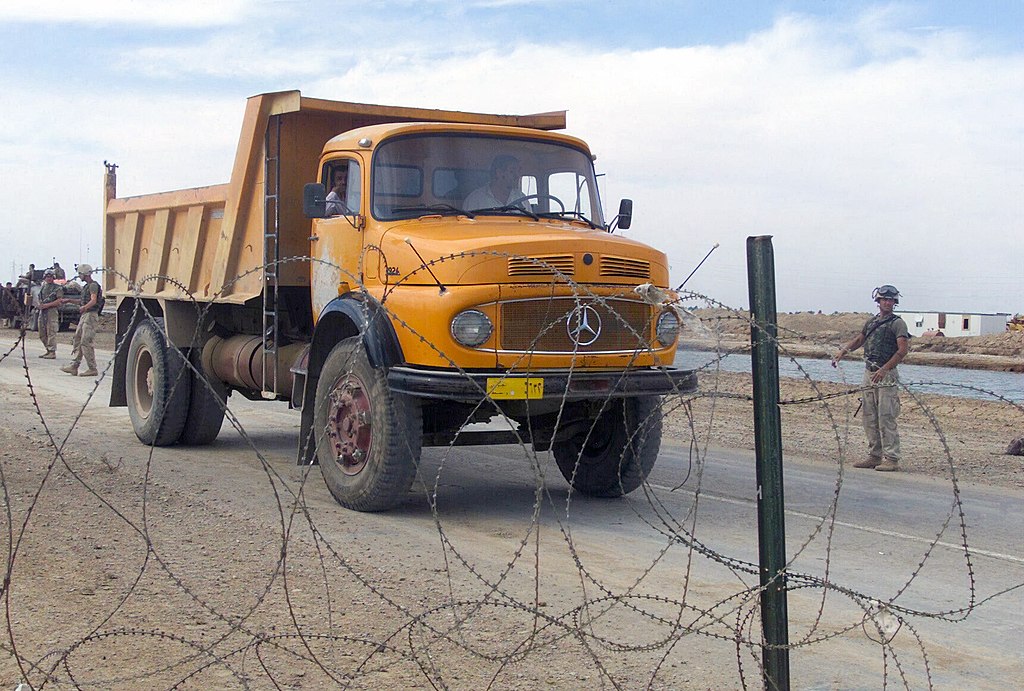
Once that modification sank in, I decided to have some fun. I imagined myself as an independent dump truck owner trying to scratch out a living in the Pacific Northwoods. My old piece of equipment had seen many years, many rough assignments. The beat-up truck was nothing to look at, having lost its shine and most of its paint on the top of the cab. The tabs were current, but the license plates themselves were bent, dented, dust-covered and barely legible. The tires—should’ve been replaced years ago, but for reasons known only to the road gods, still held enough air to carry the truck—fully loaded—up and down dale, on road and off.
At the quarry, workmen loaded up the open-box bed until the tires threatened to blow. I then shifted into gear, and with a slow grind I rolled down the two-lane highway leading toward the series of dirt roads I had to take to reach the summit of Mt. Raymond. I imagined sporty cars passing me with great flare. I felt no need to increase my speed; no compunction to race and roar up the mountain. I was paid by the hour for this gig, plus meals, so why hurry?
As I approached the second turn-off on the road leading out of town and into the deep woods, I winked repeatedly my left eye. The half-broken orange signal light mounted atop the left fender obediently complied. I then downshifted and negotiated the turn onto the (rugged) short-cut trail I’d established yesterday. Soon I merged onto “Björn’s Walk” trail, already elevated from the road out of town. By third gear, I found my stride . . . er, step . . . toward the junction with “Ray-Way.”
“Ray-Way,” is the route that leads all the way to the top, where it turns into “Nor-Way. The first section features a gradual incline—nothing too serious, yet enough slope to provide a reminder of The Little Engine that Could. After 40 paces or so, the grade increases more dramatically, and by the time the trail passes under the large fallen oak that requires a substantial “duck,” my imaginary dump truck wonders (again) if there’s adequate clearance. The truck always makes it—without having to let out any air from the tires—but invariably the long log grazes the top of the cab.
Just beyond the oak underpass, the way turns sharply and enters a dense poplar zone. This part is called, “The Ladder,” given how straight and steep it is. At the top is a hairpin turn, necessitated by another fallen tree. I say “top,” but in fact the summit still lies ahead, though the incline to it from the top of The Ladder is far more manageable.
After 15 or 20 paces, the construction site comes into view. I downshift and ease up to the rock pile and disperse my load. As I do so, I transform myself from an old guy driving a dump truck to just an old guy with an empty rock-carrying pack. I feel the contrast between being seriously overweight and “skinny,” and I understand why weight loss programs and supplements are a multi-billion-dollar business in our culture.
Having brought another load of rocks to the very top, I’m that much closer to completing an “arduous task.” The successful weight-loss program—so to speak—motivates me to go back for another load. The hike will be a breeze—and all downhill; as close to weightless as I can be on planet earth.
Subscribe to this blog and receive notifications of new posts by email.
© 2025 by Eric Nilsson
