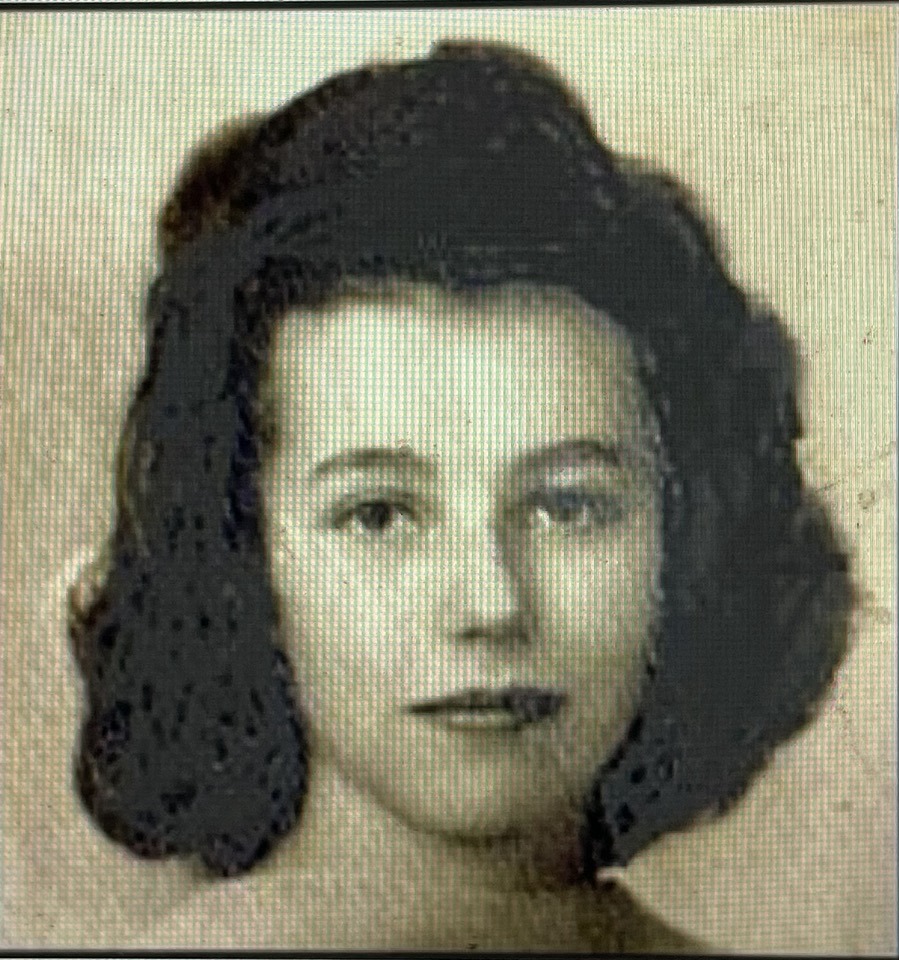
OCTOBER 23, 2025 – No person alive knows for sure when and why Mother developed her “nervous tic,” as my sisters and I learned to call it, because that’s what Mother herself called it. Given her glamorous appearance in her high school yearbook picture and the photos that graced her and Dad’s wedding album—not to mention our grandmother’s attestations about Mother’s extraordinary popularity in high school and college—I doubt very much that Mother displayed a “nervous tic” when she was young. I suspect it first appeared after her electric shock treatments at age 27. They’d been administered at Belle Meade, the renowned psychiatric institution in New Jersey where my grandparents had placed her after the first time her rich mind had plunged into psychosis. I’m no neurologist or physiologist, but based on good ol’ post hoc, ergo hoc reasoning and the lack of other known possible causes, I’m sticking with my theory of causation behind the “nervous tic.” Of course, the sketchy part of this somewhat flimsy logic is the assumption that Mother hadn’t exhibited the “nervous tic” before the shock treatments. As I said at the outset, no one still alive is around to confirm or refute my assumption.
In any event, causation is an academic question, especially given that Mother died seven years ago at the age of 93. In her old age, the “nervous tic” was less evident, perhaps because by that time, thanks to advances in the treatment of bipolar disorder, Mother was on a regimen of psychotropics, albeit with checkered success.
Our family—Dad, my three sisters, and I—were well accustomed to the “nervous tic.” From where we sat or stood, it was as much a part of Mother’s aura and personality as were her many other memorable traits, mostly manifest in her extraordinary capacity for interacting with people of all kinds, of all backgrounds, of all circumstances. Her brain was always in overdrive; her intellectual curiosity, insatiable.
As a kid I was more entertained by the “nervous tic” than I was embarrassed by it. Unlike your garden variety facial tic, Mother’s tic version reminded me of a baseball pitcher. If you studied her face carefully, you’d notice the preliminary stages to the actual tic—or pitch—itself. First came the “signal” phase. That was Mother’s reaction to someone’s statement in conversation; an assertion, point of information or what have you that seemed to speed up one of the gears inside her head. It might be an assertion by someone or a remark with an element of surprise that required a sudden change in the direction of Mother’s thinking. Whatever the trigger, her eyes and facial muscles signaled that the tic was winding up for the “pitch.”
Based on my now distant recollections, I don’t remember that Mother’s “nervous tics” ever came out of nowhere, as it were. Inevitably, it seemed, the tic was triggered by conversation. The most hilarious example occurred when our whole family was packed into Dad’s two-door Buick Super on our way to Sunday dinner down at our grandparents’ house in Southeast Minneapolis. I wound up sitting directly behind Mother, who was still wearing her church finery, including a stylish (for her, anyway) hat in keeping with the norms of the day. I don’t remember what the conversation was all about, but I’m confident there was one: you couldn’t get far, let alone all the way to Minneapolis, without an energetic exchange of opinions among my sisters and parents. Someone must’ve triggered the “nervous tic,” because I remember watching the back of Mother’s head winding up for the pitch. It was a fast ball right across the plate. Mother’s head jerked so hard her hat flew right off her head and into my lap, like chalk flying off a baseball when it smacks into the catcher’s mitt. My sisters and I went into immediate hysterics. That was entirely predictable. Less predictable was that Mother herself joined in our laugh fest. Fortunately, Dad’s eyes were on the road, but his quick glance to the right told him what had happened. Now everyone in the car was laughing—hard.
By that time, of course, I was well acquainted with Mother’s “nervous tic.” What impressed me most on that occasion was her ability to laugh at herself.
That’s all background to the dream I had last night. I was back at our family home in Anoka—along with all three of my sisters and our parents. We were visiting in the living room, and everyone was in good cheer. One of my sisters—I’m not sure which one—requested me to do some impressions, which, way back when, I used to do impromptu. “Do the family!” she said.
“First up,” I said, “is Mother.” I stood in the middle of the room and imitated her “nervous tic,” complete with a slow-mo wind-up in which I slowly opened my mouth in synch with my head twisting to the side. Then, on the return, I raised my upper jaw at the same time I gradually dropped my lower jaw. With these motions I timed the words, “I’m . . . do-. . . ing . . . this . . . just . . . to . . . be . . .” When I reached the final word of the sentence—“funny”—I released the fast ball; that is, I snapped my head in the final step of the “nervous tic.” And I pronounced “funny,” “F-U-H-nny.”
Everyone laughed, but Mother laughed the hardest. I stepped over to where she was sitting and gave her a big hug. I then woke up—with a smile–realizing how much I missed her, “nervous tic” and all.
Subscribe to this blog and receive notifications of new posts by email.
© 2025 by Eric Nilsson
