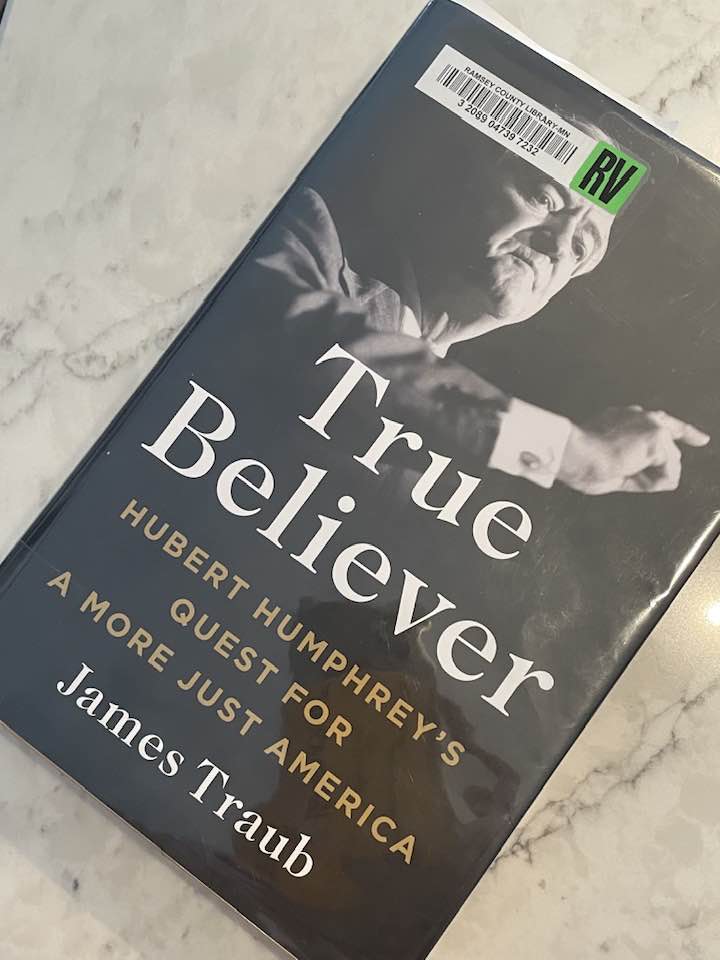
JANUARY 20, 2026 – To get my mind off Trump’s War of Retribution and his insane designs on Greenland, not to mention the business in Venezuela (what’s going on there now?) and the DOJ’s suppression of the Epstein Files (remember those?), I check regularly the week’s weather forecast: Friday’s high of MINUS 14F. The reminder helps me keep my cool. But it’s hard—as hard as ice at that temperature—especially in light of having completed reading True Believer, James Traub’s definitive biography of Hubert Humphrey.
Yesterday I dug up the author’s email and sent him a note of gratitude and appreciation for his remarkable work. I compared it favorably to Robert Caro’s acclaimed four-volume (with a fifth in progress) biography of LBJ. Traub kindly humored me with a short reply, writing that there was no way his work could match Caro’s masterful treatment of Humphrey’s mentor, “boss” and sometime torturer.
While observing in real time the wholesale wreckage of Trump II, a person can easily forget that the study of history is just as shocking as a view of the present.[1] What shocks me so much about the history of the 1960s and 70s, is that having been born in 1954, through the pinnacle years of Humphrey’s life and career, I was growing increasingly aware of the world beyond my personal universe. The 1964 presidential campaign and election made a lasting, if superficial, impression on my young mind. The shadow of the Vietnam War, the unsettling domestic violence and disruptions of the late sixties, the 1968 assassinations, the political turmoil in that same year, Kent State, the expansion of the war into Laos and Cambodia, Nixon’s crushing victory over McGovern, the Watergate break-in and subsequent scandal—all these were shocks and jolts that I couldn’t ignore, despite my youth and naïveté.
In most cases, simply because immediate necessity requires it, individually and collectively we move on; our memories fade to create added “bandwidth” so we can confront immediate demands and satiate present desires. Just imagine if we remained fixated on the past at the expense of addressing the present or future. We’d remain forever stuck in an ever deepening rut.
Paradoxically, however, by forgetting the past—or given the inescapable effect of generational replacement, by not knowing the past in the first place—our pace forward is forever burdened by mud from the past; thick, heavy mud from the ruts our forebears inherited and passed on to us and the new ones they created.
In studying the life and times of Humphrey, I’m struck by how little has changed regarding the fundamentals of our deeply rutted republic. The details are a mix of “shock and awe,” to borrow a phrase applied here wholly out of its original context.
One persistent feature of our flawed democratic landscape is campaign finance. People of the center-left today often cite Citizens United as the trigger point for the “legal corruption” of our current electoral system. I would be among the harsh critics of that toxifying decision of the Supreme Court, but I would also point to the larger problems: duration of the campaign season and private financing of political campaigns. These basic flaws didn’t arise out of Citizens United. They were unbounded by it. If you reach back to Humphrey’s presidential campaigns—the general election in 1968 and his (unsuccessful) nomination quest in 1972—you can see that over half a century ago, the same problems of a grueling nomination process and constant appeal for funds were central hurdles for everyone except, the Kennedys. What I didn’t appreciate as an 18-year old voter, however, was the crushing effect that campaign finance laws of the time had on a number of prominent donors—Democrats, as well as Republicans.
My personal “shock and awe” occurred when in the course of my study of Humphrey’s own brush with finance violations, I learned that a prominent lawyer with whom I’d once had business dealings (while I was at Wells Fargo) had been Humphrey’s national campaign manager in 1972 and . . . drum roll, drum roll . . . had gone to prison (long before I’d even heard of him) for having violated campaign finance laws.
From a domestic policy perspective, Humphrey’s era ran amok of America’s tandem swamps: race relations and unequal economic opportunity. In the 1968 and 1972 campaigns, Humphrey faced persistent tension between left and right; between McCarthy and Bobby Kennedy, then McGovern on Humphrey’s left and “law and order”/war hawks on his right; between Black advocates of desegregation by busing and suburban whites vehemently opposed to is; between business interests wanting government out of their . . . business . . . and labor unions pushing for a bigger share of the pie; between the demands of civil rights leaders and the anger of “lunch bucket” whites now migrating to George Wallace’s version of “common sense” and “states rights.” These tensions all spilled out on the streets—most notably of Chicago—and TV screens across the country—in late August 1968, wrecking Humphrey’s long-time and well-earned dreams. Smashed in the wreckage was not only his own political career, but prospects for a better, more just, more broadly prosperous America. Four years later, Humphrey would lose the nomination to the man on his left—George McGovern—who himself would lose to the man on Humphrey’s right . . . Richard Nixon.
The same unbridgeable divides of the 60s and 70s persist to this day, mostly manifest in economic disparities, giving rise to populism that in many ways mimics the rise of George Wallace, albeit wearing a clown hat and make-up.
At the center of Humphrey’s career in Washington was LBJ, the unrivaled grand master of American politics. Their relationship was remarkably close, but not as friends, colleagues or even collaborators, but more as puppet and puppet-master. What’s so utterly sad in retrospect is that as a result of the Johnson’s obsession with Vietnam and insistence that Humphrey follow the president’s line—“or else . . .”—the oxygen was sucked out of America’s future. Johnson’s handling of Vietnam and manipulation of Humphrey right up to Election Day 1968 is what led to Richard Nixon, who took us down a very different path from what it could well have been under the “Happy Warrior” from Minnesota.
What we need now more than ever before is Humphrey’s indefatigable persistence, vast political skills, substantive grasp of thorny issues, ability to get along with people with whom he strongly disagreed, and perhaps most important, his irrepressible optimism. But the unsolved problems of his time reveal remind us that just as roughly half the nation rejected Humphrey back then, in November 2024, again about half the voters rejected the character traits with which Humphrey was imbued.
I just checked the forecast again. The promise of MINUS 14F on Friday is holding.
Subscribe to this blog and receive notifications of new posts by email.
© 2026 by Eric Nilsson
[1] As an incurable optimist—an evolutionary survival trait—I remain more hopeful about the future (See the humanity’s “grand arc of migration and integration,” as my wife’s astute cousin identifies the high level trends of our salvation).
