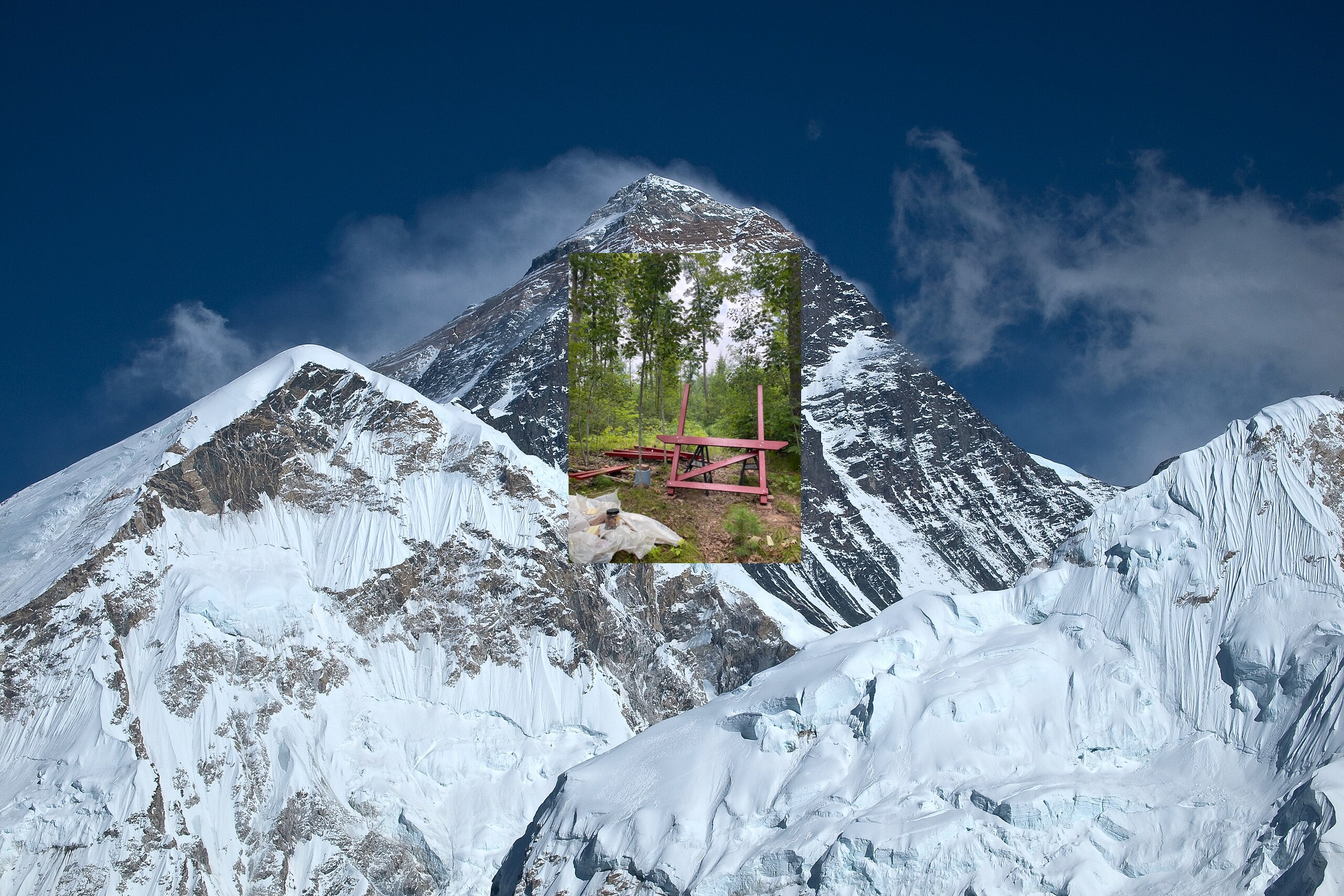
AUGUST 4, 2025 – In the thick of this morning’s Canadian smoke, I continued my work on the Pergola-on-a-Platform. Each phase of the project brings new challenges, as is often the case when putting theory into practice.
I started by hiking over to Rustic John’s compound to help myself to a couple of five-gallon pails worth of gravel. Don’t worry—I’d asked John if I could take some from his five-foot high mound of road material he keeps on hand. He’d said, “Go ahead.” Instead of using five-gallon pails, I went whole hog and used a wheelbarrow. This I pushed all the way back to our place, thence deep into the woods to the jumping off trail into the tree garden. At the junction, I shoveled gravel into the bags of my über-forester’s seedling carrier and hiked up the “mountain” to the construction site. After dumping the gravel around two of the four pads for the legs of the structure I’m building, I repeated the exercise for the other two legs.
Next, I hauled up a couple of sawhorses and my tools to begin the long-anticipated work of assembling the Pergola-on-a-Platform. It felt like an almost mystical moment of truth—and I was scared. I kept putting it off to reset the sawhorses, re-organize the lag screws, and move into more optimal position, the first four or five pieces I’d be working on—anything to defer the commencement of the most critical phase of the whole operation.
What if all my designs and re-designs, calculations and re-calculations didn’t work out? What if the whole sculpture posing as some utilitarian structure turned out to be a complete bust; one big failure, both aesthetically and from the standpoint of any possible practical use? What then? How would I justify all my time and effort and cost—and painful irony associated with cost, since the impetus for the whole project had been my inventory of long dormant lumber stashed away both at home and at the Red Cabin? (Thus far, I’ve spent a hundred bucks on paint alone and another fifty bucks on hardware, since my large collection of hex bolts and lag screws didn’t include what I wanted or needed.)
I felt a bit like a guy who’d taken a few lessons in technical mountain climbing and actually done some in real life out in Yosemite and once in the Dolomites, before joining the legions who think they’re ready to climb Mount Everest. The guy trains for months, goes out to Colorado regularly to practice climbing as many Fourteeners (out of the 58) as possible. He’s all excited about his venture and posts regularly to his blog, called, “Everything for Everest!” It’s about all that he can talk about at the office, at client meetings, firm meetings, any kind of gathering, and of course, whenever he squeezes time from his busy work and training schedules to socialize. Everyone who knows him knows he’s planning to scale Mount Everest.
Then, amidst great fanfare among his friends and associates, he departs for Nepal. And returns unceremoniously about two weeks later. He slips into the office, business as usual, and goes about his daily life as if nothing changed. Because it hasn’t, or rather, he wishes that he’d never said a word about climbing Mount Everest and never spent all that time and money trying to do the impossible.
What he doesn’t want anyone to know is that 14,000 feet elevation above sea level is apparently his ceiling. Over in the Himalayas, he got so sick and disoriented after three days at the South Base Camp (17,598 feet), he had to be evacuated by helicopter at a staggering expense, which he was required to pay before the authorities would allow him out of the country. The whole venture turns out to be an object lesson in biting off more than he could chew. Nearly a year has passed since his return, and yet he never speaks a word to anyone (besides his spouse) about the humiliation. Being too damn nice, his fellow Minnesotans know better than to ask, “Hey, weren’t going to climb Mount Everest?”
With that analogy in my head, I picked up the drill and begin putting lag screws into the pre-drilled holes. On the third screw, I reached the limits of power torque. I took my hand rachet and continued where the power drill had gone on strike. Through the paint I could see that the predrilled hole was through a sizable knot. I then remembered how hard it had been to drill through the far denser wood of the knot. Now, I put extra elbow grease into the effort as the screw entered the post to which the cross member was attached. Suddenly, the bolt became all too easy to turn. I knew instantly that I’d busted the darn thing. It seems that wood is stronger than steel and man.
Now I felt like a solo sailor just starting an offshore passage to points far over the horizon, when his rudder snaps. His well-wishers are still waving farewell from the wharf, and he must now use his dinghy to tow the vessel back to port for repairs. Oh, the humiliation!
Soon, however, things got worse for me. After the two main braces on one side were in place, I stepped back and realized, “It’s not square! But how did that happen?”
It was now an hour past the time I’d planned to leave the Red Cabin for home, yet I was high up in the tree garden, sweating profusely—actually and figuratively—trying to figure out how to salvage my expedition to Mt. Everest; my solo journey across the Pacific in a 30-foot sloop; my “Pergola-on-a-Platform.”
Sometimes you need to aim for the bottom so you can get enough bounce to get your nostrils back above the waterline. That’s what I did today. The “bottom” was the prospect of having to rename my project, “A Platform-without-a-Pergola” or “A Bad Study in Wood and Lag Screws” or just plain, “Bonfire Opportunity.” These humiliating possibilities provided the requisite springboard to send me shooting up through the water’s surface like an ICBM launched from a nuclear submarine. There was simply no way I was going to declare defeat—at least not yet—and in short order, I made the necessary corrections to square things up. Despite the late hour, I continued by installing the diagonal brace on the side I’d worked into position. I could celebrate. Not only was now everything square, but my engineering proved to be every bit as sound in reality as it had appeared through multiple drawings in my drafting book. I could pack up my tools and descend the trail back down to the lake and the Red Cabin.
For the entire drive home, I mulled over “next steps,” and hashed over multiple possible alternatives for easier assembly of the remaining sides. I now have an “A-Plan” and two back-up plans. I can’t wait to resume work when I return to the project, which I’m “takin’ to the top.” Stay tuned.
Subscribe to this blog and receive notifications of new posts by email.
© 2025 by Eric Nilsson
