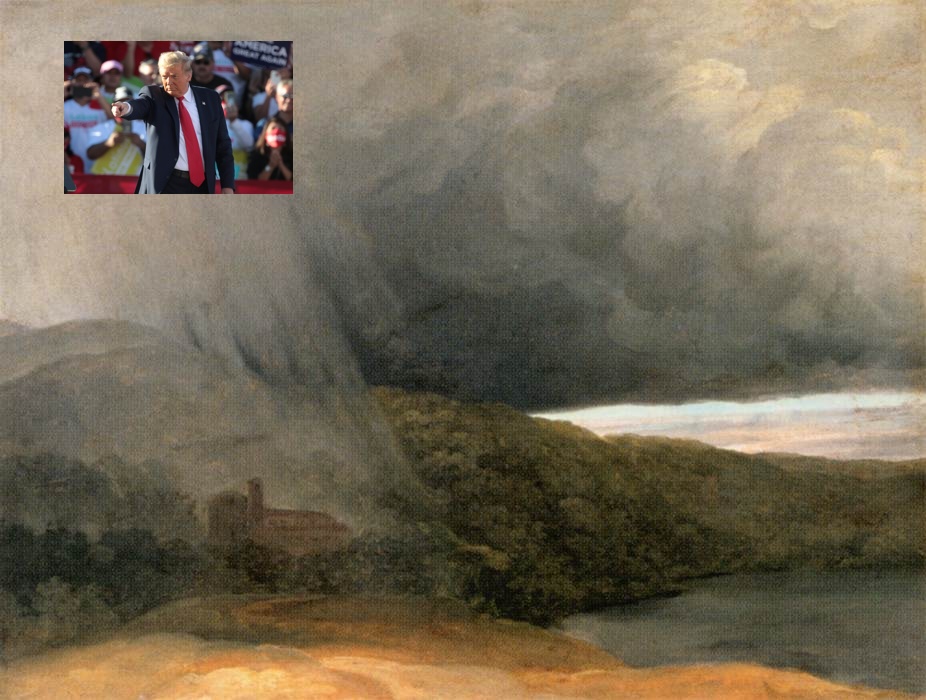
OCTOBER 12, 2025 – As I ponder current events, I wonder how to understand matters via some metaphor; that is, what imagery best describes our circumstances? Aside from amusement value, how might a metaphorical examination of our era open doors, windows, perspectives that would allow us to grasp our predicament with greater clarity?
I imagine myself in the English countryside—why English, I’m not sure, but perhaps because of the recent storm, Amy, which ripped with fury across all of Great Britain. Anyway, England it is, though not in the present but in the distant past. How distant, I leave myself ample berth but before modern conveniences such as electric illumination, telephone, gas combustion engines, radios, and meteorological technologies any more advanced than the centuries-old weathervane.
The specific setting is a farmstead of modest size and appointments, not unlike other farms in the area. The occupants tease and squeeze, milk and store from the land, enough food and good fortune to survive and propagate. Under normal circumstances life in this setting can be lonely, despite the compactness of familial existence. But so it is, so it has been, and so it will be among all people in all places, at all times: We are, after all, individuals with hopes, fears, joys, and burdens independent of all other individuals. Yet concurrently we are also inexorably interdependent, especially when catastrophe threatens or strikes.
Imagine, then, life on this modest English farm when thick gray clouds sweep in and block the sun. The wind picks up and blows loose anything that isn’t tied down. You’ve lived through enough weather to know what’s brewing and what’s at stake—your unharvested crops; your livestock; your house and barn; your stores of feed; your family and your means of survival.
As the wind now howls through the trees and makes them bend and bow in submission, you scramble to gather the animals into the barn, then tie down everything that would otherwise take flight. The crops must fend for themselves.
You’re desperate to finish up quickly so you can ride your lame but loyal horse to your neighbors’ place. They’ve been down on their luck—the man recently fell off a ladder and broke his leg; his wife is still recovering from childbirth that nearly killed her; their three older kids, all under 10, are left with the responsibility for farm and family. They’ll need help herding the animals to shelter and caring for parents and newborn sibling. Your ride is five minutes if you take the shortcut around the meadow across the stream—fordable now but for how long? You’ll still need to saddle up and calm down your horse who’s spooked by thunder and lightning.
The storm moves with uncontrollable anger. A lightning bolt hits the old oak by Gideon’s field and splits the tree as thunder rattles the soul with the sound of a cymbal crash. There’s no time left to ride to the neighbors; no time to save the hay outside from drenching rain. What do you do in the face of all hell now breaking loose?
What do you do as a citizen of the Republic under attack and siege by its own leaders?
Do you shutter yourself inside, throw a log on the fire, pour yourself a stout drink, pack your pipe and pretend the weather outside is an illusion?
Or do you don what passes for raingear, lean into the wind, brave the constant lightning and flying objects, and try to salvage as much hay as you can?
Or do you do the impossible and ride to help your neighbors?
Or do you take your hunting rifle, and in defiance, stand in the road in front of your house, shoot rounds into the sky and scream, “Damn you Zeus!”?
Or do you pull the Bible off the shelf, turn it to the 23rd Psalm and read it for your cowering family to hear, followed by a prayer of fear?
Or do you weed from the chaos what you can control—starting with not making your predicament worse, not defying odds and putting your life and family at risk?
Or do you simply stand by the window, watching the storm unload its fury on your farm, your life, your prospects, with no notion of what will follow—until what follows . . . follows?”
A great storm has been unleashed upon us. It didn’t materialize from thin sun-filled air. It’s been brewing for quite some time—for generations, one could argue. For numberless reasons our country and culture allowed the storm to gather and, in some cases, worked actively to bring it on. Historians of the future will sort it all out—perhaps—but meanwhile, we the people of the storm must weather it. Given the rise and fall of historic empires, the chance exists that when the storm moves past, the farm will lie in ruins and we must book passage for a new life in a new land across treacherous seas. Yet another chance might await us: rebuilding the farm—the fences, the buildings, the pastures, the croplands—ourselves, for a better, smarter, more secure future.
The forks in the road of our future, however, don’t change the reality of the storm that now thunders overhead. And a storm it is, an autumnal precursor of blizzards ahead, no summer squall that moves on quickly, leaving rainbows, not terror, in its wake.
Subscribe to this blog and receive notifications of new posts by email.
© 2025 by Eric Nilsson
