AUGUST 21, 2025 – I have a friend who’s fond of saying, “No one is an A-student at everything.” What he means is that no one can master everything in this complex world of ours. I’ve found this to be true of most people I know, including the A+ students at one thing or another or at many things.
I used to think my dad was the one exception to this rule. As far as I’d observed, he was a master at everything he attempted. Yet right there was the catch—“at everything he attempted.” Forever striving in his shadow of perfection, I finally realized that what he’d mastered most completely was judging his limits. What he knew he couldn’t or wouldn’t master, he didn’t even attempt, thus preserving his reputation for mastery and expertise across a broad spectrum of pursuits.
His less-than-A-student-at-everything status was revealed to me one evening when we were visiting and he insisted (as he was wont to do) on reading an excerpt from a recent scholarly magazine article he’d encountered. After he’d read (perfectly) a paragraph or so, he started a new sentence but stopped abruptly. He then moved to put the article in front of me and pointed to an italicized phrase. I’ve long forgotten what it was except that it was in French. I’d had enough instruction in French to be able to read it, and though I knew Dad had taken a French class in college (one day years before I’d come across his textbook among all the books in the den), it was but a passing encounter with the language. What was clear to me in the moment was that if he’d learned the basic rules of French pronunciation, he was no Francophone, and he wasn’t about to embarrass himself in front of me, which meant he wasn’t prepared even to try pronouncing what he hadn’t mastered. Better for me to make the attempt—and be the one embarrassed.
My mother, by contrast, wasn’t afraid to try anything. Though she’d been an A-student throughout her formal academic career, she was perfectly satisfied not being an expert. Her status in this regard wasn’t a reflection of her having less aptitude than Dad but rather, of her eagerness to take on any number of new ventures. She took deep plunges into a wide variety of subjects, and she didn’t care if metaphorically speaking her hat was on backwards or sideways or her French had an unmistakably American accent. What mattered to her was giving everything the college try, even if she could never quite master the art of the portrait or conquer a difficult passage in a challenging Mendelssohn piano sonata.
As I navigated through life, I longed for mastery but realized that as much as I wanted to emulate Dad, my outcomes were more like Mother’s.
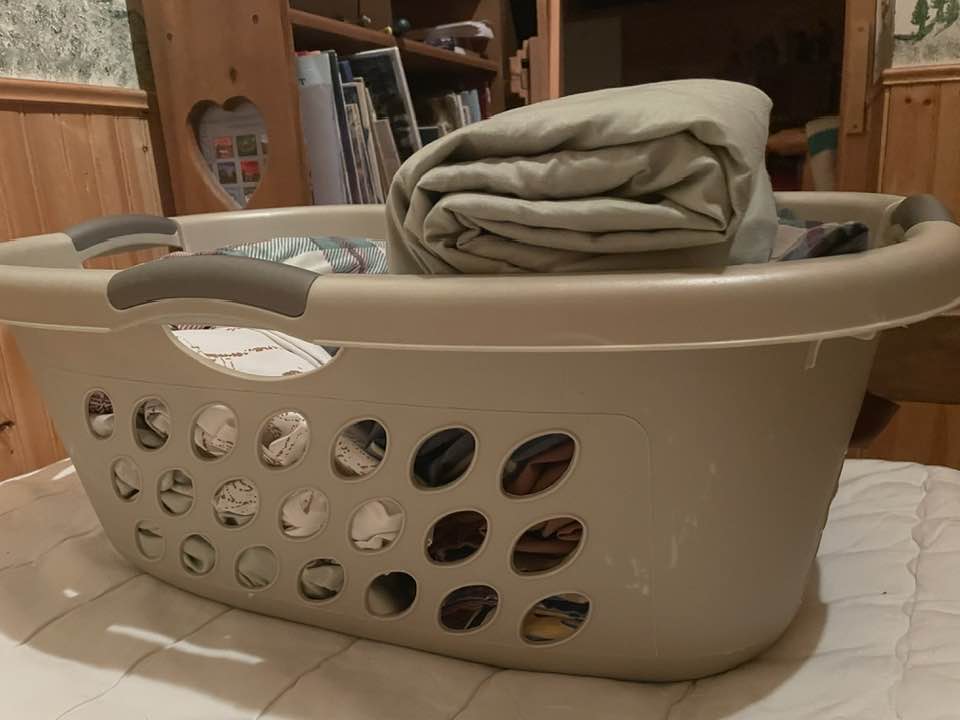
What often seemed like a harsh reality presented itself again today when I was folding laundry. After our family’s week in Red Cabin paradise last week, we’d carted home enough towels, bed sheets and pillowcases to outfit a large resort hotel. While I was upstairs nursing a cold, Beth was operating a major self-service laundry operation out of our basement. This morning when I was preparing for a return trip to the Red Cabin, I figured I’d take the umpteen baskets of clean sheets and towels. Because of the potential strain on her back, however, Beth hadn’t yet folded anything.
Having learned finally after decades of marriage that taking initiative is a desirable attribute, I decided to fold the laundry. This was not some alien process for me. I’ve folded lots of laundry in my day, though whether I’ve mastered the art of doing so is quite another question. When I pulled the first full clean crumpled sheet from the basket, however, I wasn’t concerned with mastery—if in fact there was any aspect of this chore to be mastered. I simply wanted to get the job done, and it seemed to me that with a minimum of fuss and a modicum of patience and focus, I could transmute the jumble of towels, sheets, and cases into neat piles for easy transport.
Except . . . given my comical non-expertise, in attempting to fold the first sheet I managed to match up the wrong corners of the damned thing and get it all twisted up. Just seconds out of the basket, it was a “do-over.” I was relieved that no one had observed my error. If anyone can claim “expertise” in folding bedsheets, I recognized that I certainly could not.
Soon, however, I recovered my senses and was swiftly folding sheets and towels and . . . pillowcases—my favorite, because I could fold them in my sleep. Onward and upward, as I like to say . . . until, I pulled out a fitted sheet. For years these, like plastic packaging, have been the bane of my existence. For starters, when putting a fitted sheet on a bed, on the first try there’s exactly a 50-50 chance of matching the sheet correctly with the orientation of the mattress. As long as I can remember, however, I’ve always started off slipping the wrong corner of the fitted sheet over the first corner of the mattress. And when it comes to folding a damn fitted sheet, no matter how hard I try to wind up with something that will lie flat in a linen closet, I produce what looks more like a very large, very poorly wound ball of string.
At this juncture I refused to fall into the trap of a fitted bedsheet. I did the grown-up thing. I asked for help. Not only that, I sought help from my . . . spouse.
“Okay,” I said on the approach to her book office. “Can you please give me instruction on how to fold a fitted sheet?”
“Sure,” she said with a guileless smile.
Taking the sheet, she sank her fists into the of the corners of the sheet and shook it. “First you put your hands into the corners like this . . . then cross them over like this. Then you do it again like this . . . Then you fold it up . . . the best you can.”
“Fold it up the best you can”? I was shocked. My wife doesn’t ordinarily go with “the best you can.” Nine times out of ten, “the best you can” buys you a do-over, usually with her doing the do-over. Yet here she’d said it: “Fold it up the best you can.” I noticed, however, that no resemblance existed between her (nicely) folded fitted sheet and my version of the exercise—“a very large, very poorly wound ball of string.”
After dropping the nicely folded fitted sheet into the basket, Beth returned to her office, leaving me to my lack of mastery of folding fitted bedsheets. As I struggled with the rest of the linen bound for its return to the Red Cabin, I grappled with my immutable role in life as jack of a few trades and master of none. Everyone else—my sisters, their spouses, my spouse—have achieved mastery in various arenas and are widely regarded and admired for their expertise, even though, in keeping with my friend’s adage, “none of them is an A student at everything.”
As I struggled with yet another fitted bedsheet, I tried to give myself a little encouragement. “When all is said and done,” I told myself, “you’re making way too big a deal out of mastery of folding a stupid fitted bedsheet. I mean, in the grand scheme of things, as long as you can get the finished product to fit in the linen closet at the Red Cabin, who cares if the folding job isn’t perfect? I mean at the end of the day, so to speak, what’s the sheet for?”
The question was revelatory. Or rather, the answer was: if I’ve mastered nothing else in life, it’s the proper use of “lie” and “lay.” Just as I can fold a pillowcase (if not a fitted sheet) in my sleep, so I know that when I fall asleep upon a fitted sheet, I’m lying—not laying—in bed. But I didn’t get there on my own. The reason I know how to use “lie” and “lay” is that both my parents were master grammarians.
Subscribe to this blog and receive notifications of new posts by email.
© 2025 by Eric Nilsson
