AUGUST 16, 2025 – (Cont.) The more I read about apocryphal epochs in 20th century history, such as Nazi Germany, the Soviet Union under Stalin and China under Mao, the more they seem to feature the same three aspects of the human condition. These have universal application, I think, and can be used as tools of insight into our current circumstances and prospects.
The first of these is that however refined our theories of economics and political science, the key determinant of outcomes isn’t an economic or political theory, system or structure. The principal factor is psychology—and perhaps psychiatry. If you want to understand how a Hitler, Stalin or Mao rose to power, for instance, look not to “Nazism” or “Communism” but to the inner workings of the grey matter inside the cranium of a Hitler, Stalin, Mao—and their respective enablers, apologists and active supporters. Though some “theory” is advanced as a kind of coat-hanger, as is the case with an actual coat-hanger the hanger has nothing to do with the style, size, color, fabric or purpose of the coat. Yet, advocates and detractors of the coat make much of the hanger—so much, that the masses come to see coat and hanger as inseparable.
But if you really want to understand a despot such as Hitler, Stalin or Mao, you can’t be distracted by the hanger. You must remove the garment from its hanger and examine every feature of the coat, not the coat hanger. Only then can you understand the full nature of the article and how and why it attracted and repelled the people who gave it distinction from the billions of other coats.
In this regard, I am reminded of the appeal that my Russian history professor made to his students last semester: “Read literature! To understand the human condition, you must read great literature, for the greatest psychologists are the authors of great literature.” This from an historian; a 91-year-old, life-long student of history, and with it, all the heaps of theories of economics and political science, along with their numberless interpretations and misinterpretations.
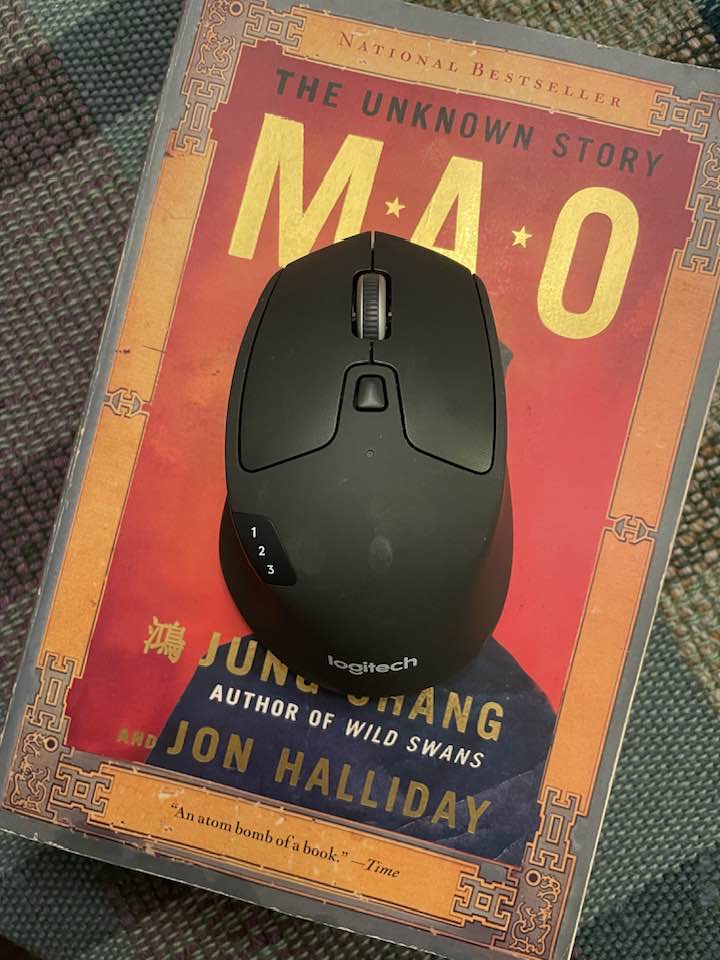
My second take-away from the study of apocryphal epochs—most recently, Mao’s China via Mao: The Unknown Story—is that however much in theory or lip service we assign to “equality,” this notion is fraught with contradiction.
In the first place, despite the genetic fact that 99.9% of the DNA of one member of homo sapiens is “equal” to the DNA of all other members of the species, by the remaining “active ingredients” within our DNA, not to mention upbringing, immutable individual disposition, aptitude and experience, we are anything but equal from one person to another.
Second, if we acknowledge our differences—our “unequalness”— some of us still adhere to the notion that we should have “equal rights” Yet, if you look around, even in a relatively egalitarian society historically speaking (putting slavery, Jim Crow and systemic racism aside), you see far more evidence of persistent inequality in a host of arenas, from the legal system to housing to education to access to affordable medical care. Few of us begin life from the same starting line, and few of us proceed through life at the same pace.
Third and most critically, however, the manner in which we react to allures, forces and influences around us is as unequal as it is unpredictable. Some of us are driven by fear; others by vengeance and retribution; others by lust and greed; some of us are, in the words of our esteemed president, “high energy,” while others are chronically “low energy.” Standards of empathy, ethics and morality likewise vary across any given society. Moreover, each of us views the world through various biases and all of us are susceptible to propaganda of one sort another.
What all this means is that when it comes to individual and collective action, we don’t all move in the same direction at the same rate for the same duration. Nowhere do the consequences of “unequal” action appear more strikingly than in the context of the few lording over the many.
This brings me to my third “take-away” from my most recent study of extreme despotism, of Mao lording over China. Even if one discounts the uncompromising condemnation of Mao leveled by Jung Chang and Jon Halliday in Mao: The Unknown Story, one must acknowledge the scale and intensity of suffering among the Chinese between July 7, 1937 (the start of a three-day battle between Imperial Japanese forces and Nationalist Chinese troops in what became known as the “Marco Polo Bridge incident” near Beijing, and in a larger context, considered to be the start of World War II) and September 9, 1976 (the day Mao died). First, the Chinese people endured the brutal invasion and occupation of Japan, then the civil war between the “Communists” ultimately led by Mao Zedong and the Nationalists, led by Chiang-Kai Chek, then 37 years of extreme privation, oppression, persecution and wholesale destruction of thousands of years of Chinese culture. The destruction wrought at the command of Mao eclipsed the horrific experience perpetrated by the Japanese. In a vain effort to turn China into a nuclear power, Mao consigned much of China to abject poverty.
Yet, within two years of Mao’s death, his successor, Deng Xiaoping, put the country on the track of recovery. Within another decade, China was experiencing meteoric economic growth, much of it manifest in a greatly improved standard of living. Today, of course, China is the second largest economy in the world. Still considered a “Communist” country, China has embraced many elements of a market economy and unlike Mao’s China, modern China is highly integrated into the global economy.
This extraordinary turnaround reveals the most crucial quality of our nature: resilience. We can crush and grind our own kind into dust; commit the most heinous crimes against ourselves; unleash unspeakable horrors on civilization; and destroy the greatest creations of which our better selves are capable. In short, we can scorch ourselves from the face of the earth, and yet, we can bounce back faster and higher than a fastball of Flubber hurled by Shohei Ohtani straight down from a second story balcony hanging over the street.
This gives me hope. Out of the ashes of our own destructive tendencies the phoenix always rises. This is the lesson we must know and remember as we are buffeted by the ill-winds of our current times.
Subscribe to this blog and receive notifications of new posts by email.
© 2025 by Eric Nilsson
