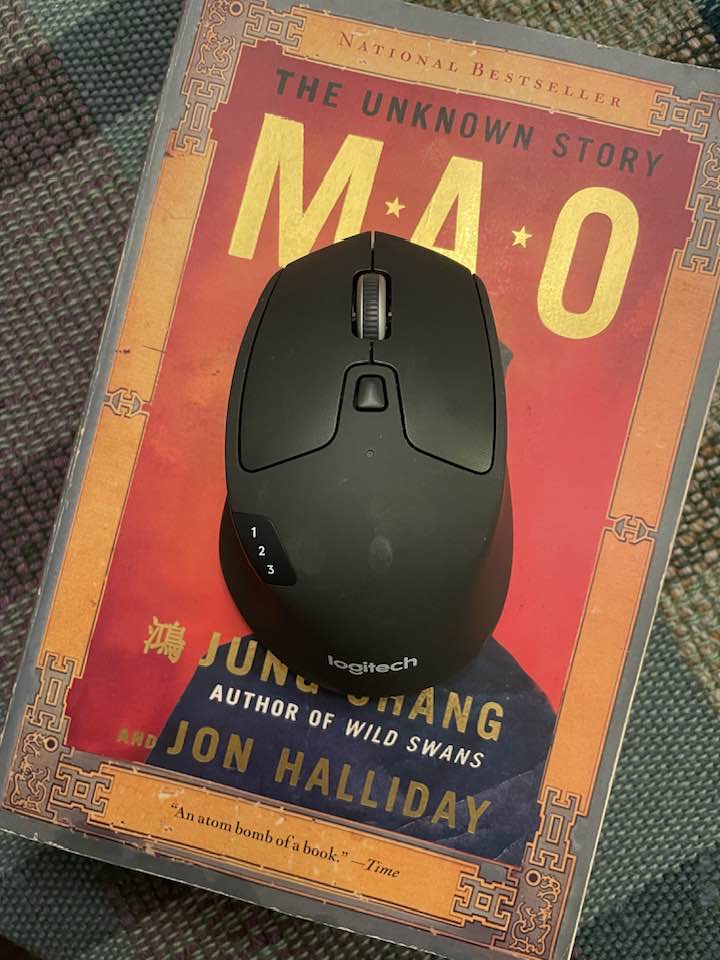
AUGUST 15, 2025 – (Cont.) The central thesis of Mao: The Unknown Story is that Mao Zedong was a monster. By comparison, Adolf Hitler was an elder statesman and Joseph Stalin, a venerable world leader. Chung and Halliday, the authors of Mao, portrayed him as the ultimate nihilist narcissist psychopath, who brought nothing but utter ruin to China and its people. If he had any redeeming quality whatsoever, it was an affinity for classical Chinese poetry, but this was hardly enough to offset the 70 million deaths—not to mention the countless millions more who suffered torture, prison, internal exile and starvation—for which Chung and Halliday hold Mao accountable.
They argue that Mao had a single objective: become the world’s most powerful person at any cost, including the wholesale destruction of his own people and country. They argue further that although Mao never achieved his objective, the price of his unceasing attempt was paid—with usurious interest—by everyone affected by his wholesale sadism.
Before reading the book I was certainly aware of the excesses of Mao’s “economic” policies, such as the Great Leap Forward (1958-62) that was in fact a giant step backward, and the violent political extremism that prevailed during the Cultural Revolution—a movement unleashed in 1966 and designed to eliminate culture. I’d been unaware, however, of the crushing sacrifices imposed on the nation’s peasants, who were forced to live on just a few hundred calories a day—before that standard was lowered further. The worst of it was that the sacrifices weren’t made for a better tomorrow but to pay for the military infrastructure that Mao demanded to fulfill his personal objective of being boss of the world.
Although the book received extraordinary popular acclaim, it was panned by many historians for biased and unreliable sources and misinterpretation of evidence. In fact, an anthology of 14 papers critical of the book was published in 2009, entitled, Was Mao Really a Monster: The Academic Response to Chang and Halliday’s “Mao: The Unknown Story”. For the amateur, the considerable controversy surrounding the book creates a dilemma: what information, exactly, is to be discounted, and what is the effect on the overall assessment of Mao?
I think one must look past certain potential minefields, such as the total number of deaths attributed to Mao—one common criticism of the book by “professional” Sinologists. If not 70 million, then how many? But more important, does it matter? If it were “just” 7 million, should Mao be deemed any less of a murderous despot?
What I found most interesting about the book, in any event, was what it had to say about Stalin and Nixon and their interactions with Mao; a lot as it turns out. Stalin and Mao well-matched when it came to cunning and conniving against each other. In the final analysis, it’s fair to say that Mao prevailed simply because he survived Stalin[1]. In the case of Nixon (and Kissinger), the only fair conclusion is that Mao played Nixon and Kissinger like proverbial fiddles. (Cont.)
Subscribe to this blog and receive notifications of new posts by email.
© 2025 by Eric Nilsson
[1] One amusing anecdote in the book concerned the reaction to Stalin’s death. To project a positive impression on the Soviet Politburo in the aftermath of Stalin’s death, Mao ordered that a gigantic portrait of the Soviet leader be displayed on Tiananmen Square, where a huge pro-Soviet, pro-Stalin demonstration was to occur. In the usual manner, instruction placards were on display, telling “demonstrators” how to behave and what to shout. One of the signs said, “Don’t Laugh.”
