AUGUST 14, 2025 – If you’re feeling glum about our nation’s prospects, I invite you to take a close look at China from 1937 to the present. Why China and why during that period? For its extreme example of our resilience as a species. Many other examples exist, but none on the scale or to the extreme of China. Sure, “Team Trump” has done unspeakable damage to America’s future, but he’s a rank amateur compared to the devil that rampaged across all quarters of China not so long ago.
For years I’d avoided a meaningful examination of China during the period in question. The country simply loomed too large in population and complexity and more important, Mainland China was too inscrutable for me to think I could do more than skate through an occasional newspaper article. I was biased, of course, by China’s long and confusing history and unfamiliar geography. With so many well established reference points, European history and affairs have always more accessible to me. I found deep plunges into one area or another of European study far easier than anything associated with Asia, especially China. By default I always gravitated toward the familiar and away from the unfamiliar.
One exception was a book I read in the 1990s, the international blockbuster (37 million copies), Wild Swans: Three Daughters of China by Jung Chang. The story was an account of the extraordinary lives of the author’s grandmother and mother and an autobiography, as she gave a riveting exposition of life in China during the Cultural Revolution and her time as a member of the Red Guards and later, a prisoner at a “re-education” labor camp. It was an intense book, superbly well written (Chang left China to pursue her PhD in linguistics from York University in England—the first person from the PRC to obtain a PhD from a British university). I could not put the book down until I’d finished it.
Now fast forward to last January. My good friend Linda Lovas Hoeschler had invited me over to pull anything I wanted from the library of her late husband and my good friend, Jack. I did so, concentrating on Russian history, but in the “Asian History” section, I happened to see a hefty biography of the Great Helmsman—Mao Zedong, or “Mao Tse-Tung,” as he was known by us who grew up in the 1960s, referred to derisively as “Mousey Tongue.”
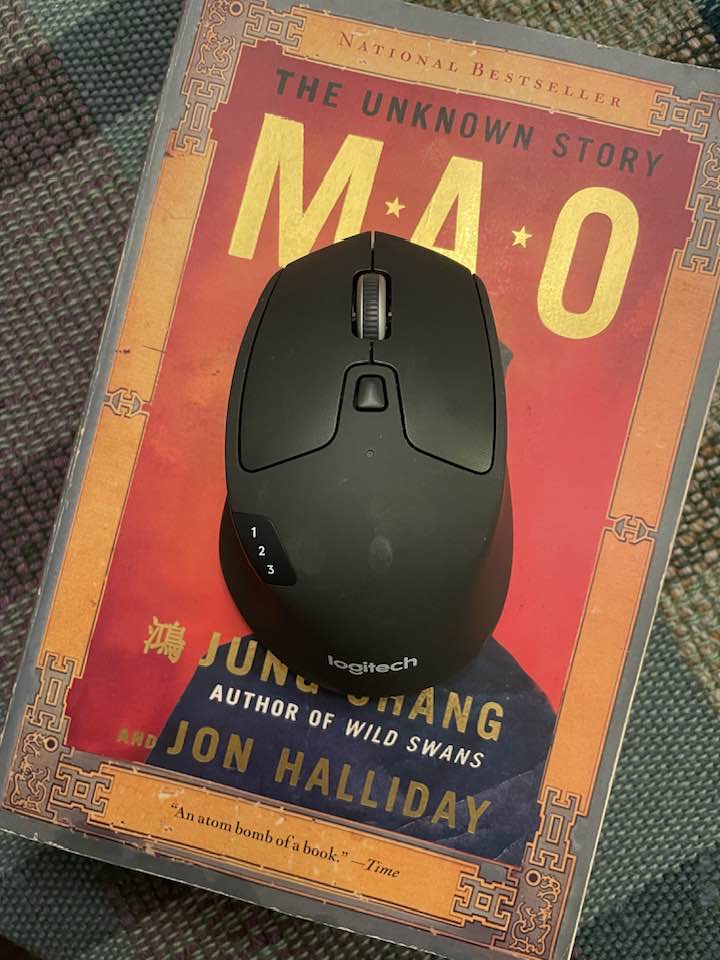
More than anything, what drew me to the tome was the name of its co-author—Jung Chang. I was in no hurry to read it, since however, since I’d just begun my course at the University of Minnesota in Russian history, which included a reading list as long as Tolstoy’s theory of history appended to War and Peace. About a month ago, however, I had an opening. From the pile of “on deck” books, I pulled Mao: The Unknown Story. At 616 pages plus notes, it’s not a work I could read in a week, but by the same token, it’s not a book I’d want to speed read. In fact, several chapters I re-read to ensure that I’d retain the gob-smacking analysis laid out by Chang and her collaborator, Jon Halliday, a distinguished Irish scholar who specializes in modern Asia history.
Except to polish off a book club book—Cuba: An American History by Ada Ferrer—which at 470 pages, each packed with in-depth examination and analysis, was itself a fascinating read, I was unable to put Mao down until I’d read to the very last word. (Cont.)
Subscribe to this blog and receive notifications of new posts by email.
© 2025 by Eric Nilsson
