MARCH 4, 2026 – Yesterday in a regular chat with a close college friend, we talked politics—as usual. After venting our spleens over the latest outrage—war against Iran—my good friend asked me, “Where do you think America will be a year from now? What’s your prediction?” After answering his question, I asked him, in turn, “What’s your prediction?”
His answer: a year from now we’ll be immersed in impeachment proceedings against Trump.
Of course, that forecast carried an implicit perquisite prediction: that the Democrats would seize control of the House and at least a two-thirds-majority in the Senate. But that, in turn, assumes clear- or at least definitively accepted election results in November, and no derailment by hooligans emulating the January 6 (2021) crowd, robustly supported by the Charlatan-in-Chief.
Democrat control of the House? I’d call it probable, and therefore, impeachment equally probable. But a two-thirds majority in the Senate necessary for conviction? Highly doubtful. A veto-proof Democratic majority in both House and Senate? More doubtful still. The net result: lots of Democratic-led investigations in the House, but with limited effect apart from enough revelations to light up your newsfeed end-to-end—depending on the algorithms tailored to your politics.
Meanwhile, the steady gush of grift, corruption, hubris, arrogance, contemptuous tear-down of governmental institutions, and foreign adventurism (Cuba? Canada?) will continue unabated.
The body politic will remain entrapped in the framework of its structural flaws.
The real question is how the rest of our country will do—the economy, advancement of technology (for better and worse), the condition of our multi-faceted infrastructure, and perhaps most important, people’s moods and confidence—weighted demographically, and therefore economically and politically. And how the inevitable “wild cards” will affect each of these arenas of consideration.
I can’t hazard a very well-informed guess, except from a perspective so attenuated from actual data, it has little more significance than writing “INFORMATION” on a card and treating the word as a terabyte of data and analyses. That perspective is simply,
Some 340 million people will still inhabit what to date has been called the United States. Some will continue to live in the lap of luxury times 12, while far more at the other end of the spectrum will struggle to keep their nostrils above the waterline. Most folks in the vast middle ground will hold their own but with mounting burdens and baggage, from affordable healthcare to affordable education and just plain affordable. Some people will notice that incrementally, the country will be deeper into the post-democracy phase of the country’s history. For others, the reality will appear as a single-blast revelation. In any case, though the usurpation of our foundational principles might be complete by March 4, 2027, plenty of familiar flags, red, white and blue, will still flap in the wind.
If I can’t divine the future any more clearly than the next person, how might I navigate into the fog? What advice might I give people junior to me or in some way dependent on my actions? Or perhaps more important, what counsel should I seek and accept from them? Where should I store our household’s acorns—and should I trade some or all for hazelnuts or winterberries? Should I march in protest or hide in obscurity? Should I continue not to leave our house without my passport—or will a photo of it in the cloud suffice?
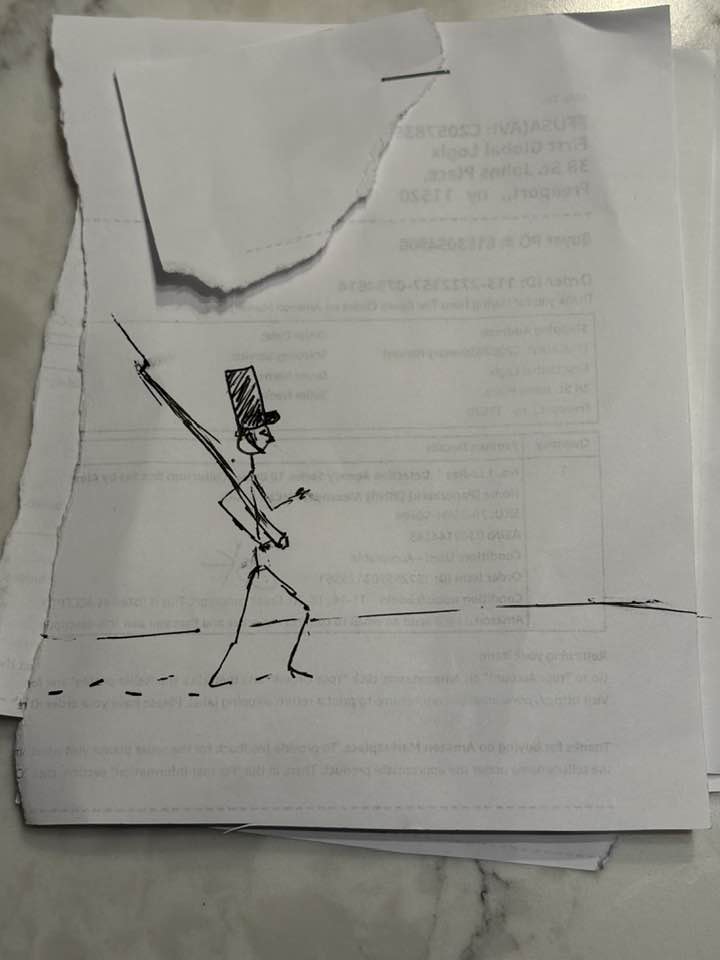
In any case, America’s ultimate outcome has a long way to go along a rocky, winding course. The best that any of us can do along the way—as our granddaughter well knows—is: 1. Smile, 2. Be kind, 3. Pay attention, and 4. Know where you’re going. In that spirit, I’m ready to . . . March fo(u)rth.
Subscribe to this blog and receive notifications of new posts by email.
© 2026 by Eric Nilsson
