JULY 4, 2025 – (Cont.) On Sunday, our last full day in Connecticut for this third annual June sojourn, we awoke to a short downpour. In the aftermath, the lingering mist over the cove teased our imaginations and distracted us quite effectively from the artificiality of the “real world” that dominates the news. Once we’d organized ourselves, we joined Byron’s family at the ever-popular Hangry Goose on the eastern shore of the Lieutenant River, part of the Connecticut River estuary, in Old Lyme.
“Old Lyme,” by the way, was established in 1855 when it separated from larger “Lyme,” which was founded in 1667, creating the anomalous and confusing circumstance in which the “Old” was almost two centuries “newer” than the original. Since our family’s place is in just plain “Lyme,” I like to think of our neck of the woods as the “real” Lyme—acknowledging, of course, that if descendants of the indigenous people who occupied these lands long before the Dutch and British would take issue with white references to “old,” “Old,” and “original.”
When I was a kid I was further confused by my Grandfather’s seemingly arbitrary interchangeable reference to Lyme and “Hamburg,” which with his New Jersey accent, he’d pronounce, “HAM-boig.” Only recently did I learn that “Lyme” is the larger township in which the tiny hamlet of Hamburg resides. The latter is the collection of a few familiar landmarks: the Congregational church (and behind it, an ancient cemetery with gravestones leaning at random angles) perched at the top of a long gentle slope; by the roadside, Reynolds General Store (now defunct but still standing); Reynolds Boats, Reynolds Subaru dealership, the Cove Landing Marine, the little Hamburg Yacht Club; and a handful of residences right on the water’s edge sandwiched between the Yacht Club building and Cove Landing Marine. Hamburg is also home to a few ancient houses and their now aging occupants; the “fairgrounds” the size of a large doormat; and the old town hall, festooned with bunting and Yankee spirit on the Fourth of July. And I nearly forgot: there’s the row of seven or eight places, including Lyme Light, that overlook the cove and all that I’ve described of the rest of “Hamboig.”
In any event, the menu and frenetic but cheerful service at Hangry Goose soon obscured my unspoken ponderings about the slicing and dicing of Lyme and amusement I now enjoy recalling my long-standing confusion over Grandpa Holman’s references to Lyme and “Hamboig.” And of course, the past was further overwhelmed by the present—dominated by the very youngest members of the family. What could monopolize a grown-up’s attention more easily than a happy almost-two-year-old responding to mild reprimands in both French and English with equal understanding—and disregard? Furthermore, when the family’s resident nine-year-old artist turns out an amazing array of illustrations on the pages of her sketchbook—all between the time she orders her pancakes and when soon thereafter they’re placed in front of her—the grown-ups look with awe and forget altogether what it was they were talking about and thought was so important.
Eventually, this enjoyable experience concluded, and we made our way to the Flo Gris Museum upstream from the Hangry Goose by not more than a few hundred meters. Several years had passed since we’d visited this gem which is located in such a picturesque setting, 125 years ago it spawned the formation of the Lyme Art Colony. It was the joint project initiated by one Florence Griswold, who to make ends meet, had turned her late sea captain’s Greek Rival house in Old Lyme into a boarding house; Henry Ward Ranger, an artist from the City who stayed at the Griswold house while on vacation and pronounced the surrounding landscapes “just waiting to be painted”; and Childe Hassam, another painter from New York. Word soon got out that Lyme and its surroundings were a painter’s paradise, and soon notable American artists joined the summer “colony.” None of this should surprise anyone who’s visited Lyme, since its magical landscapes truly are “just waiting to be painted,” or in the case of non-artists who are just as smitten by the scenery, “just waiting to be photographed.”
But Flo Gris features more than golden oldies. Exhibits of high quality contemporary works are always a joy to experience there. On this occasion we were treated to the works of landscape artist Nancy Friese (from North Dakota, of all places) and a collection of amusing paintings, photos and sculptures revolving around “cow talk.”
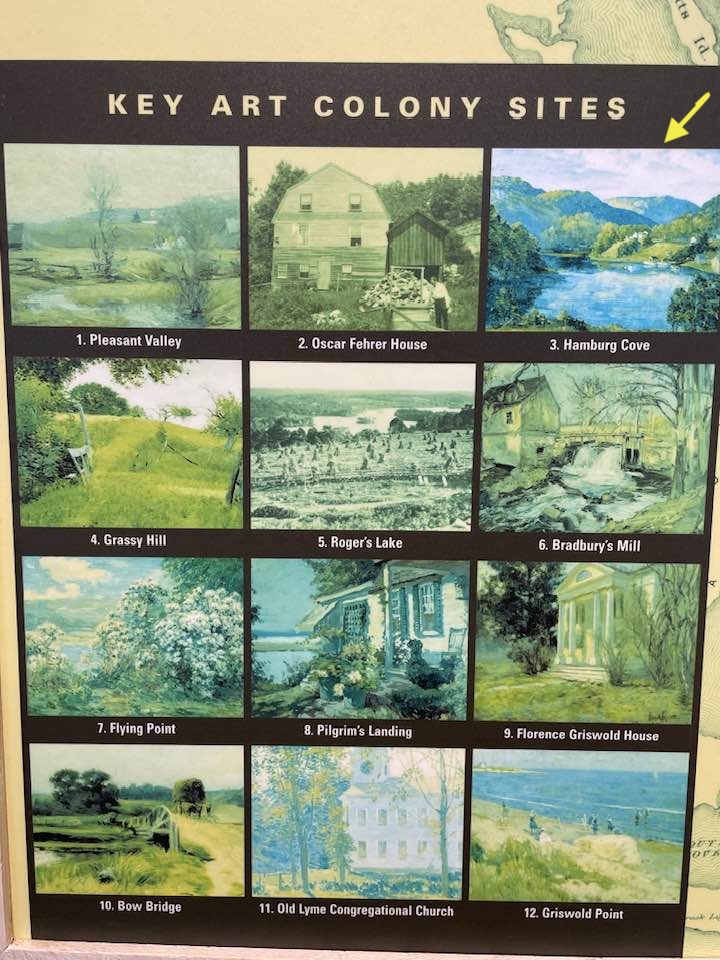
In the commodious rooming house itself, we enjoyed the works of the artists from the era of the Colony. They are exquisite depictions of numerous bucolic settings around Lyme. I remembered from our previous visit, the display featuring a map with the dozen or so locations that were the favorites of the artists. One of the spots was the front yard of Lyme Light! I’ve always been transfixed by the view of the cove from that vantage point. From one day to the next—in fact, often from one hour to the next—the scene changes based on atmospheric conditions, time of day, time of year. It is in a perpetual state of dynamic beauty, and I can easily appreciate why artists were drawn to the place.
We spent a long time at the museum and strolling around the grounds, just as we did on our previous visit, but no amount of time is enough at such a wondrous place in such a wondrous world. (Cont.)
Subscribe to this blog and receive notifications of new posts by email.
© 2025 by Eric Nilsson
