FEBRUARY 8, 2026 – Whenever I pick up Illiana from school on a sunny day, to get the conversation rolling, I remind her that “As I’ve mentioned before . . . between the winter solstice back in December and the summer solstice in June, the north end of the earth’s axis is leaning more and more toward the sun, giving us a few minutes more daylight every day.” By mere repetition, she is now well attuned to “Grandpa science.”
Though on the whole a correlation exists, of course, between an increase in daylight (and more direct sun rays), on the one hand, and warmer temperatures, on the other, the two trajectories aren’t parallel. A while ago, after an early January thaw, the reported low up at Grindstone Lake was MINUS 39F despite the increase in daylight.
Our online app for checking the interior temp at the cabin quit reporting on January 16, about the time of the mercury’s big plunge. I concluded that the interruption was caused by a power outage, a malfunction of our server or, most likely, our rooftop satellite dish having been buried in snow, blocking our wifi signal. As a presumably responsible adult, I can’t explain why I hadn’t called our neighbor, John, to check on our place to ensure that the furnace was still functioning—or why before today (except that it was so blasted cold) I hadn’t pulled my act together and found my way up to the Red Cabin to check on things.
Anyway, at 10:15 this morning, I decided to take appropriate action. After loading up my ski gear, I headed for the frozen lake. After a half hour on the road, I phoned our older son Cory for our daily chat about local ICE operations and the latest political news. We talked for close to an hour. Because he’s so well informed and follows a variety of influencers on both ends of the political spectrum and since he is such a lucid, original and analytical thinker, Cory has become my favorite political commentator. Besides, he’s exceptionally clear and articulate. It’s not difficult to understand where his inimitable daughter gets her vocabulary and command of the spoken word—and her ability to read people.
When his “to do” list for the day required us to sign off from the conversation, I continued the drive in silence—no phone, no music, no radio; just “quiet time” to accommodate . . . well, thinking about the state of the world, the world of our state and what the next few months will bring to Minnesota and to the nation at large. Upon turning onto State Highway 70 toward Stone Lake, Wisconsin, I transitioned thoughts to my dual objectives ahead: 1. Checking on the Red Cabin; and 2. Skiing on the Birkebeiner Trail.
Fortunately, our plow guy had earned his fees, though he hadn’t bothered—nor would we have expected him to—set his blade to the recent snowfall of an inch or so. As if driving a runabout across smooth waters, I piloted the car without trouble down our drive to the back of the Red Cabin. “It’s still standing,” I always say to myself upon catching sight of the place we built 31 years ago.
The next thing I always look for in winter is exhaust rising out of the furnace vent pipe coming out of the back lower roof. If I see the white exhaust, I know “we’re in business” and sigh with relief. The absence of a “smoke signal,” though, doesn’t necessarily mean trouble. After all, the furnace isn’t operating continuously, except when the mercury is in sub-zero (F) territory. But in the absence of wifi connectivity for checking the interior temp remotely, until I’d let myself in through the back doorway, I wouldn’t know if the furnace had been operating as it should. When I stepped into the cabin proper and felt warmth, I said, “Yes!” out loud, whereupon pent-up anxiety instantly vanished.
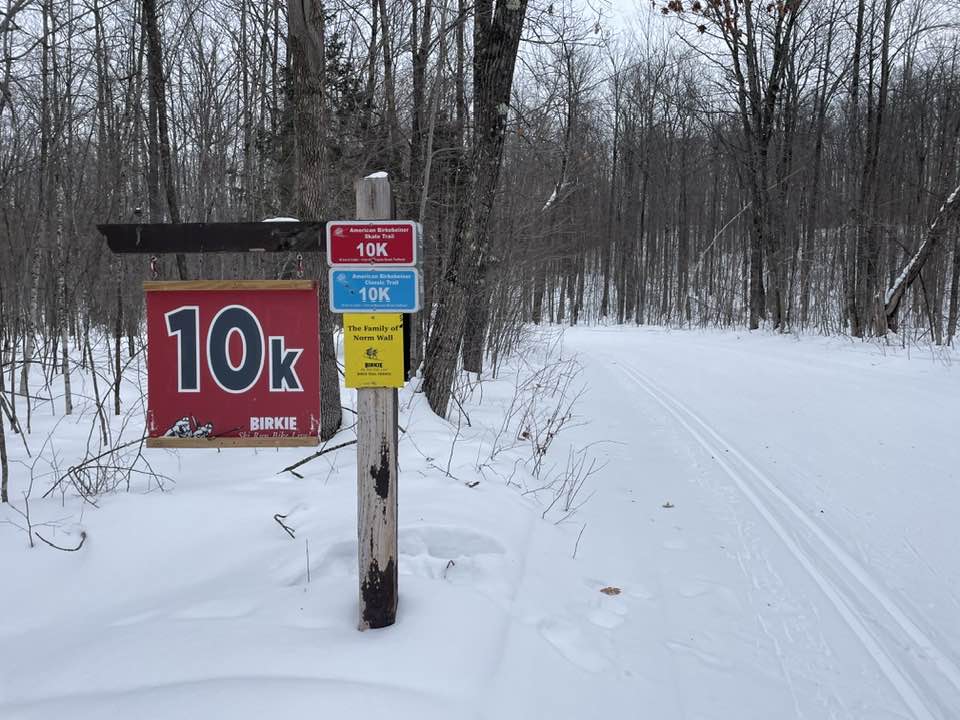
Less than a half hour later, I was in my ski clothes and driving out again, headed for the Birkie Trail. Though it was my 56th consecutive day of skiing this season, it was only my first outing this year on the famous 54-kilometer x-c ski trail (skate and classic) running from Hayward to Telemark outside Cable, Wisconsin.
For us x-c skiers, there is nothing else quite like this extraordinary ski course—not in this region, anyway. Having x-c skied in other parts of the country, I maintain that nowhere else in North America can one find a point-to-point ski trail as long and splendid as the American Birkebeiner Trail. For my hour-long outing, I saw no signs of civilization other than the well-groomed trail itself and the kilometer posts. Now and again I encountered other skiers—definitely a sign of civilization, especially when they responded to my greetings. A few were “gunners,” in high training, surely, for the big Birkie Ski Marathon race two weeks from yesterday. The rest were out for an enjoyable Sunday outing, as was I.
At exactly 71 ½ I’m a far cry from the Olympian I used to pretend I might one day be. My strength and endurance aren’t sufficient to allow me to “go for broke,” an hour out and an hour back, as was common back in my halcyon days of fitness. As Illiana so wisely advised the other day (in response to mention of the number of ski days I’d tallied thus far this season), “You don’t want to over-do it.” Her sensibility reminded me today of the paradoxical witticism attributed to Oscar Wilde, to-wit: “Everything in moderation, including moderation.”
Thus, I broke a sweat but no speed, distance or duration records. My exertion was just enough for a gratifying release of endorphins, the salient benefit of which is to distract the mind from its burdens. This goal was happily achieved. The first half, which saw me to the top of “Bitch Hill,” was mostly upgrade, which meant that the return was largely downgrade. The trail and snow conditions were ideal, and instead of assuming a tuck on the steeper downhill sections, I simply stood up, my skis gliding smoothing at the steady command of gentle gravity.
I felt as if I were standing on some kind of conveyance—a train carriage, perhaps, or a troika. Turning my head to the side, I watched the woods rush by. The trees right along the trail were in a full-tilt sprint. Their neighbors behind, moved too, but not as fast. The trees way, way back, up and down the undulating terrain, seemed nearly stationary. Where the pitch of the run moderated, so did the movement of the woods—or rather, of my train, my troika . . . my skis. At one point, I stopped altogether to admire a glorious oak, so straight and tall, its girth the measure of its ancient age. In a section of woods around the next bend, a large grove of old growth, wild and asymmetrical white pine stood crowded together like a gathering of Germanic chieftains clad in thick, uneven skins and furs dusted with snow, their long unruly locks and beards braided and tied. Another few hundred meters beyond the chieftains, I entered the zone I call the “Spires,” a place where conical spruce of various heights stand like a congregation of cathedrals.
After skiing through this paradise, I felt refreshed, recharged, rejuvenated, in heart, mind and soul.
An hour later, I was driving across the frozen farmscape south of Spooner. After the daylong overcast and its absence of color, I caught a glimpse of the bright orange sunset through a narrow opening in the sky above the southwest horizon. The time was nearly 5:20, which, as advertised, was when the sun was scheduled to slip below the horizon . . . or rather, when because of the earth’s rotation, the sun would appear to slip below the horizon.
The sunset reminded me what I’d mentioned to Illiana just the other day when I was backing the car out of our driveway to take her home. As I turned my head to the side, for an instant my eyes caught a glimpse of our yard and the next two backyards.
“Illiana, what I find interesting is that we all know the earth is round, a sphere, a globe, right?”
“Yeah.”
At that moment, I stopped the car. “But look across our yard and the next two yards . . .”
“Ye . . . ah.”
“They’re as flat as a pancake. I mean, judging by what we see right here with our own eyes, the earth is flat! And you know what?”
“What?”
“Way back in time, people thought the earth was flat, and the thing of it is, when you look around, you could swear the world is flat! But of course, back then they were way off base, way wrong. Which just goes to show, some things—some really big things—simply aren’t what they seem to be.
“Yet, at the same time, isn’t it just a little ironic that we think it’s funny how people used to think the earth was flat?”
Illiana was quiet, but in her silence, I could nearly hear the wheels turning inside her head.
By the time I’d reached the end of my recollection, the earth had turned enough to hide the sun from view. Another day down, one might say, but it feels better to think of it as just another spin of the globe with many more billions to go.
Subscribe to this blog and receive notifications of new posts by email.
© 2026 by Eric Nilsson
