JANUARY 11, 2026 –
Thursday evening I hosted a rump session of my book club. (Two of our five members were MIA, which might have been a referendum on the host’s book selection, The Man Who Loved China, by Simon Winchester (See my 8/20/25 post – https://writemakesmight.net/ub-and-the-man-who-loved-china/ ). As is so often the case with our group—rump or full—we talked politics, and on this latest occasion, the ICE killing, so fresh on our minds, dominated our discussion.
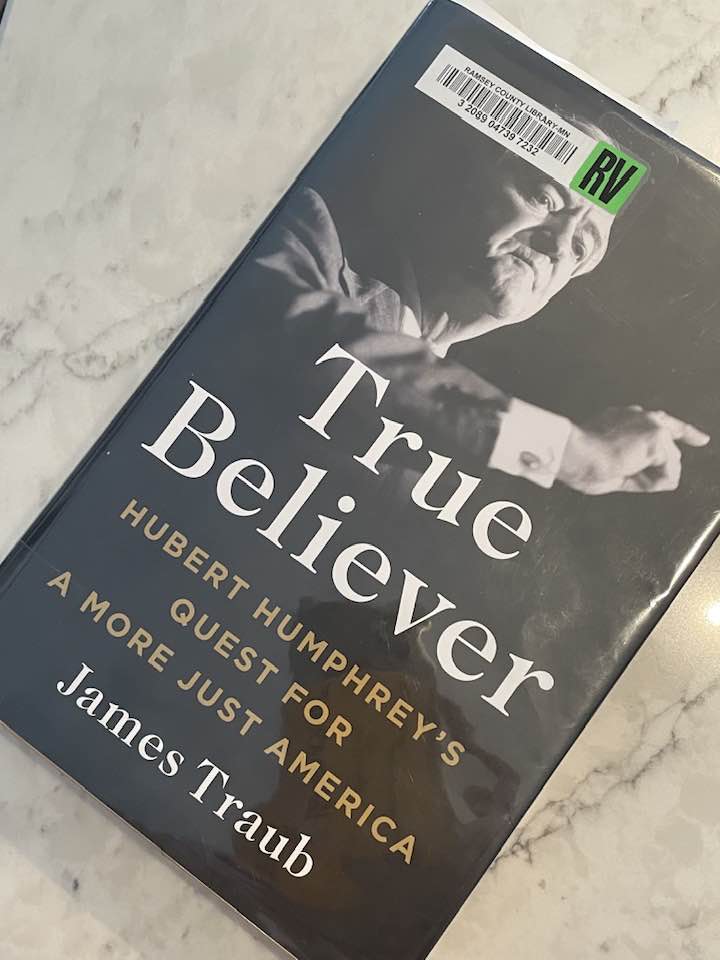
When it came to next month’s book choice, the next man up, Brian, a software engineer by vocation, but a man of many avocational interests, presented two possibilities: 1. The Little Bach Book: An Eclectic Omnibus of Notable Details about the Life and Times of the Esteemed and Highly Respected Johann Sebastian Bach by David Gordon (2017), and 2. True Believer / Hubert Humphrey’s Quest for a More Just America by James Traub (2024).
Given that I’m currently experiencing a mini-revival of a personal interest in the music of Bach (the Father—the Son and the Wholly Spirit—of Western Classical (as well as other genres of music—see (or rather, “hear”) Ray Manzarek, particularly his organ intro to The Doors’ hit, “Light My Fire,” inspired by Bach’s Two-Part Inventions), I was ready to endorse Book Choice No. 1. My endorsement nearly transitioned to a motion to approve when Brian informed us that the “little book with the long title” was under 200 pages long. Great, I thought: I’ll have plenty of time to catch up on my stack of books on the Korean War. Upon hearing Brian’s background on Book No. 2, however, I had to squelch my initial enthusiasm for Book No. 1.
I’m now fully engrossed in the biography of Hubert Humphrey, Minnesota’s “Happy Warrior,” whose imprint on our state’s—and country’s—political history is as profound as any of the many memorable characters who’ve crossed those stages.
Throughout the three decades that I worked in downtown Minneapolis, I’d often walk through the lower level of City Hall and through the underground walkway to the Hennepin County Government Center that occupies the two adjoining blocks. Where the walkway passes under the above-ground entrance to City Hall, a large window affords a view of a life-size statue of Humphrey, facing the street above with his arms of bronze spread in an open and welcoming gesture.
I remember an occasion several years ago around lunchtime one day when I encountered two young Somali women standing just below the window and peering up at the statue; one of the women pointing at it. I stopped, and though I assumed they’d never heard of “Hubert H. Humphrey,” I asked them anyway. They smiled and said yes, his name was unfamiliar to them, but they were curious, so I gave them an ever so brief biographical sketch of the man. They listened attentively and thanked me for having introduced them to the “boy wonder” Mayor of Minneapolis in the 1940s before he “graduated” to the U.S. Senate and later, Number One Observatory Circle (the Vice President’s official residence), before an unsuccessful runs for the White House in 1968 and again in 1972 but returning to the Senate until his death at the relatively young age of 66 in 1978.
I’m now 123 pages into the 460-page (plus notes) fascinating book. As with every good biography, Taub’s book delves into the times and influences, as well as the life, of the subject character. In the case of Humphrey’s biography, this means learning about small-town life on the prairie (eastern South Dakota) in the first quarter of the 20th century—from feast to famine—and the turbulent way left-of-center politics of Minnesota (e.g. Stalinists vs. Trotskyites (!)) and polarization between Republicans and Democrats nationally during the Great Depression. For additional entertainment, one learns of the grip of unshakable graft and corruption inside the Minneapolis City Hall before Humphrey’s time—and how he dealt with it effectively without succumbing to it or getting himself killed.
As to the life of Humphrey, the book devotes considerable attention to his remarkably good and gifted father and to Hubert Jr.’s own impressive intellectual talent and capacity, as well as to his extraordinary skill in connecting with people from all quarters of society. At the same time he was a bona fide scholar and intellectual with deep connections to academia, he was from the earliest age, an inexhaustibly hard worker, who by personality and necessity knew what it meant to scrape and scratch out a living. He never strayed from his roots, from the admirable values instilled by his father, especially, and he cultivated an insatiable curiosity about the theoretical underpinnings of his policy positions.
What stands out most prominently about Humphrey, especially in contrast to our own times, is the hopefulness and consensus-building mentality that he brought to politics, along with intellectual integrity. In the introduction, however, Taub introduces the political betrayal of Humphrey by his former mentor in the Senate, the inimitable LBJ, the ultimate flawed tragic Shakespearean figure of American political history.
Minnesota has had many Wunderkinder (and Wundermännen) in its political past (e.g. Harold Stassen, Luther Youngdahl, Floyd B. Olson, Orville Freeman, Walter F. Mondale), but none was the equal of Hubert H. Humphrey, Jr. “HHH,” as he was identified in newspaper headlines, was known to be an endless “talker,” but having grown up in a Republican household, what I hadn’t appreciated was Humphrey’s adherence to principle, his unwavering positive character traits, his political courage, his extraordinary political skills in outmaneuvering the Communists—yes true and tried card-carrying Communists and other extremists—inside the DFL (Minnesota’s version of the Democratic Party), his “middle of the road” pragmatism in addressing real problems, his full-on assault against anti-Semitism in Minneapolis (known as the capital of American anti-Semitism in the 1940s), and his early championship of civil rights—an impatient advocacy that he took to the Democratic National Convention in Philadelphia in 1948 and against all odds, overwhelmed his opponents.[1]
Taub’s biography of Minnesota’s most famous public servant is a study in the power of hope and the importance of character. In an era when cynicism about politics and politicians reigns supreme, reading True Believer and reflecting on the life and work of the “Happy Warrior” provides encouragement and inspiration.
Now to cut away for my daily dose of music by . . . the genius of Eisenach, later of Leipzig, “Papa” Johann Sebastian Bach.
Subscribe to this blog and receive notifications of new posts by email.
© 2026 by Eric Nilsson
[1] One of his most memorable lines in his 10-minute speech at the convention: “My friends, to those who say that we are rushing this issue of civil rights, I say that we are 172 years late!” Another: “To those who say that this civil rights program is an infringement of states’ rights, I say this . . . that the time has arrived in America for the Democratic Party to get out of the shadow of states’ rights and walk forthrightly into the bright sunshine of human rights. People—people—human beings, this is the issue of the twentieth century, people of all kinds, and these people are looking to America for leadership and they are looking to America for precepts and example.”
